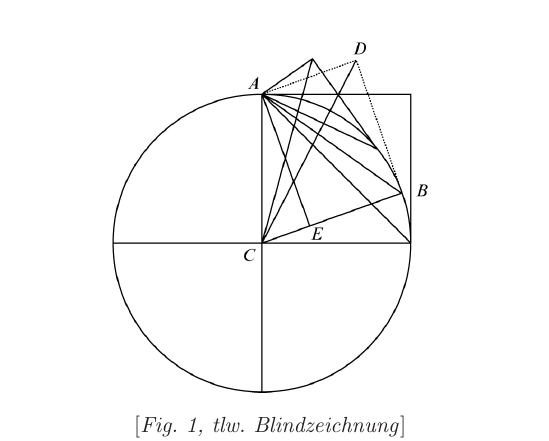
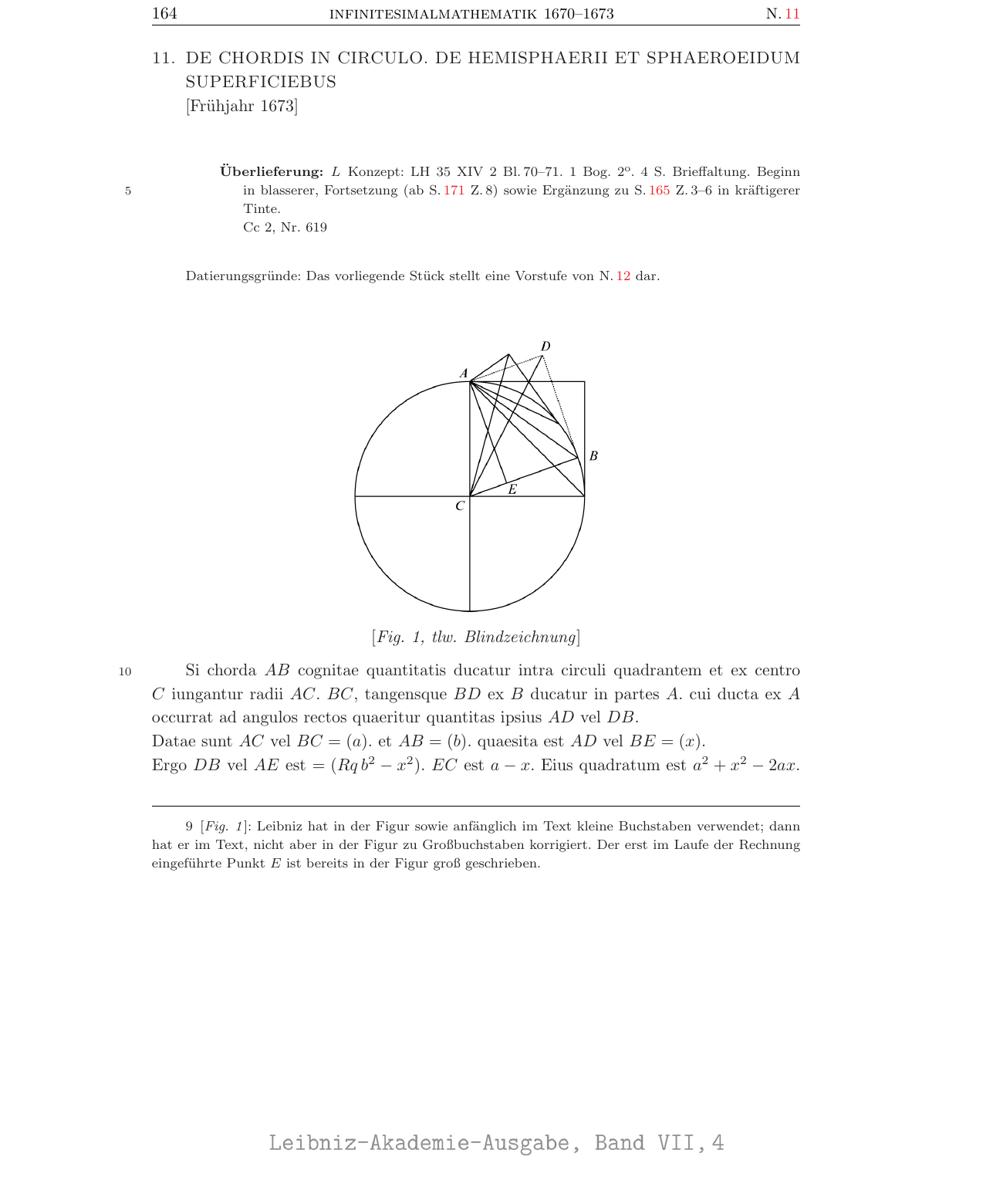
3addatur quadrato AE = b² − x². fiet a² + b² − 2ax = □ de AC seu a². Ergo b² − 2ax = 0. Ergo b² = 2ax. Ergo b²/(2a) = x.
Add this to the square on AE, which is b² − x². The result is a² + b² − 2ax, equal to the square on AC, or a². Thus b² − 2ax = 0, so b² = 2ax and x = b²/(2a).
4Componantur chordis in semicirculo ductis quadrata chordae cuiusque ad angulos rectos, fiet figura solida ungulae cuiusdam specie, quam appellare possis ungulam chordarum aequalis quartae parti cylindri cuius rectangulum generans est quadratum diametri.
On the chords drawn in a semicircle set up the square of each chord at right angles to it. A solid somewhat like a hoof will result. One might call it the hoof of chords. It is equal to a quarter of the cylinder whose generating rectangle is the square on the diameter.
5Quaestio circa transmutationes figurarum, ponantur omnes chordae concurrentes in uno puncto A. ita inflecti ut fiant parallelae, quaeritur an altitudo figurae productae futura sit eadem cum arcu semicirculi, seu an is transiturus sit in rectam. Ita vicissim si arcus semicirculi ABC in rectam deflectatur et chordae intelligantur fixae in arcu, mobiles ab altero latere, quaestio an reventurae sint parallelae.
A question about transforming figures. Suppose all the chords meeting at a single point A are turned until they become parallel. Will the resulting figure have a height equal to the semicircular arc? In other words, will the arc turn into a straight line? Conversely, straighten the arc of the semicircle ABC and imagine that the chords are fixed to the arc but free at their other ends. Will they come to be parallel?
6Problema Hugenii Horol. oscill. part. 3 prop. 9.: Sphaeroeidis oblongi superficiei curvae circulum aequalem invenire.
Huygens’s problem, Oscillating Clock, part III, proposition 9. To find a circle equal in area to the curved surface of a prolate spheroid.
7Ergo ad arcum semicirculi in rectam extensum applicentur omnia quadrata b². seu chordarum, et earum loco, cum duo quaelibet quadrata chordarum quadrato diametri aequentur, eorum inquam loco, quadrata diametri applicentur dimidio arcui, seu arcui quadrantis, vel arcui semicirculi applicetur rectangulum cuius unum latus est diameter, alterum semidiameter. Solidum inde productum dividatur per diametrum, relinquetur rectangulum sub semidiametro et arcu semicirculi, quod si dimidietur, quia triangula dimensi sumus: habebitur rectangulum sub radio et arcu quadrantis circuli aequale semicirculo, quod convenit demonstrationi Archimedeae, certum nota veritatis.
[Addition to lines 3–6.] Lay all the squares b², the squares on the chords, along the arc of the semicircle stretched into a straight line. Since the squares of any two chords taken together equal the square on the diameter, put squares on the diameter in their place along half the arc, that is, along the quadrant. Or lay along the semicircular arc a rectangle with the diameter for one side and the radius for the other. Divide the resulting solid by the diameter. The rectangle contained by the radius and the semicircular arc remains. Halve it, since what we measured were triangles, and we obtain a rectangle contained by the radius and the quadrant arc equal to the semicircle. This agrees with Archimedes’ demonstration, a sure mark of truth.
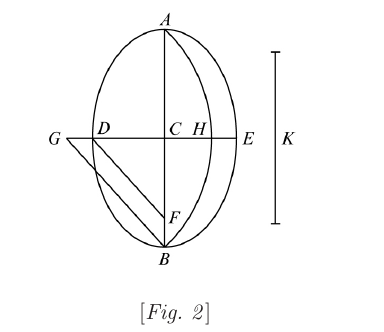
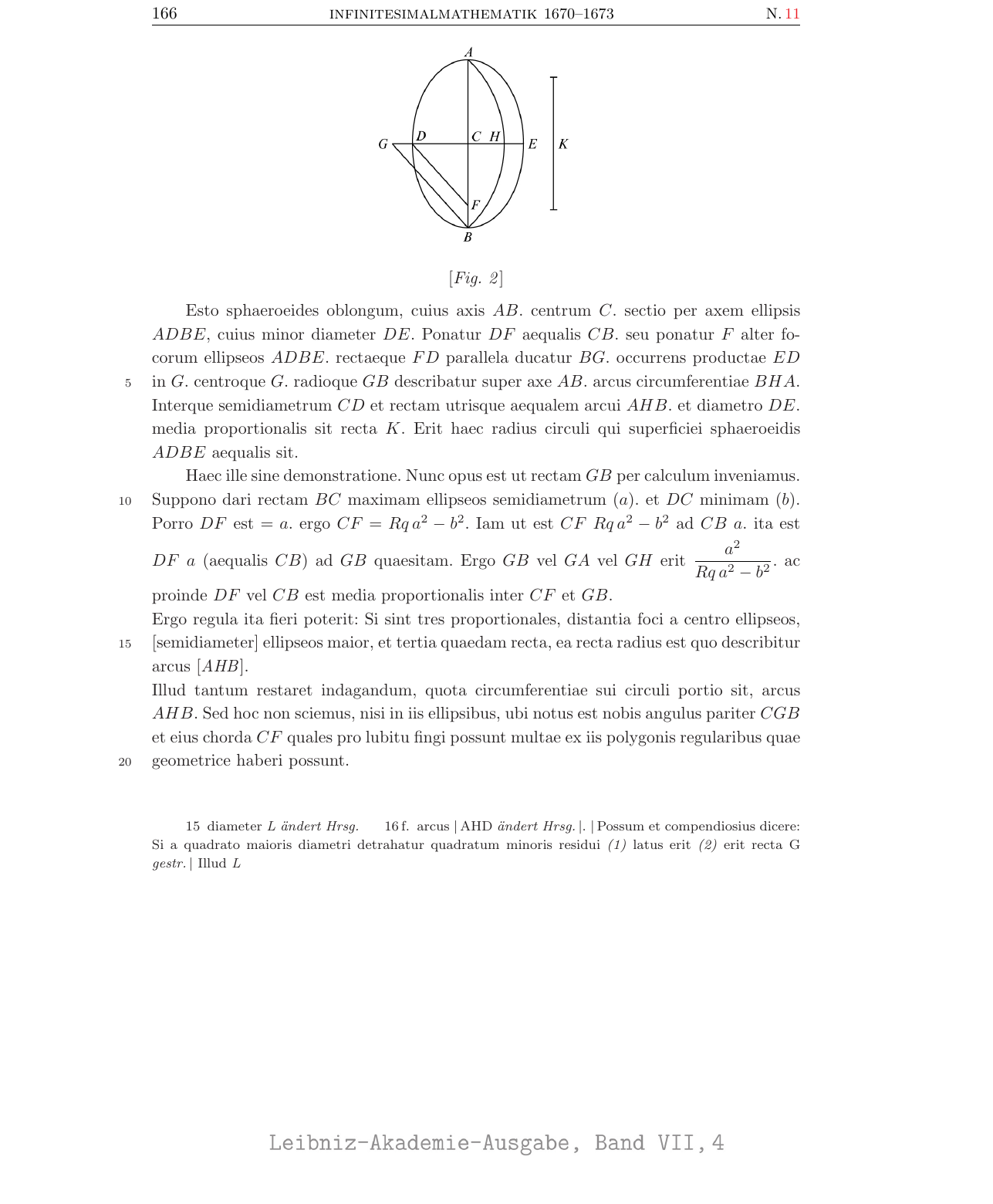
8Esto sphaeroeides oblongum, cuius axis AB. centrum C. sectio per axem ellipsis ADBE, cuius minor diameter DE. Ponatur DF aequalis CB. seu ponatur F alter focorum ellipseos ADBE. rectaeque FD parallela ducatur BG. occurrens productae ED in G. centroque G. radioque GB describatur super axe AB. arcus circumferentiae BHA. Interque semidiametrum CD et rectam utrisque aequalem arcui AHB. et diametro DE. media proportionalis sit recta K. Erit haec radius circuli qui superficiei sphaeroeidis ADBE aequalis sit.
Let there be a prolate spheroid with axis AB and centre C. The section through the axis is an ellipse ADBE with minor diameter DE. Take DF equal to CB, or, what comes to the same thing, take F to be one of the foci of the ellipse ADBE. Draw BG parallel to FD to meet ED produced at G. With centre G and radius GB describe over the axis AB the circular arc BHA. Take the line K as the mean proportional between the radius CD and a straight line equal to the arc AHB and the diameter DE together. K will be the radius of a circle equal in area to the surface of the spheroid ADBE.
9Haec ille sine demonstratione. Nunc opus est ut rectam GB per calculum inveniamus. Suppono dari rectam BC maximam ellipseos semidiametrum (a). et DC minimam (b). Porro DF est = a. ergo CF = Rq a² − b². Iam ut est CF Rq a² − b² ad CB a. ita est DF a (aequalis CB) ad GB quaesitam. Ergo GB vel GA vel GH erit a²/(Rq a² − b²). ac proinde DF vel CB est media proportionalis inter CF et GB.
So far Huygens, without a proof. Now we must find GB by calculation. I suppose we are given BC, the major semiaxis of the ellipse, a, and DC, the minor, b. Now DF = a, so CF = √(a² − b²). As CF, or √(a² − b²), is to CB, or a, so DF, or a (equal to CB), is to the required GB. Thus GB, GA and GH each equal a²/√(a² − b²). DF, or CB, is therefore the mean proportional between CF and GB.
10Ergo regula ita fieri poterit: Si sint tres proportionales, distantia foci a centro ellipseos, [semidiameter] ellipseos maior, et tertia quaedam recta, ea recta radius est quo describitur arcus [AHB]. Illud tantum restaret indagandum, quota circumferentiae sui circuli portio sit, arcus AHB. Sed hoc non sciemus, nisi in iis ellipsibus, ubi notus est nobis angulus pariter CGB et eius chorda CF quales pro lubitu fingi possunt multae ex iis polygonis regularibus quae geometrice haberi possunt.
The rule may therefore be given thus. Take three lines in continued proportion, the distance of the focus from the centre of the ellipse, the greater [semidiameter] of the ellipse, and a third line. This last is the radius with which the arc [AHB] is drawn. There would remain only to determine what fraction of its circle’s circumference AHB occupies. We shall know this only for ellipses for which both the angle CGB and its chord CF are known to us. Many such ellipses may be devised at will from those regular polygons that can be constructed geometrically.
11Superficies sphaeroeidos, est ad superficiem sphaerae cuius circulus maior seu basis hemisphaerii est aequalis basi hemisphaeroeidos, ut peripheria ellipseos ad peripheriam circuli. Fabri. [Signum: destilletur.]
The surface of a spheroid is to the surface of the sphere whose great circle, or base of its hemisphere, equals the base of the half-spheroid, as the circumference of the ellipse is to the circumference of the circle. Fabri. [Leibniz adds his sign for “let this be distilled.”]
12Regnauld. Superficies sphaeroeidis est aequalis superficiei cylindri cuius basis ellipsis genitrix, altitudo axis alter, sub quo revolutio facta non est, seu rectangulo sub peripheria ellipseos et diametro qui axis non fuit. Ideo superficies sphaeroeidis lati ad superficiem sphaeroeidis longi eiusdem ellipseos, est ut axes revolutionis reciproce, seu ut diameter minor ad maiorem.
Regnauld. The surface of a spheroid is equal to the surface of a cylinder whose base is the generating ellipse and whose height is the other axis, the one about which the revolution did not take place. That is, it equals the rectangle contained by the circumference of the ellipse and the diameter that was not the axis of rotation. Thus the surface of the oblate spheroid is to that of the prolate spheroid generated by the same ellipse as the axes of revolution taken inversely, or as the lesser diameter to the greater [sic].
13Nota si semicirculum cogitemus esse polygonum, componetur hemisphaerium ex multis frustis conicis, et superficies eius ex multis superficiebus conicis. Non potest intelligi sphaera corpus polygonum; uti circulus, planum; quia in solidis non dantur plura quam 5 corpora regularia. Ergo circuli tantum omnes in hemisphaerae in polygona resolvendi sunt, ut generator semicirculus, cum omnibus quos percurrit, et circuli qui a sinubus describuntur.
Observe that if we conceive the semicircle as a polygon, the hemisphere will be composed of many conical frusta and its surface of many conical surfaces. A sphere cannot be conceived as a polygonal solid in the way that a circle can be conceived as a plane polygon, since among solids there are only five regular bodies. It is therefore only the circles in the hemisphere that must all be resolved into polygons, such as the generating semicircle, all those through which it passes, and the circles described by the sines.
14Ponantur omnia haec facta hexagona, ita ut hexagonum generans transeat semper per angulos hexagonorum basi parallelorum. Inter duo ergo semihexagona generantia intercipientur 5 hedrae planae, inaequales, ex quibus summa et ima, penesumma et peneima aequales et similes; media est rectangulum erectum, cuius altitudo seu duo latera opposita erecta, horizonti perpendicularia, si axis sphaerae horizonti parallelus cogitetur, sunt duo quaedam latera hexagoni generantis; reliqua duo horizonti parallela, sunt latera duo hexagonorum, quorum diameter seu ex centro in angulum ducta, est sinus seu recta basi parallela ducta ex axe in angulum quem medium latus semihexagoni generantis facit cum reliquis duobus lateribus.
Let all these be made hexagons so that the generating hexagon always passes through the corners of the hexagons parallel to the base. Between two generating half-hexagons there will thus lie five unequal plane faces. The highest and lowest are equal and similar to each other, as are the next highest and next lowest. The middle face is an upright rectangle. Suppose the axis of the sphere parallel to the horizon. The height of the rectangle, that is, its two opposite upright sides perpendicular to the horizon, is given by two sides of generating hexagons. Its other two sides, parallel to the horizon, are two sides of hexagons whose diameter, or line drawn from the centre to a corner [sic], is the sine, the line drawn parallel to the base from the axis to the corner the middle side of the generating half-hexagon makes with either of its two neighbours.
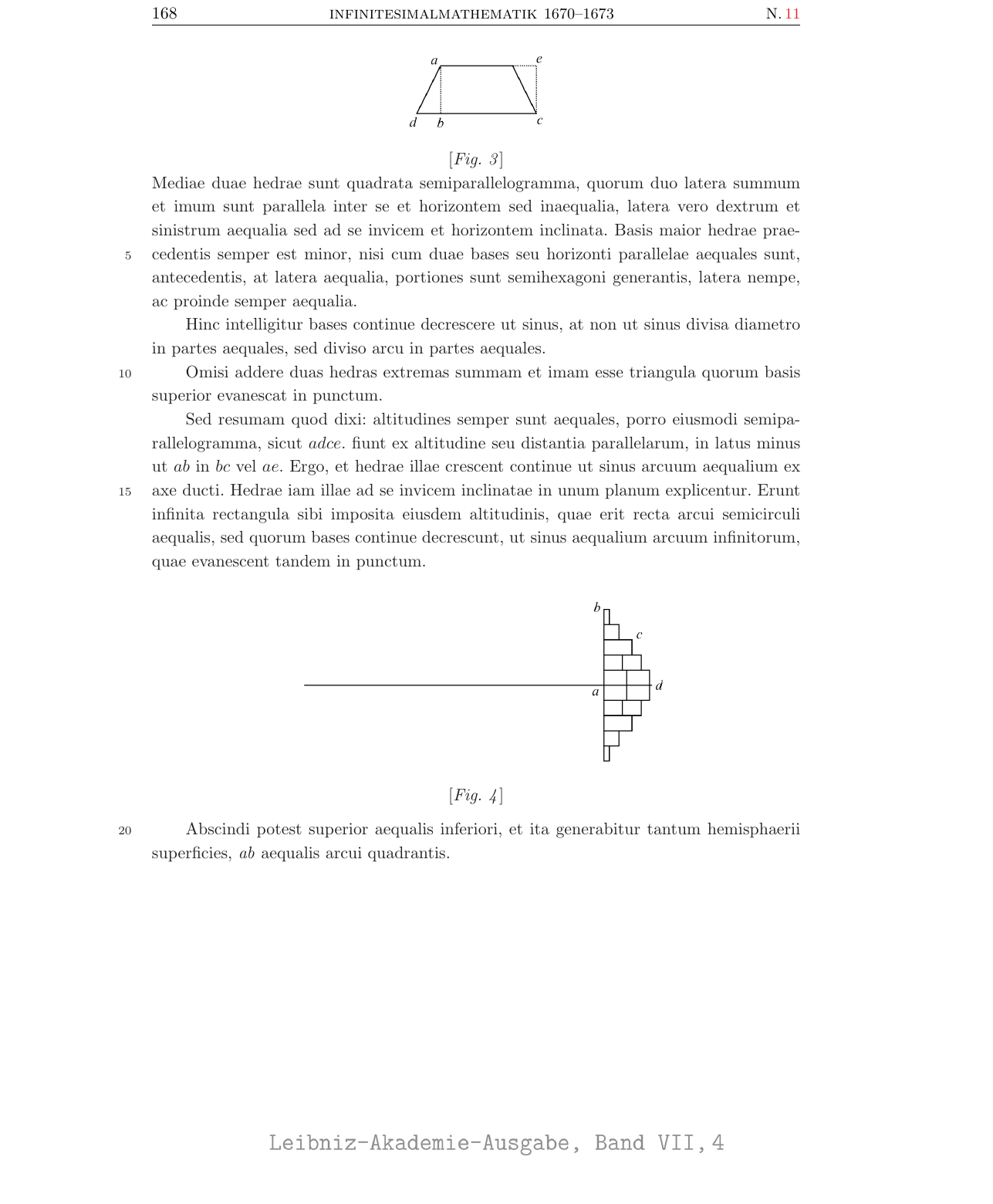
15Mediae duae hedrae sunt quadrata semiparallelogramma, quorum duo latera summum et imum sunt parallela inter se et horizontem sed inaequalia, latera vero dextrum et sinistrum aequalia sed ad se invicem et horizontem inclinata. Basis maior hedrae praecedentis semper est minor, nisi cum duae bases seu horizonti parallelae aequales sunt, antecedentis, at latera aequalia, portiones sunt semihexagoni generantis, latera nempe, ac proinde semper aequalia.
The two intermediate faces are four-sided half-parallelograms. Their top and bottom sides are parallel to one another and to the horizon, but unequal. The right and left sides are equal, but inclined to one another and to the horizon. The larger base of the preceding face is always the smaller base of the one before it, except where the two bases, the lines parallel to the horizon, are equal. The equal sides are portions of the generating half-hexagon, namely its sides, and hence are always equal.
16Hinc intelligitur bases continue decrescere ut sinus, at non ut sinus divisa diametro in partes aequales, sed diviso arcu in partes aequales. Omisi addere duas hedras extremas summam et imam esse triangula quorum basis superior evanescat in punctum.
We see from this that the bases decrease continually as the sines do, the sines being taken at equal divisions of the arc, not at equal divisions of the diameter. I omitted to add that the two end faces, the highest and the lowest, are triangles whose upper base vanishes into a point.
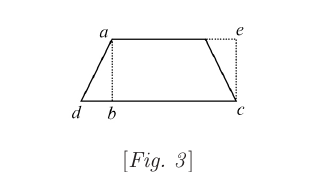
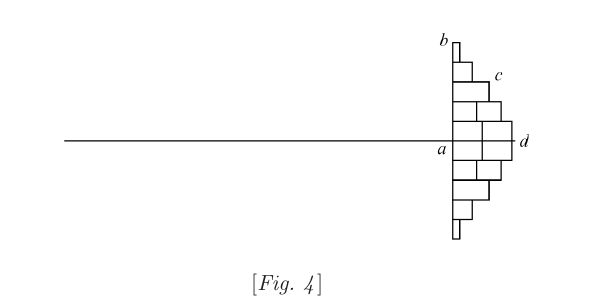
17Sed resumam quod dixi: altitudines semper sunt aequales, porro eiusmodi semiparallelogramma, sicut adce. fiunt ex altitudine seu distantia parallelarum, in latus minus ut ab in bc vel ae. Ergo, et hedrae illae crescent continue ut sinus arcuum aequalium ex axe ducti. Hedrae iam illae ad se invicem inclinatae in unum planum explicentur. Erunt infinita rectangula sibi imposita eiusdem altitudinis, quae erit recta arcui semicirculi aequalis, sed quorum bases continue decrescunt, ut sinus aequalium arcuum infinitorum, quae evanescent tandem in punctum.
But let me return to what I said. The heights are always equal. Half-parallelograms of this sort, such as adce, are obtained from the height, or distance between the parallels, multiplied by the shorter side, as ab by bc or ae. Therefore these faces too will increase continually as the sines drawn from the axis for equal arcs. Now unfold the faces, inclined to one another, into a single plane. There will be infinitely many rectangles laid one upon another, of the same height, which will be a straight line equal to the semicircular arc, but with bases continually decreasing as the sines of infinitely many equal arcs, until at last they vanish into a point.
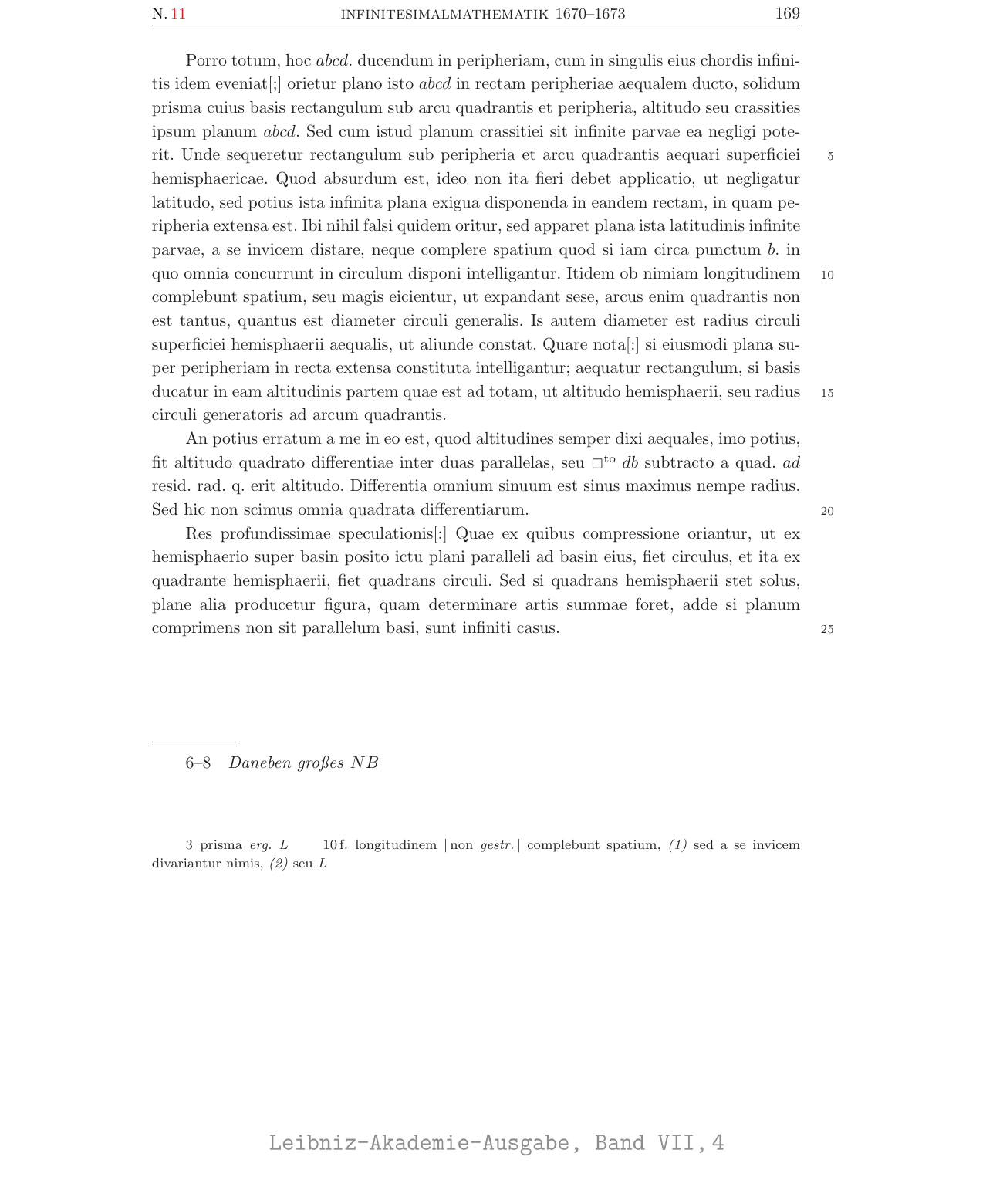
19Porro totum, hoc abcd. ducendum in peripheriam, cum in singulis eius chordis infinitis idem eveniat[;] orietur plano isto abcd in rectam peripheriae aequalem ducto, solidum prisma cuius basis rectangulum sub arcu quadrantis et peripheria, altitudo seu crassities ipsum planum abcd. Sed cum istud planum crassitiei sit infinite parvae ea negligi poterit. Unde sequeretur rectangulum sub peripheria et arcu quadrantis aequari superficiei hemisphaericae.
Further, this whole figure abcd must be multiplied by the circumference, since the same thing happens at each of its infinitely many chords. Multiplying the plane abcd by a straight line equal to the circumference will give a solid prism. Its base is the rectangle contained by the quadrant arc and the circumference, and its height or thickness is the plane abcd itself. But since this plane is of infinitely small thickness, the thickness could be neglected. It would follow that the rectangle contained by the circumference and the quadrant arc equals the hemispherical surface.
20Quod absurdum est, ideo non ita fieri debet applicatio, ut negligatur latitudo, sed potius ista infinita plana exigua disponenda in eandem rectam, in quam peripheria extensa est. Ibi nihil falsi quidem oritur, sed apparet plana ista latitudinis infinite parvae, a se invicem distare, neque complere spatium quod si iam circa punctum b. in quo omnia concurrunt in circulum disponi intelligantur. Itidem ob nimiam longitudinem complebunt spatium, seu magis eicientur, ut expandant sese, arcus enim quadrantis non est tantus, quantus est diameter circuli generalis. Is autem diameter est radius circuli superficiei hemisphaerii aequalis, ut aliunde constat.
This is absurd. The application must therefore be made in such a way that the breadth is taken into account. The infinitely many little planes must instead be set out on the very line along which the circumference has been stretched. No falsehood arises there, to be sure. But these planes of infinitely small breadth plainly stand apart and do not fill the space. Suppose now that they are arranged in a circle about the point b where they all meet. Their excessive length will likewise make them fill the space, or rather they will be thrust out so as to spread themselves. For the quadrant arc is not as great as the diameter of the general circle. That diameter, as we know from elsewhere, is the radius of the circle equal in area to the hemispherical surface.
21Quare nota[:] si eiusmodi plana super peripheriam in recta extensa constituta intelligantur; aequatur rectangulum, si basis ducatur in eam altitudinis partem quae est ad totam, ut altitudo hemisphaerii, seu radius circuli generatoris ad arcum quadrantis.
Observe, then, that if planes of this sort are imagined standing on the circumference stretched into a straight line, the rectangle is equalled if the base is multiplied by that part of the height which is to the whole as the height of the hemisphere, or radius of the generating circle, is to the quadrant arc.
22An potius erratum a me in eo est, quod altitudines semper dixi aequales, imo potius, fit altitudo quadrato differentiae inter duas parallelas, seu □ᵗᵒ db subtracto a quad. ad resid. rad. q. erit altitudo. Differentia omnium sinuum est sinus maximus nempe radius. Sed hic non scimus omnia quadrata differentiarum.
Or did I rather go wrong in saying that the heights are always equal? Rather, to find the height, subtract the square of the difference between the two parallels, or the square on db, from the square on ad. The square root of the remainder will be the height. The total difference of all the sines is the greatest sine, namely the radius. But here we do not know all the squares of the differences.
23Res profundissimae speculationis[:] Quae ex quibus compressione oriantur, ut ex hemisphaerio super basin posito ictu plani paralleli ad basin eius, fiet circulus, et ita ex quadrante hemisphaerii, fiet quadrans circuli. Sed si quadrans hemisphaerii stet solus, plane alia producetur figura, quam determinare artis summae foret, adde si planum comprimens non sit parallelum basi, sunt infiniti casus.
A matter for the deepest inquiry. Which figures arise from which by compression? Thus a hemisphere resting on its base, struck by a plane parallel to that base, will yield a circle, and a quadrant of the hemisphere will accordingly yield a quadrant of the circle. But if the quadrant of the hemisphere stands alone, quite another figure will be produced. It would take the greatest skill to determine it. Add that if the compressing plane is not parallel to the base, there are infinitely many cases.
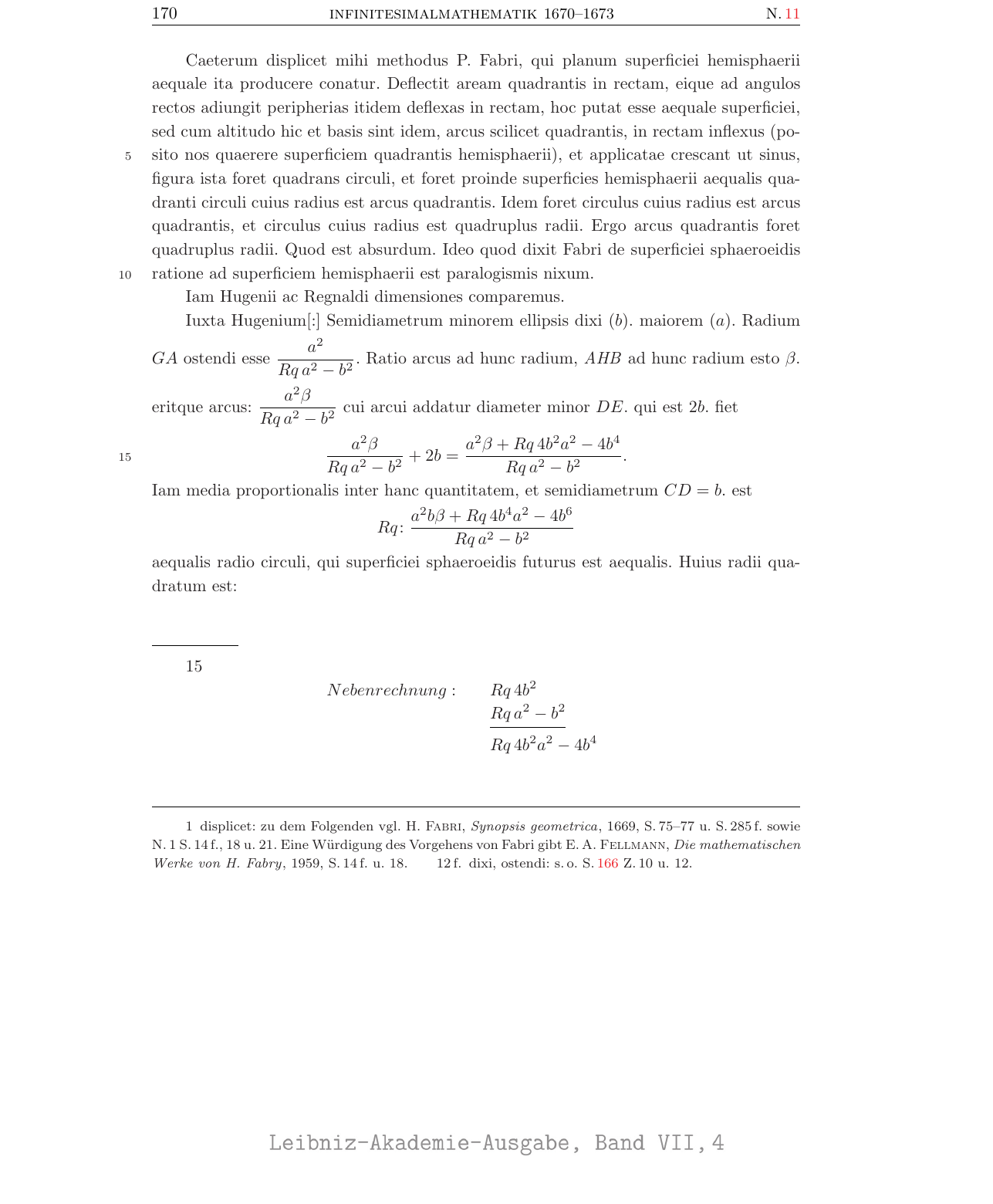
24Caeterum displicet mihi methodus P. Fabri, qui planum superficiei hemisphaerii aequale ita producere conatur. Deflectit aream quadrantis in rectam, eique ad angulos rectos adiungit peripherias itidem deflexas in rectam, hoc putat esse aequale superficiei, sed cum altitudo hic et basis sint idem, arcus scilicet quadrantis, in rectam inflexus (posito nos quaerere superficiem quadrantis hemisphaerii), et applicatae crescant ut sinus, figura ista foret quadrans circuli, et foret proinde superficies hemisphaerii aequalis quadranti circuli cuius radius est arcus quadrantis. Idem foret circulus cuius radius est arcus quadrantis, et circulus cuius radius est quadruplus radii. Ergo arcus quadrantis foret quadruplus radii. Quod est absurdum. Ideo quod dixit Fabri de superficiei sphaeroeidis ratione ad superficiem hemisphaerii est paralogismis nixum.
For the rest, I dislike Father Fabri’s method of trying to produce a plane figure equal to the surface of the hemisphere. He straightens the area of the quadrant into a line, and joins the circumferences to it at right angles, likewise straightened into lines. This he thinks equal to the surface. But the height and base here are the same, namely the quadrant arc bent into a straight line (supposing we are seeking the surface of a quadrant of the hemisphere), and the ordinates increase as the sines. The figure would be a quadrant of a circle. Hence the hemispherical surface would equal the quadrant of a circle whose radius is the quadrant arc. The circle whose radius is the quadrant arc would be the same as the circle whose radius is four times the radius. The quadrant arc would therefore be four times the radius. This is absurd. What Fabri said about the ratio of the spheroidal to the hemispherical surface thus rests on fallacious arguments.
25Iam Hugenii ac Regnaldi dimensiones comparemus. Iuxta Hugenium[:] Semidiametrum minorem ellipsis dixi (b). maiorem (a). Radium GA ostendi esse a²/(Rq a² − b²). Ratio arcus ad hunc radium, AHB ad hunc radium esto β. eritque arcus: a²β/(Rq a² − b²) cui arcui addatur diameter minor DE. qui est 2b. fiet a²β/(Rq a² − b²) + 2b = (a²β + Rq 4b²a² − 4b⁴)/(Rq a² − b²).
Now let us compare Huygens’s and Regnauld’s measurements. In applying Huygens’s rule, I called the lesser semidiameter of the ellipse b and the greater a. I showed that the radius GA is a²/√(a² − b²). Let β be the ratio of the arc AHB to this radius. The arc will be a²β/√(a² − b²). Add the minor diameter DE, which is 2b. We obtain a²β/√(a² − b²) + 2b = (a²β + √(4b²a² − 4b⁴))/√(a² − b²).
26Iam media proportionalis inter hanc quantitatem, et semidiametrum CD = b. est Rq: (a²bβ + Rq 4b⁴a² − 4b⁶)/(Rq a² − b²) aequalis radio circuli, qui superficiei sphaeroeidis futurus est aequalis. Huius radii quadratum est:
The mean proportional between this quantity and the semidiameter CD = b is √((a²bβ + √(4b⁴a² − 4b⁶))/√(a² − b²)). This equals the radius of the circle that will equal the surface of the spheroid. The square of this radius is as follows.
27Rq 4b² × Rq a² − b² → Rq 4b²a² − 4b⁴.
[Calculation in the margin.] Multiply √(4b²) by √(a² − b²). The result is √(4b²a² − 4b⁴).
28(a²bβ + Rq 4b⁴a² − 4b⁶)/(Rq a² − b²). Unde fieri poterit circulus, si per β rationem [arcus ad radium], et aliquid aliud praeterea notum nobis, modo ratio arcus AHB ad peripheriam sui circuli nota sit, quod vocemus α. Ac proinde per βα/[α] id quadratum multiplicetur, fiet: (a²bβ²α + βα Rq b⁴a² − 4b⁶)/([α] Rq a² − b²). Quod aequatur superficiei sphaeroeidis, secundum Hugenium.
(a²bβ + √(4b⁴a² − 4b⁶))/√(a² − b²). From this we can obtain the circle by using β, the ratio [of arc to radius], and something else known to us, provided we know the ratio of the arc AHB to the circumference of its circle. Call that ratio α. Multiply the square, accordingly, by βα/[α]. We obtain (a²bβ²α + βα√(b⁴a² − 4b⁶))/([α]√(a² − b²)) [sic]. This equals the surface of the spheroid according to Huygens. [In each denominator the bracketed α is struck out.]
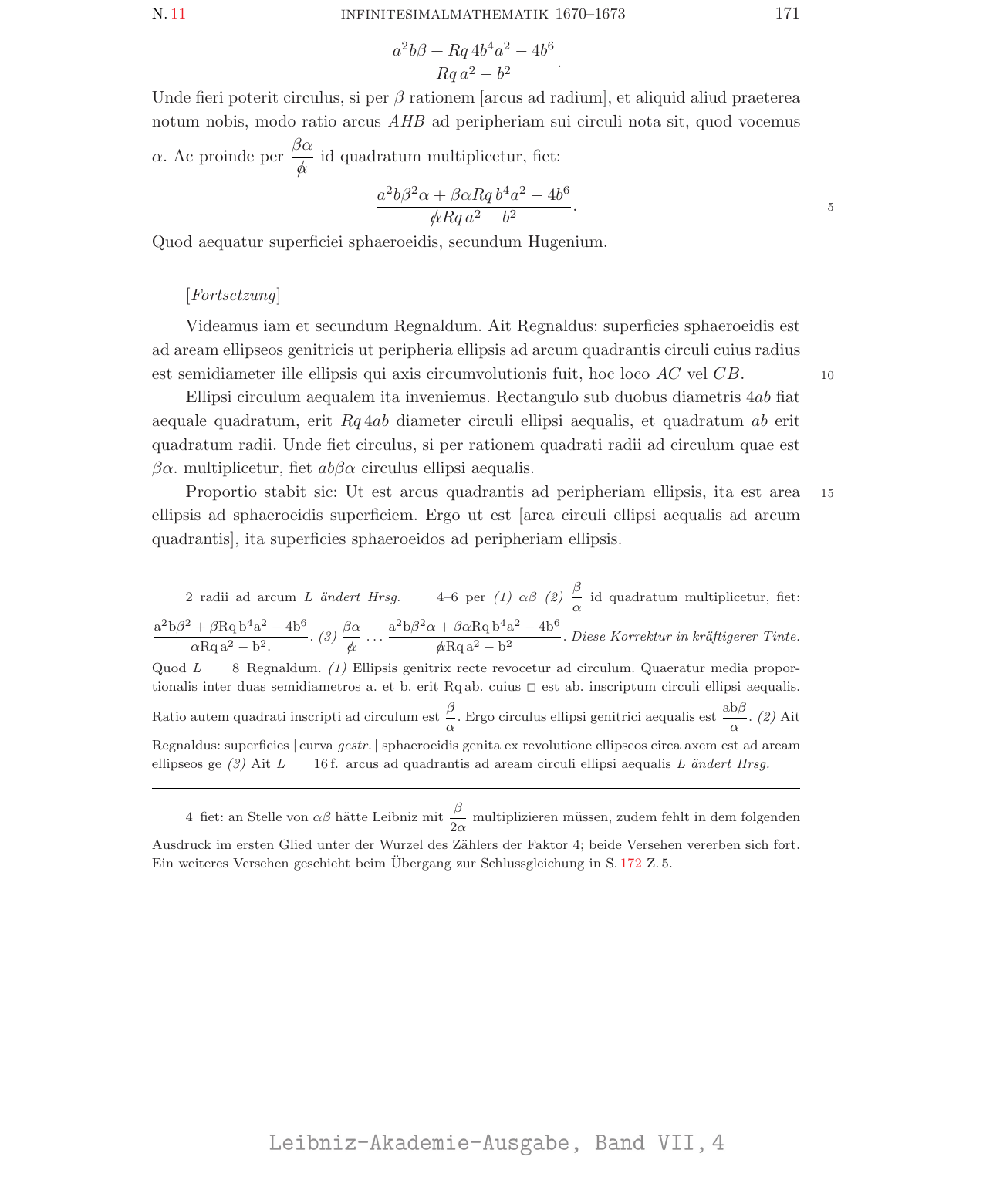
29Videamus iam et secundum Regnaldum. Ait Regnaldus: superficies sphaeroeidis est ad aream ellipseos genitricis ut peripheria ellipsis ad arcum quadrantis circuli cuius radius est semidiameter ille ellipsis qui axis circumvolutionis fuit, hoc loco AC vel CB.
[Continuation.] Let us now see how the calculation goes according to Regnauld. Regnauld says that the surface of a spheroid is to the area of its generating ellipse as the circumference of the ellipse is to the quadrant arc of the circle whose radius is that semidiameter of the ellipse which was the axis of rotation, here AC or CB.
30Ellipsi circulum aequalem ita inveniemus. Rectangulo sub duobus diametris 4ab fiat aequale quadratum, erit Rq 4ab diameter circuli ellipsi aequalis, et quadratum ab erit quadratum radii. Unde fiet circulus, si per rationem quadrati radii ad circulum quae est βα. multiplicetur, fiet abβα circulus ellipsi aequalis.
We shall find a circle equal to the ellipse as follows. Construct a square equal to 4ab, the rectangle on the two diameters. Then √(4ab) will be the diameter of the circle equal in area to the ellipse, and ab will be the square of its radius. From this we shall obtain the circle by multiplying by the ratio of the square of the radius to the circle, which is βα [sic]. The result abβα will be the circle equal to the ellipse.
31Proportio stabit sic: Ut est arcus quadrantis ad peripheriam ellipsis, ita est area ellipsis ad sphaeroeidis superficiem. Ergo ut est [area circuli ellipsi aequalis ad arcum quadrantis], ita superficies sphaeroeidos ad peripheriam ellipsis.
The proportion will stand thus. As the quadrant arc is to the circumference of the ellipse, so the area of the ellipse is to the surface of the spheroid. Therefore as the [area of the circle equal to the ellipse is to the quadrant arc], so the surface of the spheroid is to the circumference of the ellipse.
Notes on text 356
Transmission (A). Leibniz’s working draft, LH 35 XIV 2, fols. 70–71 (Cc 2, no. 619). One folio bifolium, four written pages, folded as a letter. The beginning is in paler ink. The continuation from p. 171, line 8 and the addition to p. 165, lines 3–6 are in stronger ink. The editors date the draft to spring 1673 on the ground that it precedes no. 12. The title and date head the Academy text. The page and figure numbers here follow that edition.
Text-critical apparatus (A). On p. 164 the manuscript diagram and the first state of the text used lowercase letters. Leibniz changed the letters in the text to capitals and left the diagram as it was. E, introduced during the calculation, was already a capital in the diagram. The edition identifies Fig. 1 as partly drawn by blind impression. On p. 165 the addition is printed below the main text. It follows the Huygens heading here, with its reference back to lines 3–6.
On p. 166, lines 15–16, the editors change the manuscript’s “diameter” to “semidiameter” and AHD to AHB. Leibniz crossed out an attempt at a shorter statement. “I can also say it more briefly. If the square of the lesser diameter is subtracted from the square of the greater, [the side of] the remainder [will be the line G …].” The wording breaks off. On p. 167, line 10, he abandoned “As …” and then “therefore let the whole surface of the hemisphere be unfolded into a cone.” At line 17 he began with “six,” with unfinished “plane figures” and then “plane faces,” before writing “five.”
On p. 169 the large marginal NB stands beside lines 6–8, where the infinitely narrow planes fail to fill the space. Leibniz inserted “prism” in line 3. At lines 10–11 he struck out “not” before “will fill the space” and abandoned “but they diverge from each other too much.” These revisions matter to the sequence of his objections.
On p. 171, line 2, the manuscript gives “of radius to arc.” The editors reverse it to agree with the definition of β on p. 170. At lines 4–6 the multiplier developed from αβ to β/α and then to βα with a struck denominator α. The corresponding revision of the displayed fraction is in stronger ink. An earlier draft at line 8 reads, “Let the generating ellipse be reduced properly to a circle. Seek a mean proportional between the two semidiameters a and b. It will be √(ab), whose square is ab, inscribed in the circle equal to the ellipse. The ratio of the inscribed square to the circle is β/α. Therefore the circle equal to the generating ellipse is abβ/α.” A second opening, “Regnauld says that the [curved] surface of the spheroid generated by the revolution of the ellipse about its axis is to the area of the generating elli…,” also gave way to the present wording. At lines 16–17 the editors reverse the manuscript’s garbled comparison of the arc and the equal circle’s area. Square brackets in the reading distinguish these editorial supplies, while an explicit cancellation note identifies the bracketed factors in the calculations.
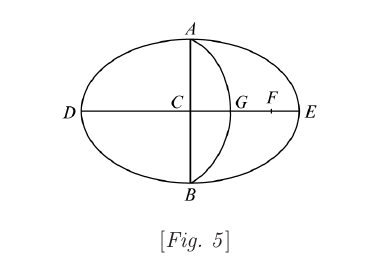
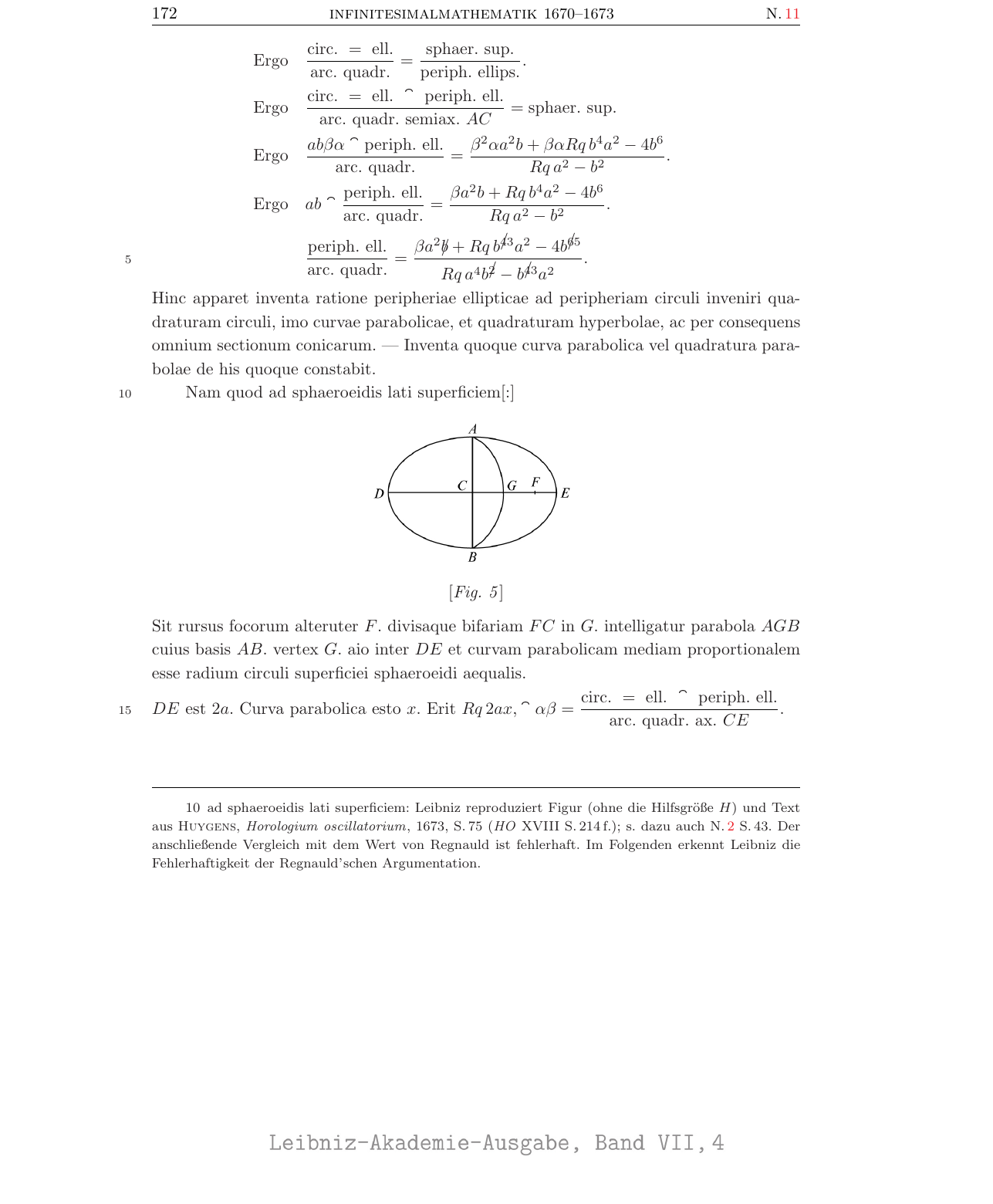
Editors’ notes (A). For pp. 165–166 the editors identify the construction of the prolate spheroid as Huygens, Horologium oscillatorium (1673), III, prop. 9, p. 74 (Œuvres complètes XVIII, pp. 212–215). For the oblate spheroid on p. 172, compare Huygens, p. 75 (Œuvres XVIII, pp. 214–215). Leibniz reproduces the second figure without the auxiliary H. In both places the editors refer to A VII,4 no. 2, p. 43. On p. 167 they refer Fabri’s assertion to his Synopsis geometrica (1669), pp. 284–285. Regnauld’s erroneous rule for the surface of a spheroid is printed in Monconys, Journal des voyages, part III (1666), Lettres, pp. 15–24. The passages on pp. 167 and 171 concern the main proposition and corollaries IV and V. For the criticism of Fabri on p. 170 they cite the Synopsis, pp. 75–77 and 285–286, A VII,4 no. 1, pp. 14–15, 18, 21, and E. A. Fellmann on Fabri’s mathematics (1959), pp. 14–15 and 18.
At p. 171, line 4, the editors say the multiplier should be β/(2α). They also identify the missing factor 4 in the first term under the numerator’s radical. Both errors carry forward. They flag a further error in passing to p. 172, line 5, and the faulty comparison with Regnauld following the oblate construction. At the end Leibniz himself questions Regnauld’s reasoning.
Checks and terms (Ours). The initial chord calculation gives x = b²/(2a), the projection BE on the radius. The semicircle addition pairs complementary chords whose squared lengths add to the squared diameter. Halving radius × semicircular arc gives πr²/2, the area of a semicircle. The first construction in Fig. 2 requires the sum of arc AHB and diameter DE beneath the mean proportional. Leibniz’s calculation on p. 170 confirms the reading. Its three equal lengths GA, GB and GH are radii about G.
In Fig. 3 the equal sloping sides and unequal parallel bases form a trapezoid. The dotted construction gives bc = ae as the mean width in the area product ab × bc. The upright height is √(ad² − db²). This explains the shift from equal sloping sides on p. 168 to Leibniz’s question about equal heights on p. 169. His claim that the quadrant arc would be four times the radius on p. 170 belongs to his reductio.
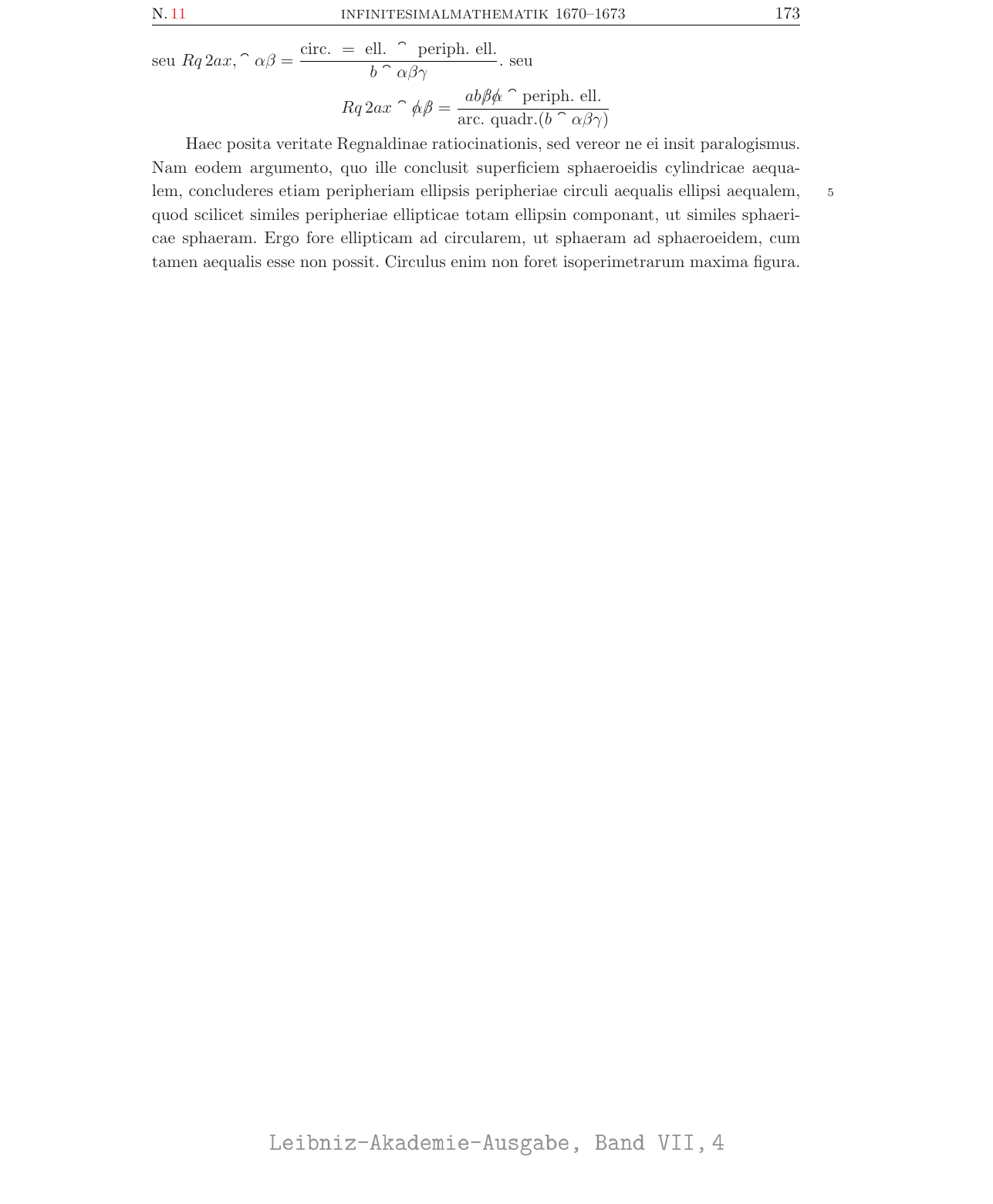
Let θ be the angle subtended at G by arc AHB, in radians. Then β = θ and α = θ/(2π). The factor converting a squared radius into the area of its circle is π = β/(2α). For the missing factor on p. 171, squaring and expanding 2b²√(a² − b²) gives 4b⁴a² − 4b⁶. The preceding page includes both factors of four. On p. 172 simply dividing the preceding right-hand expression by ab does not produce the last line, even after setting aside the earlier dropped factor. The text retains the changes to exponents. The last display on p. 173 retains the product marks and the struck factors. γ enters without a definition here. At the close the argument concerns the areas enclosed by equal perimeters.
“Surface” denotes surface area in the equalities with a circle. “Circle” may mean its area, while “circumference” and “arc” denote lengths. After “Fabri” on p. 167 there is a small looped mark. Its outline matches the entry destilletur, distilletur (“let it be distilled”) in the edition’s key on p. 872. Its purpose in this particular passage is unspecified. The short multiplication arc is rendered × in English, Rq as a square root with parentheses to show its scope, and □ as “square.” The five diagrams and the attached printed pages preserve the original positions of the labels, the cancellations and the stacked form of the calculations.
The separate Hannover corrigenda, Berichtigungen zu den Reihen I, III und VII, version 1, pp. 62–63, start the corrections for VII,4 at p. 271. They list no changes to pp. 164–173. The source edition is G. W. Leibniz, Sämtliche Schriften und Briefe, Reihe VII, Band 4, 1670–1673: Infinitesimalmathematik, edited by Walter S. Contro and Eberhard Knobloch (Berlin, 2008), N. 11, pp. 164–173. The digital edition is provided by the Akademie der Wissenschaften zu Göttingen through the Leibniz-Archiv, Gottfried Wilhelm Leibniz Bibliothek, Hannover, under CC BY-NC 4.0. Monadica supplies the English translation, mathematical transcription and editorial checks. The figure details are crops of the edition.
Hannover source edition · CC BY-NC 4.0