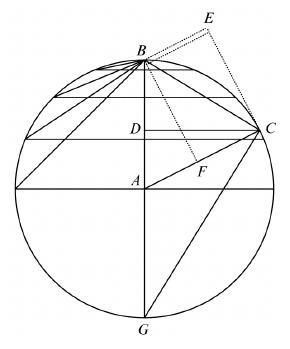
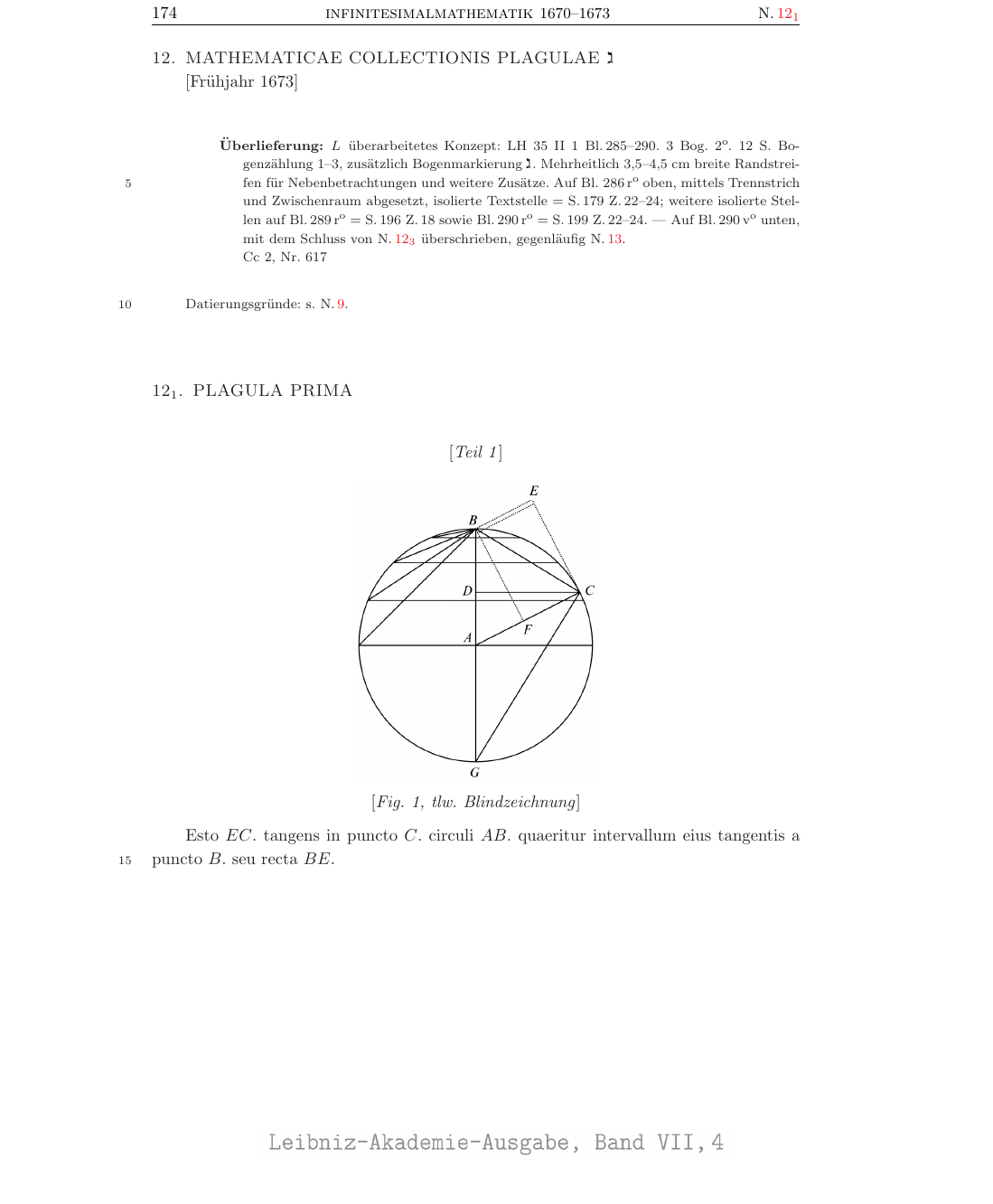
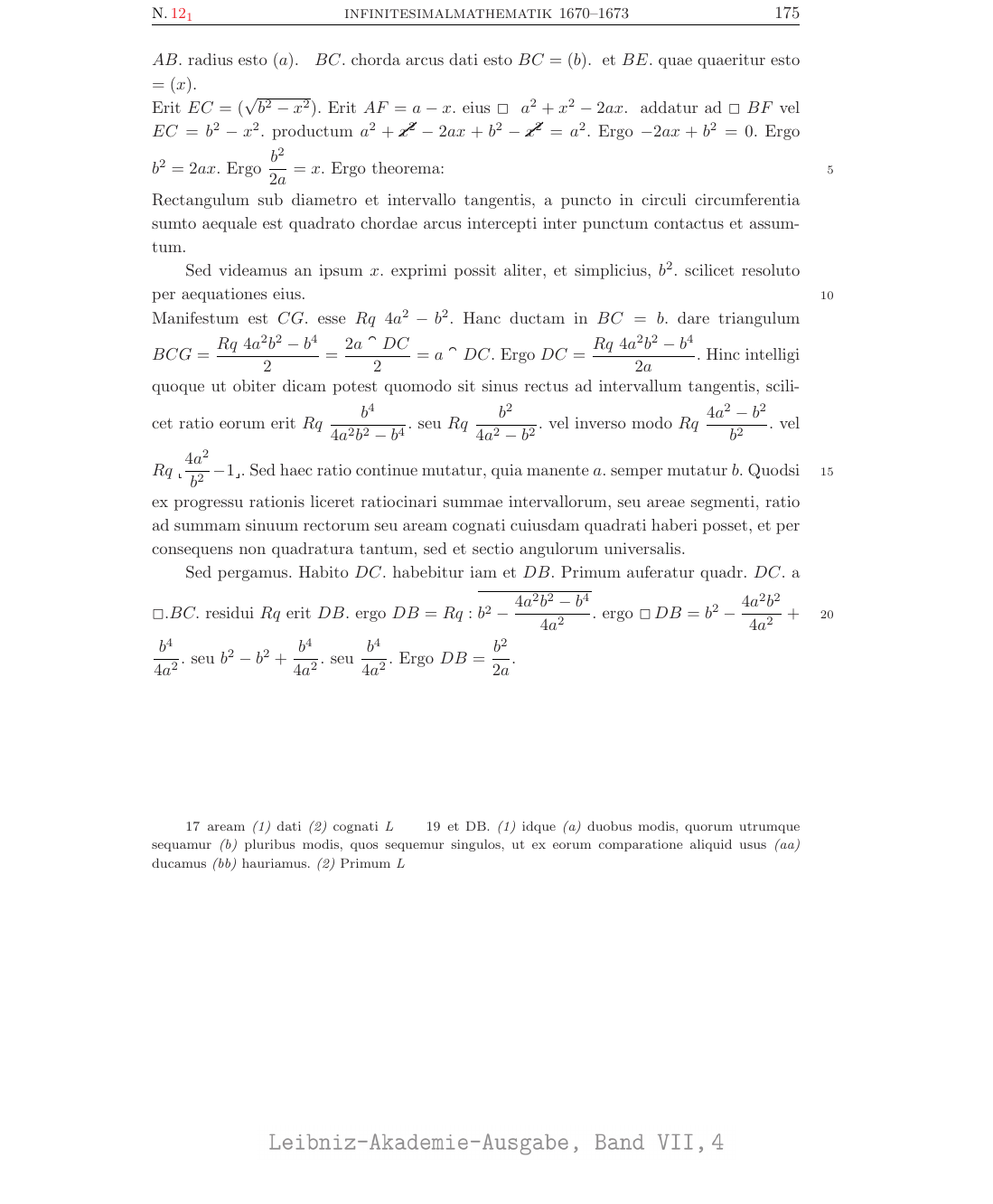
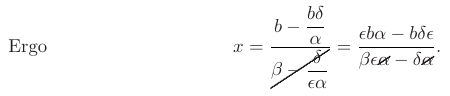
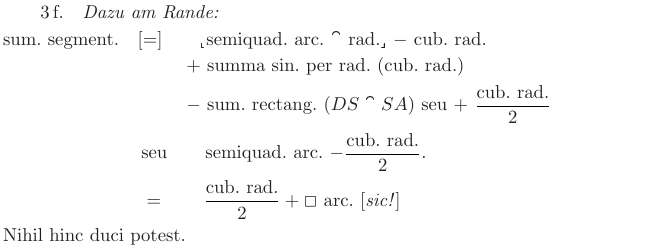
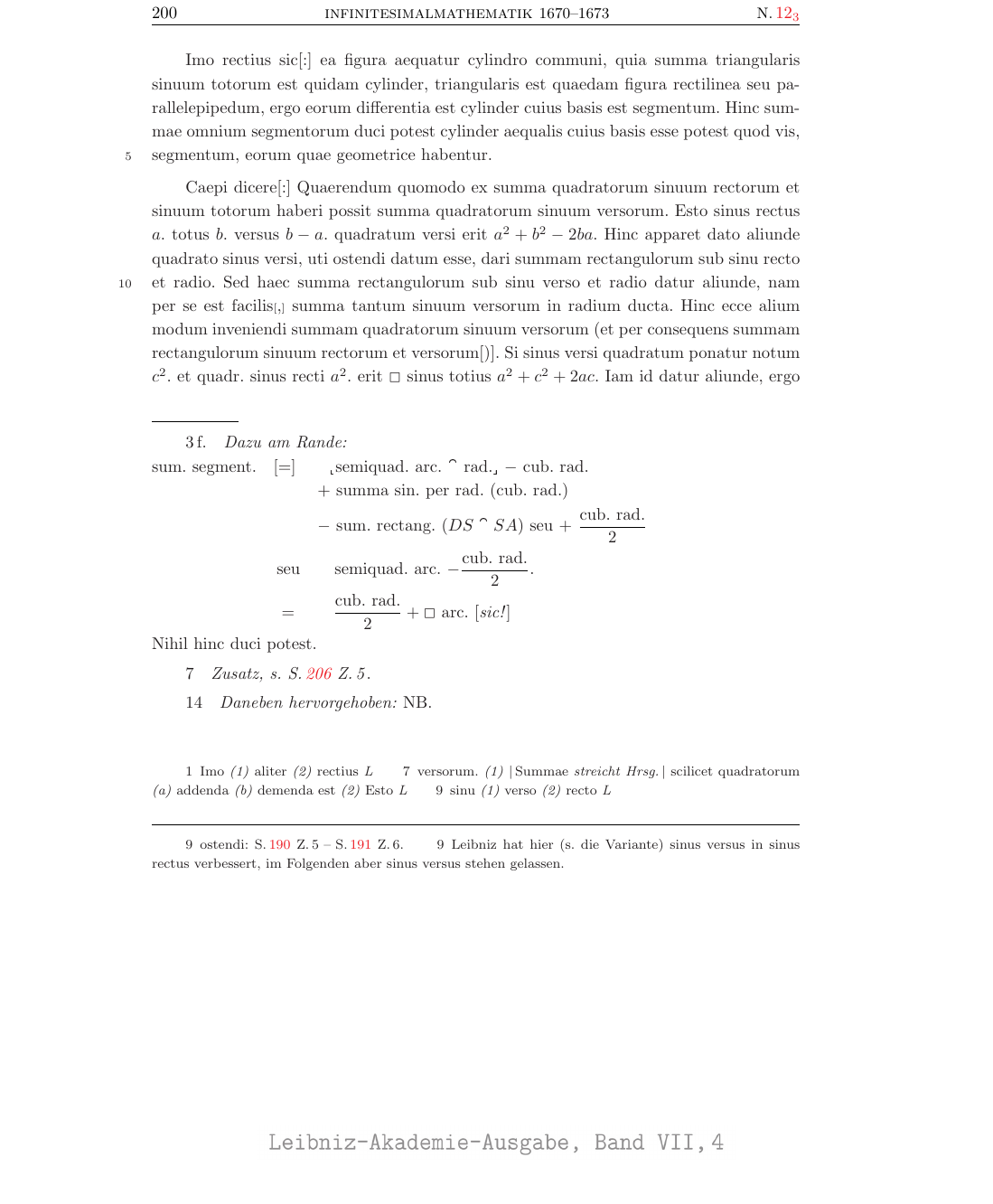
4Erit EC = (√(b² − x²)). Erit AF = a − x. eius □ a² + x² − 2ax. addatur ad □ BF vel EC = b² − x². productum a² + [x²] − 2ax + b² − [x²] = a². Ergo −2ax + b² = 0. Ergo b² = 2ax. Ergo b²/(2a) = x. Ergo theorema:
Then EC = √(b² − x²). AF = a − x, whose square is a² + x² − 2ax. Add the square of BF or EC, namely b² − x². The result is a² + x² − 2ax + b² − x² = a², the two x² terms cancelling. Thus −2ax + b² = 0, so b² = 2ax and b²/(2a) = x. Hence the theorem follows.
5Rectangulum sub diametro et intervallo tangentis, a puncto in circuli circumferentia sumto aequale est quadrato chordae arcus intercepti inter punctum contactus et assumtum.
The rectangle formed by the diameter and the distance of the tangent from a point taken on the circle equals the square on the chord of the arc between the point of contact and the chosen point.
6Sed videamus an ipsum x. exprimi possit aliter, et simplicius, b². scilicet resoluto per aequationes eius.
But let us see whether x can be expressed differently and more simply, by resolving b² through its equations.
7Manifestum est CG. esse Rq 4a² − b². Hanc ductam in BC = b. dare triangulum BCG = (Rq 4a²b² − b⁴)/2 = (2a ⌢ DC)/2 = a ⌢ DC. Ergo DC = (Rq 4a²b² − b⁴)/(2a). Hinc intelligi quoque ut obiter dicam potest quomodo sit sinus rectus ad intervallum tangentis, scilicet ratio eorum erit Rq (b⁴/(4a²b² − b⁴)). seu Rq (b²/(4a² − b²)). vel inverso modo Rq ((4a² − b²)/b²). vel Rq ⌞4a²/b² − 1⌟. Sed haec ratio continue mutatur, quia manente a. semper mutatur b. Quodsi ex progressu rationis liceret ratiocinari summae intervallorum, seu areae segmenti, ratio ad summam sinuum rectorum seu aream cognati cuiusdam quadrati haberi posset, et per consequens non quadratura tantum, sed et sectio angulorum universalis.
Clearly CG = √(4a² − b²). Multiplying this by BC = b gives the triangle BCG = √(4a²b² − b⁴)/2 = 2a·DC/2 = a·DC. Hence DC = √(4a²b² − b⁴)/(2a). Incidentally this shows the ratio between the right sine and the tangent distance. It is √[b⁴/(4a²b² − b⁴)], or √[b²/(4a² − b²)], or, inversely, √[(4a² − b²)/b²] or √(4a²/b² − 1). But this ratio changes continually, since a stays fixed while b changes. If the progression of the ratio allowed us to infer the ratio of the sum of the distances, or area of the segment, to the sum of the right sines, or area of a certain related square, we would obtain both quadrature and a universal division of angles.
8Sed pergamus. Habito DC. habebitur iam et DB. Primum auferatur quadr. DC. a □ BC. residui Rq erit DB. ergo DB = Rq: b² − (4a²b² − b⁴)/(4a²). ergo □ DB = b² − 4a²b²/(4a²) + b⁴/(4a²). seu b² − b² + b⁴/(4a²). seu b⁴/(4a²). Ergo DB = b²/(2a).
To proceed, once DC is known, DB too will be known. Subtract the square on DC from the square on BC. The square root of the remainder is DB. Thus DB = √[b² − (4a²b² − b⁴)/(4a²)]. Its square is b² − 4a²b²/(4a²) + b⁴/(4a²), or b² − b² + b⁴/(4a²), or b⁴/(4a²). Therefore DB = b²/(2a).
9At supra ostensum est b²/(2a) esse intervallum tangentis a puncto dato. Ergo demonstratum habemus intervallum puncti in circumferentia assumti, a tangente alterius puncti in eadem circumferentia sumti esse sinum versum arcus inter utrumque punctum intercepti.
But above we showed that b²/(2a) is the distance of the tangent from the given point. We have therefore proved that the distance of one point on a circumference from the tangent at another point on it is the versed sine of the arc between them.
10Et hinc iam confectum habemus: summam omnium sinuum versorum, seu figuram sinuum versorum aequari duplo segmento arcus, maximi sinuum versorum. Et hanc summam sinuum versorum finitorum ductam in latus polygoni, aequari duplo segmento polygoni, eandem cum arcu supradicto basin habenti.
From this we have established that the sum of all the versed sines, or the figure of the versed sines, equals twice the segment of the arc belonging to the greatest versed sine. This sum for finitely many versed sines, multiplied by the side of the polygon, equals twice the segment of the polygon having the same base as that arc.
11Hinc cum sinus versi iam calculati habeantur, facile poterimus quodcunque segmentum polygoni metiri circumferentia divisa v.g. in 100,000 partes. Et ita facillime metiri possumus omnia circuli segmenta quanta volumus approximatione. Facile autem habentur sinus versi ex tabula sinuum, sunt enim chordarum, id est duplorum sinuum rectorum arcuum sequentium quadrata per diametrum divisa.
Thus, since the versed sines have already been calculated, we can readily measure any segment of a polygon, dividing the circumference, for example, into 100,000 parts. In this way we can measure all circular segments to any desired approximation. The versed sines are readily obtained from a table of sines. They are the squares of the chords, that is, of twice the right sines of the following arcs, divided by the diameter.
12Hinc res emergit observatione digna: Summa omnium sinuum rectorum est radii quadratum. Summa quadratorum duplorum sinuum rectorum, divisa per radium dabit aream segmenti quadrantis. Enuntiemus sic potius: Summa omnium sinuum rectorum semicirculi est duplum quadratum radii, vel dimidium quadratum diametri. Summa omnium sinuum versorum semicirculi duplicata est aequalis semicirculo, seu summa omnium sinuum versorum semicirculi est aequalis quadranti. Ergo summa omnium sinuum versorum totius semicirculi quadruplicata aequalis est circulo. Et proinde cuilibet sectori
Something worth noting emerges. The sum of all the right sines is the square of the radius. The sum of the squares of twice the right sines, divided by the radius, will give the area of the segment of the quadrant. Let us put it this way instead. The sum of all the right sines of the semicircle is twice the square of the radius, or half the square of the diameter. Twice the sum of all the versed sines of the semicircle equals the semicircle. In other words, the sum of all the versed sines of the semicircle equals the quadrant. Hence four times the sum of the versed sines of the whole semicircle equals the circle. Consequently any sector is equal to—
13Nota[:] metiri possumus segmenta circuli, seu potius polygoni circularis, summa sinuum versorum ducta in latus polygoni. Idem et caeteris curvis proportione quadam.
[At line 10.] Note that we can measure the segments of a circle, or more precisely of a circular polygon, by multiplying the sum of the versed sines by the side of the polygon. The same holds for other curves in a certain proportion.
14Imo iam extat tabula sinuum versorum apud Maginum.
[Addition at line 11, in a different ductus.] Indeed, Magini already has a table of versed sines.
15aequalis est portio eius pro ratione sectoris ad circulum. Hinc differentia inter certam portionem summae sinuum versorum totius semicirculi pro ratione sectoris, et summam sinuum versorum, arcus sectoris, est aequalis triangulo sectoris. Hinc cum summa sinuum [versorum] quadrantis aequetur duplicato segmento quadrantis et semicirculi aequetur quadranti, ergo differentia inter utrasque aequabitur dimidio quadrato radii seu triangulo quadrantis. Hinc exhiberi potest summa quaedam sinuum versorum, aequalis summae cuidam sinuum rectorum.
—its portion taken in the ratio of that sector to the circle. Hence the difference between a specified portion of the sum of versed sines of the whole semicircle, in the ratio of the sector, and the sum of the versed sines of the sector’s arc equals the sector’s triangle. Since the sum of the [versed] sines of the quadrant equals twice the segment of the quadrant, and that of the semicircle equals the quadrant, their difference will equal half the square of the radius, or the triangle of the quadrant. Thus one can exhibit a sum of versed sines equal to a certain sum of right sines.
16Porro cum constet ex chordis ut BC. fieri sinus versos, si scilicet quadrata chordarum per diametrum [dividantur], videndum an non istae chordae sint sinus recti, aut potius sinuum rectorum dupli. Nam cum summa haberi possit sinuum rectorum, si quadratorum quoque sinuum rectorum summa haberi posset absolute, et si possit haberi quoque harum chordarum summa, haberemus summam sinuum versorum, et proinde quadraturam circuli.
Since the versed sines arise from chords such as BC when their squares are [divided] by the diameter, we must see whether these chords are right sines, or rather twice the right sines. For we can obtain the sum of the right sines. If we could obtain both the absolute sum of their squares and the sum of these chords, we would have the sum of the versed sines, and hence the quadrature of the circle.
17[Ad ll. 1, 3, 6:] e.
[In the margin at each of lines 1, 3 and 6.] Error.
18NB. Sed summa quadratorum sinuum rectorum non potest haberi absolute. Est enim aequalis cylindro, cuius basis est figura, altitudo radius. Eiusdem sedecuplicata (puto) est summa quadratorum chordarum arcus dupli. Haec divisa per radium dat figuram sedecuplicatam, quae videtur debere aequalis esse segmento, quia id fit ex summis chordarum per radium divisis.
[At line 11.] NB. But the sum of the squares of the right sines cannot be obtained absolutely. It equals a cylinder whose base is the figure and whose height is the radius. Sixteen times this sum, I think, is the sum of the squared chords of the double arc. Dividing it by the radius gives sixteen times the figure, which seems as if it should equal the segment, since the segment is made from the sums of the chords divided by the radius.
19Ostendam autem haberi chordarum summam, nec nisi summam quadratorum deesse.
[At line 12.] I shall show that the sum of the chords can be obtained and that only the sum of their squares is lacking.
22torum (vel versorum) semper intelligenda sit ducta in aliquam partium arcus aequalium, ergo si arcus eiusdem partes sunt in ratione dupla, etiam summae sinuum erunt in ratione dupla. Ergo si quaerimus summas semichordarum sufficit sumere summam sinuum rectorum arcus dimidii dimidiatam. Semper enim eadem est summa sinuum, utcunque dividatur arcus in partes aequales minores assignabilibus, quia semper ea summa fit ex radio in radium abscisso sinu verso arcus supplementi ([signum: destilletur]) ducto (vid. Pascal.), qui semper idem, utcunque dividatur arcus. Ergo summae erunt ut partes arcus. Cum autem summa semichordarum sit dimidiata sinuum rectorum arcus dimidiati, erit summa chordarum totius arcus aequalis summae sinuum rectorum arcus dimidii. Quod non debet mirum videri, etsi quaelibet chorda maior sit quolibet sinu arcus dati, summam tamen omnium esse minorem, quia chorda est reapse triangulum vel rectilineum cdb. etsi minus (altitudine) quolibet dato, cuius basis arcus ut db. latera duae chordae dc. et bc. arcum comprehendentes (etsi arcus esse intelligatur quolibet assignando minor), trilineum autem istud, vel si arcus loco substituatur tangens, triangulum non fit ducta basi tangente in latus, sed in altitudinem, quae longe minor.
—sines (or versed sines) is always understood as multiplied by one of the equal parts of the arc. Thus, if the parts of the same arc are in a twofold ratio, the sums of the sines too will be in a twofold ratio. To find the sums of the half-chords it therefore suffices to take half the sum of the right sines of the half-arc. The sum of the sines is always the same however the arc is divided into equal parts smaller than any assignable part. For this sum is always the radius multiplied by the radius less the versed sine of the supplementary arc (the sign for “let it be distilled”) (see Pascal), a quantity unchanged by the division. The sums, then, will be as the parts of the arc. Since the sum of the half-chords is half that of the right sines of the half-arc, the sum of the chords of the whole arc will equal the sum of the right sines of the half-arc. It should not seem surprising that, although each chord exceeds each sine of the given arc, the sum of all the chords is smaller. For the chord is really a triangle or rectilinear figure cdb, smaller in height than any given height. Its base is an arc such as db, its sides the chords dc and bc enclosing that arc, which is understood to be smaller than any assignable arc. This three-sided figure, or the triangle obtained by replacing the arc with a tangent, is formed by multiplying the tangent base by the altitude, which is much smaller than the side.
23Rectius ita, ut chordae summentur, necesse est eas inter se esse parallelas, necesse est etiam eas ductas intelligi in id quod solum determinatum et in aequales partes sectum est, id est in arcum[;] tunc autem sibi longe propius accedent, ut nunc, ubi ad se invicem angulum faciunt, et in spatium exiguum coibunt. Breviter idem est ac si curva bc. in rectam extendatur parallelam ipsi ca. manente puncto b. et chordae cd. affixae maneant punctis d. tantum perpendiculares reddantur rectae bg. Manifestum est, si dimidiae earum
More precisely, to sum the chords they must be parallel to one another. They must also be understood as multiplied by the one magnitude that is determined and divided into equal parts, the arc. They will then lie much closer together than now, when they make angles with one another, and will come together in a small space. In short, it is as if the curve bc were stretched into a straight line parallel to ca, b staying fixed and the chords cd remaining attached to the points d, only now perpendicular to the line bg. Clearly, if their halves—
24Nota[:] omnes figurae planae quae bis secari possunt in duas partes similes et aequales ab omnibus rectis per centrum gravitatis transeuntibus ita secabuntur, et omnes solidae quae planis […]
[An isolated observation above lines 10–11.] Note that every plane figure which can twice be cut into two similar and equal parts will be cut in that way by all straight lines passing through its centre of gravity, and all solid figures which by planes … [The text breaks off.]
25ff −dd. arcui c−dd (dimidio arcus bc.) in rectam dd−h. extenso applicentur, productum in dd−h. fore producti in bg. subquadruplum, tum quia dimidiae tantum chordae applicatae sunt, tum quia dimidio tantum arcui. Hinc si chordae integrae applicatae intelligantur arcui dd − c. erit adhuc dimidium summae chordarum, applicatarum scilicet arcui cuius est chorda maxima.
—ff–dd are applied to the arc c–dd (half the arc bc) stretched into the straight line dd–h, the product on dd–h is one quarter of the product on bg, both because only half the chords and because only half the arc were taken. Hence if the whole chords are applied to the arc dd–c, this will still be half the sum of the chords as applied to the arc to which the greatest chord belongs.
26Si quis dubitat sumat duas rectas utramque dividat in aequalem numerum partium aequalium. Utrique applicet eodem modo alias rectas tot quot sunt partes aequales, ita ut primam rectam uni parti unius, item uni parti alterius applicet, patet producta fore rectangula tot quot sunt partes aequales vel rectae, et singula rectangula (earundem rectarum applicatarum) ad singula esse, ut sunt duae rectae datae seu axes ad axes, ergo et producta fore ut rectae. Idem ergo hoc quoque loco intelligendum. Concludo ergo et theorema correctum ita enuntio: Summa chordarum arcus dati est ut summa sinuum rectorum arcus dimidii quadruplicata.
Anyone in doubt may take two straight lines and divide each into the same number of equal parts. Apply to both, in the same way, as many other straight lines as there are parts, applying the first line to one part of the first and one part of the second. There will be as many product rectangles as equal parts or applied lines. Each pair of rectangles on the same applied line will be to one another as the given lines, that is, as axis to axis. The products too will therefore be as the lines. The same is to be understood here. I conclude and state the corrected theorem thus. The sum of the chords of a given arc is as four times the sum of the right sines of the half-arc.
27Imo duplicata tantum, quia summam sinuum rectorum arcus dimidii non assumsimus, ut summam sinuum rectorum arcus dati, sed arcus dimidio minoris. Ideo ut pronunciemus de summis sinuum rectorum arcus dimidii simpliciter, id est ita divisi ut arcus datus, dicendum est summam chordarum arcus dati esse summam sinuum rectorum arcus dimidii duplicatam. Breviter[:] semichordae sunt applicatae sinus arcus dimidii in partes easdem numero, sed dimidio minores secti. Haec summa applicatarum ut aequetur summae chordarum arcui dato in partes duplo maiores diviso applicatarum, quadruplicanda est, primum quia erant semichordae tantum, deinde quia applicatae dimidio tantum. Verum haec summa applicatarum non nisi dimidia est summae applicatarum arcus dimidii in partes in quas debet secti.
Or rather, only twice, because we did not take the sum of the right sines of the half-arc as the sum for the given arc, but as that for an arc half as large. To speak simply of the sums of the right sines of the half-arc, divided as the given arc is, we must say that the sum of the chords of the given arc is twice the sum of the right sines of the half-arc. In short, the half-chords are sine ordinates of the half-arc, cut into parts equal in number but half as large. To equal the sum of the chords applied to the given arc divided into parts twice as large, this sum of ordinates must be multiplied by four, first because they were only half-chords and then because they were applied to only half the arc. Yet this sum is only half the sum of the ordinates of the half-arc divided into the parts it ought to have.
28Imo falsum, demonstrata enim eandem esse summam sinuum rectorum arcus alicuius in partes infinitas divisi sive semel eae partes sint datae, sive alibi, partes sint dimidiae
Or rather, that is false. For it has been shown that the sum of the right sines of an arc divided into infinitely many parts is the same whether these are the given parts or parts half—
29iusto
[Inserted between the lines after “smaller.”] Than it ought to be.
30vel tertiae vel quartae priorum. Nam si partes sunt duplo maiores, sunt etiam duplo pauciores, ergo et applicatae duplo pauciores, omittuntur enim alternis, seu totidem intermediae, quot retinentur; omissa autem quaelibet, a retenta qualibet differt differentia minore qualibet data. Ergo haberi potest pro eadem, ergo etsi applicatae quaelibet ducantur in portionem duplo maiorem priore, tamen id compensatur [si] alia applicata ipsi aequali omissa est. Eadem est demonstratio, licet tertia pars, vel quarta, etc. partis datae assumantur. Idem est etsi partes sint inaequales (modo infinitae), et quaelibet earum duplicetur, vel triplicetur, vel eius 2/3, etc. assumantur. Idem breviter de aequalibus sic conficitur, quia summa sinuum semper est rectangulum ex radio in sinum versum (producto ducto in portionem arcus). Sed iste ductus est nullius momenti, neque enim facit ex plano solidum cum portio illa sit infinite parva, ideo negligetur, ex aequo, sive duplicata, sive simpla, sive dimidia intelligatur. Ergo post tot ventilationes ita concludendum est:
—or one third or one quarter as large as before. If the parts are twice as large, there are half as many of them. There are thus half as many ordinates, because alternate ordinates are omitted, as many intermediate ones as are retained. Each omitted ordinate differs from the adjacent retained one by less than any given difference, so it may be taken as the same. Even though each ordinate is multiplied by twice the former portion, this is offset [if] another equal ordinate is omitted. The same proof holds if we take a third or a quarter, and so on, of the given part. It holds also for unequal parts, provided they are infinite in number, when each is doubled or tripled, or two thirds of it is taken, and so on. For equal parts the same result follows briefly because the sum of the sines is always the rectangle on the radius and the versed sine (the product being multiplied by the portion of the arc). This last multiplication makes no difference, since an infinitely small portion does not turn a plane into a solid. It is therefore equally neglected whether the portion is doubled, left single or halved. After all this discussion the conclusion is as follows.
31Summam chordarum esse quadruplam summae sinuum rectorum arcus dimidii.
The sum of the chords is four times the sum of the right sines of the half-arc.
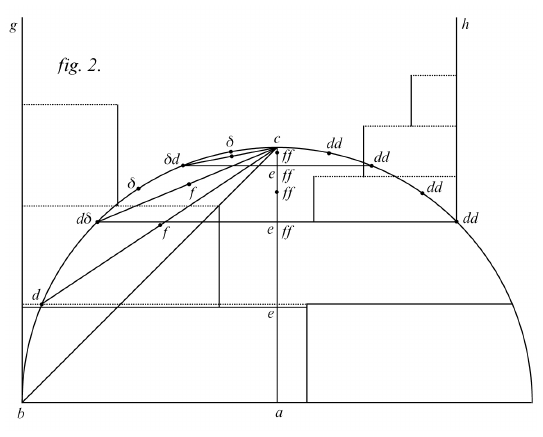
32NB. Si inventa sit summa quadratorum chordarum, et summa quadratorum sinuum rectorum, differentia eorum erit summa quadratorum sinuum versorum. Nam □CE est □CD − □DE. fig. 2. Ergo residuum summae quadratorum sinuum rectorum arcus dati a summa quadratorum sinuum rectorum arcus dimidii, quadruplicata, subtractorum aequabitur summae quadratorum sinuum versorum. Iam summa quadratorum est cylindri quaedam portio; ergo differentia inter illas duas portiones cylindricas, quae aliquando haberi potest, erit summa quadratorum sinuum versorum: eae autem erunt ut differentiae ipsorum segmentorum, multiplicatae per radium (intellige quadruplicationem).
NB. If we find the sum of the squares on the chords and the sum of the squares on the right sines, their difference will be the sum of the squares on the versed sines. For in Fig. 2, CE² = CD² − DE². Subtract the sum of the squared right sines of the given arc from four times the sum of the squared right sines of the half-arc. The remainder will equal the sum of the squared versed sines. Now a sum of squares is a certain portion of a cylinder. Thus the difference between the two cylindrical portions, which can sometimes be found, is the sum of the squares of the versed sines. These will be as the differences of the corresponding segments multiplied by the radius (understand the multiplication by four).
33Imo sic[:] summa chordarum est dupla, summa quadratorum chordarum quadrupla sinuum arcus dimidii.
[Upper margin at line 13.] Or rather thus. The sum of the chords is twice, and the sum of their squares four times, the corresponding sum for the sines of the half-arc.
34Patet hanc demonstrationem esse universalem, etiamsi arcus sit maior quadrante.
[On the opposite side.] Clearly this demonstration is universal, even if the arc exceeds a quadrant.
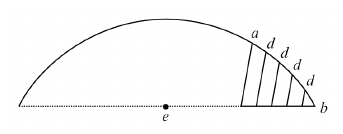
39Ut si arcus sit datus ab. et recta quaelibet be. in quam ex punctis d.d.d. arcum aequaliter secantibus dimittantur sinus, semper summa horum sinuum habebitur. Nota[:] P. Fabri cognovit tantum de arcu quadrantis in rectam deflexo; non, opinor, norat alias portiones etc. videndum tamen.
For example, take an arc ab and any straight line be, and drop sines to it from the points d, d, d dividing the arc equally. The sum of these sines will always be obtainable. Note that Father Fabri knew this only for the quadrant arc straightened out. I think he did not know it for other portions, etc., but this must be checked.
40Nota[:] datur nobis summa quadratorum sinuum versorum, datur et summa sinuum versorum, utraque est summa quadratorum sinuum rectorum certo modo divisa, eo tantum discrimine quod summa [quadratorum] sinuum versorum fit ex summa quadratoquadratorum sinuum rectorum per radium divisa. Hinc apparet summam sinuum versorum et quadratorum sinuum versorum esse symbolas, seu cognosci eorum rationem inter se (ut v.g. sunt circulus et sphaera), quod usum fortasse habere potest ad summas indagandas altiorum potestatum; aliave.
Note that we are given both the sum of the squares of the versed sines and the sum of the versed sines. Each is the sum of the squares of right sines divided in a particular manner. The difference is that the sum of the [squares] of the versed sines is formed from the sum of the fourth powers of the right sines divided by the radius. The two sums, of the versed sines and of their squares, are thus related: their ratio to each other is known, as with a circle and a sphere, for instance. This may be of use in finding sums of higher powers, or for other purposes.
41Summa sinuum versorum est quidam circulus vel sector aut segmentum circuli, ut dupliciter demonstrare possum, partim ex generali methodo de intervallo tangentium, partim etiam quia est summa quadratorum chordarum seu cylinder aliquis (cuius basis circulus aut segmentum) divisus per radium. Hinc si ista vera sunt, et verum est quod ait Pascalius de sin. prop. 4. quod summa sinuum versorum arcus aequatur differentiae inter arcum et [basin] ad quam sunt demissi sinus recti, seu distantiam sinuum extremorum; per radium multiplicatae. Quod vereor ut verum sit, daret enim quadraturam.
The sum of the versed sines is a certain circle, sector or segment. I can prove this in two ways, by the general method of tangent distances, and because it is the sum of squared chords, or a certain cylinder (with a circle or segment for base), divided by the radius. If that is true, and if Pascal is right in proposition 4 on sines, the sum of the versed sines of an arc equals the difference between the arc and the [base] to which the right sines are dropped, that is, the distance between the extreme sines, multiplied by the radius. I doubt whether this is true, for it would give the quadrature.
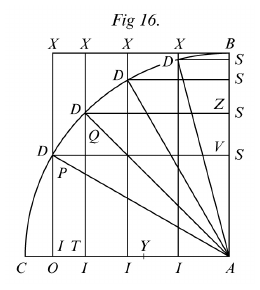
50Imo error, haec summa Pascaliana est illorum ipsorum rectangulorum, etsi haec rectangula, ut summa triangularis spatiorum curvilineum circulare complentium DDII (fig. 16) considerari possint. Datur ergo horum DDII partem circuli complentium summa simplex ipsa circularis portio, triangularis, pyramidalis. Hinc earum partium summae et reperiri quoque poterunt, si ab alia quoque parte incipiatur.
No, an error. Pascal’s sum is of those very rectangles, although these rectangles may be considered as the triangular sum of the spaces DDII filling the curvilinear circular figure (Fig. 16). Thus we are given the simple sum of these DDII filling part of the circle, namely the circular portion itself, and their triangular and pyramidal sums. The sums of these parts can therefore also be found starting from the other end.
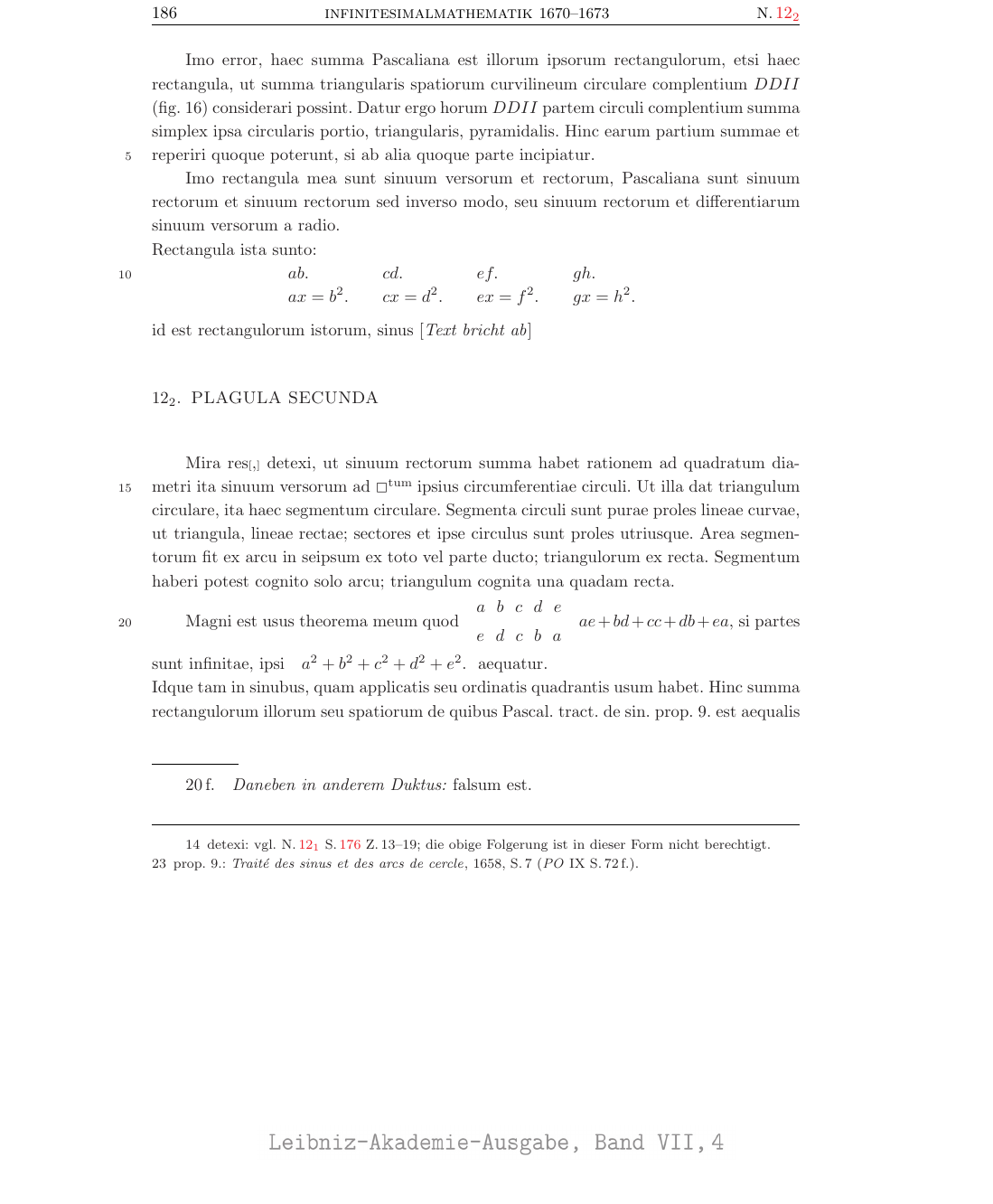
51Imo rectangula mea sunt sinuum versorum et rectorum, Pascaliana sunt sinuum rectorum et sinuum rectorum sed inverso modo, seu sinuum rectorum et differentiarum sinuum versorum a radio. Rectangula ista sunto: ab. cd. ef. gh. / ax = b². cx = d². ex = f². gx = h². id est rectangulorum istorum, sinus […]
Or rather, my rectangles are on the versed and right sines. Pascal’s are on right sines and right sines taken in the reverse order, or on the right sines and the differences of the versed sines from the radius. Let these rectangles be ab, cd, ef, gh, with ax = b², cx = d², ex = f², gx = h². That is, of these rectangles, the sine … [The text breaks off.]
5212₂. Plagula secunda.
Second sheet.
53Mira res[,] detexi, ut sinuum rectorum summa habet rationem ad quadratum diametri ita sinuum versorum ad □tum ipsius circumferentiae circuli. Ut illa dat triangulum circulare, ita haec segmentum circulare. Segmenta circuli sunt purae proles lineae curvae, ut triangula, lineae rectae; sectores et ipse circulus sunt proles utriusque. Area segmentorum fit ex arcu in seipsum ex toto vel parte ducto; triangulorum ex recta. Segmentum haberi potest cognito solo arcu; triangulum cognita una quadam recta.
A remarkable thing I have discovered. As the sum of the right sines has a ratio to the square of the diameter, so the sum of the versed sines has a ratio to the square of the circumference. As the former gives a circular triangle, the latter gives a circular segment. The segments of a circle are the pure offspring of the curved line, as triangles are of the straight line. Sectors and the circle itself are offspring of both. The area of segments is made from the arc multiplied by itself in whole or in part, that of triangles from the straight line. A segment can be obtained from the arc alone, a triangle from a certain single straight line.
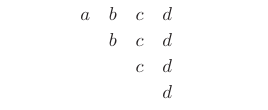
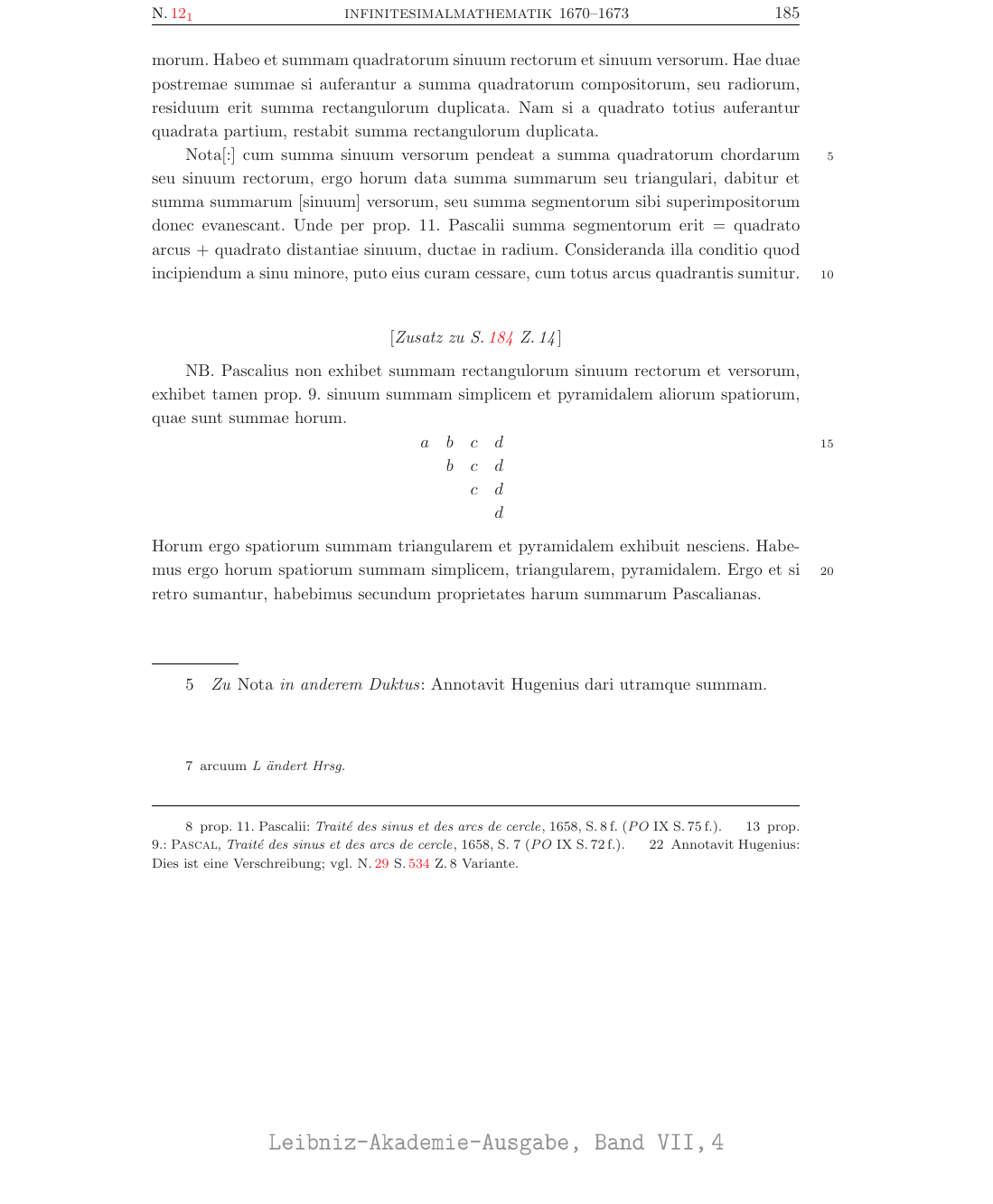
54Magni est usus theorema meum quod [a b c d e / e d c b a] ae + bd + cc + db + ea, si partes sunt infinitae, ipsi a² + b² + c² + d² + e². aequatur. Idque tam in sinubus, quam applicatis seu ordinatis quadrantis usum habet. Hinc summa rectangulorum illorum seu spatiorum de quibus Pascal. tract. de sin. prop. 9. est aequalis
Of great use is my theorem that, for the opposed rows a b c d e and e d c b a, the sum ae + bd + cc + db + ea equals a² + b² + c² + d² + e² when the parts are infinite in number. It applies to the sines as well as to the applied lines or ordinates of the quadrant. Hence the sum of those rectangles or spaces which Pascal discusses in proposition 9 of the treatise on sines equals—
55falsum est.
[Beside lines 20–21, in a different ductus.] It is false.
56summae quadratorum sinuum rectorum; idem est, si pro sinubus ordinatae. Hinc summa omnium ellipsium rectangulis inscriptorum, vel circumscriptorum aequalis summae omnium circulorum, quadratis in- vel circumscriptorum; et si sint ordinatae, summa omnium illarum ellipsium est aequalis hemisphaerio eius quadrantis revolutione geniti, quia omnes circuli eorum quadratorum hemisphaerium constituunt.
—the sum of the squares of the right sines. The same holds if we put ordinates for sines. Hence the sum of all the ellipses inscribed in or circumscribed about the rectangles equals the sum of all the circles inscribed in or circumscribed about the squares. If they are ordinates, the sum of all these ellipses equals the hemisphere generated by revolving the quadrant, because all the circles of those squares make up the hemisphere.
57Videndum an data summa triangularium et pyramidalium, ab utroque latere, dari posset summa simplex. Quoniam data summa simplici, et triangularium, et pyramidalium ab uno latere, datur et triangularium ac pyramidalium ab altero latere. Si hoc posset, haberetur quadratura circuli. Possumus enim exhibere figuras rectilineas, quae sint aequales summis triangularibus et pyramidalibus etc. quantitatum, quarundam, quarum summa sit circulus, vel quadrans circuli. Quod magni momenti esse nemo negabit.
We must see whether, given the triangular and pyramidal sums from both ends, we might obtain the simple sum. For given the simple sum and the triangular and pyramidal sums from one end, the triangular and pyramidal sums from the other are also given. If this were possible, we would have the quadrature of the circle. For we can exhibit rectilinear figures equal to the triangular and pyramidal sums, and so on, of certain quantities whose sum is the circle or a quadrant. No one will deny the importance of that.
58Adde aliam proprietatem ad adiuvandam contemplationem, omnes istas summas simplices triangularem constituentes seu quantitates esse rectangula, quorum latera habeant semper tertiam proportionalem talem, ut uni earum adiecta faciat idem, nempe radium.
Add another property to aid the inquiry. All the simple sums or quantities making up the triangular sum are rectangles. Their sides always have a third proportional which, when added to one of them, gives the same magnitude, the radius.
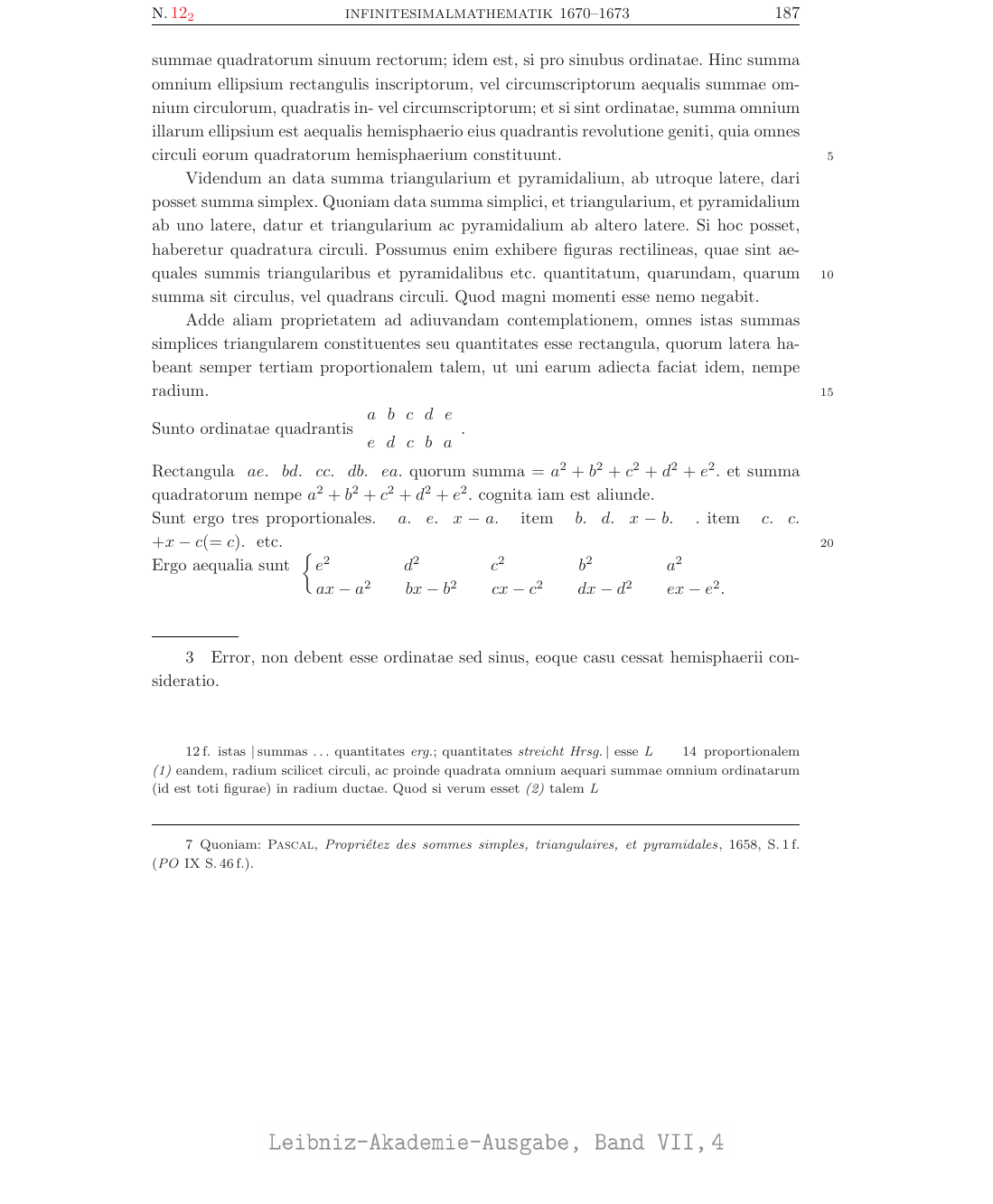
59Sunto ordinatae quadrantis [a b c d e / e d c b a]. Rectangula ae. bd. cc. db. ea. quorum summa = a² + b² + c² + d² + e². et summa quadratorum nempe a² + b² + c² + d² + e². cognita iam est aliunde. Sunt ergo tres proportionales. a. e. x − a. item b. d. x − b. item c. c. +x − c (= c). etc. Ergo aequalia sunt [e², d², c², b², a² / ax − a², bx − b², cx − c², dx − d², ex − e²].
Let the quadrant ordinates run a b c d e, and in reverse e d c b a. The rectangles are ae, bd, cc, db, ea. Their sum is a² + b² + c² + d² + e², and that sum of squares is already known from elsewhere. There are then three proportionals a, e, x − a, likewise b, d, x − b, likewise c, c, +x − c (= c), and so on. The two rows set equal are e², d², c², b², a² and ax − a², bx − b², cx − c², dx − d², ex − e².
60Error, non debent esse ordinatae sed sinus, eoque casu cessat hemisphaerii consideratio.
[Beside line 3.] Error. They ought to be sines, not ordinates, in which case the consideration of the hemisphere falls away.
61Addantur utrique aequationis parti a² + b² + c² + d² + e². fient aequalia: [2e², 2d², 2c², 2b², 2a² / ax, bx, cx, dx, ex / (a + b + c + d + e) ⌢ x].
Add a² + b² + c² + d² + e² to both sides of the equation. The following become equal: the row 2e², 2d², 2c², 2b², 2a², the row ax, bx, cx, dx, ex, and (a + b + c + d + e) times x.
62Ergo summa ordinatarum id est ipsa figura, nempe quadrans circuli, ducta in x. radium, aequabitur summae quadratorum ordinatarum duplicatae. Unde sequeretur quadrantem aequari x ⌢ (2/3)x ⌢ 2. seu 4x²/3. Si x. sit radius et circulus foret 16x²/3. Circulus autem fit ex radio et semicircumferentia, ergo 16x/3 foret semicircumferentia radio posito x. quod est absurdum.
Hence the sum of the ordinates, that is the figure itself, the quadrant of the circle, multiplied by the radius x, will equal twice the sum of the squares of the ordinates. It would follow that the quadrant equals x × (2/3)x × 2, or 4x²/3. With x as radius the circle would be 16x²/3. But the circle is the product of the radius and the semicircumference, so the semicircumference would be 16x/3 for radius x, which is absurd.
63In eo ergo error quod assumtum est ordinatim applicatas reciproce sibi iungi quod falsum est, nec fit nisi in sinubus arcuum aequaliter divisorum. Hinc ergo sequetur summam sinuum rectorum id est radii quadratum, ductam in radium seu cubum radii, aequari summae quadratorum sinuum rectorum duplicatae seu cylindro cuius basis quadrans altitudo radius quod rursus est absurdum.
The error, then, lies in assuming that the ordinates can be paired in reverse order. This is false and occurs only for the sines of equally divided arcs. It would then follow that the sum of the right sines, the radius squared, multiplied by the radius, thus the cube of the radius, equals twice the sum of the squares of the right sines, or the cylinder whose base is the quadrant and height the radius. This is absurd again.
64Error in eo est, quod summam sinuum, in radium ducendorum assumsi quasi iam ductam in arcum. Imo recte id quidem. Alius ergo error, falsa scilicet proprietas, quod a. e. x−a. mediae proportionales, nimirum a. non attingit, est tantum radii residuum, non totius diametri, sic ergo[:] x + a. e. x − a.
The error is that I took the sum of the sines to be multiplied by the radius as though it had already been multiplied by the arc. No, that part was right. It is another error, the false property that a, e, x − a are proportionals. The a falls short: what remains is from the radius alone, not the whole diameter. Thus the terms must be x + a, e, x − a.
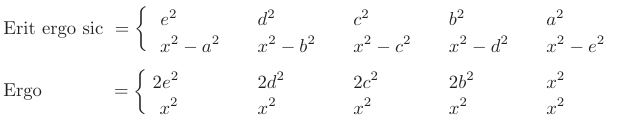
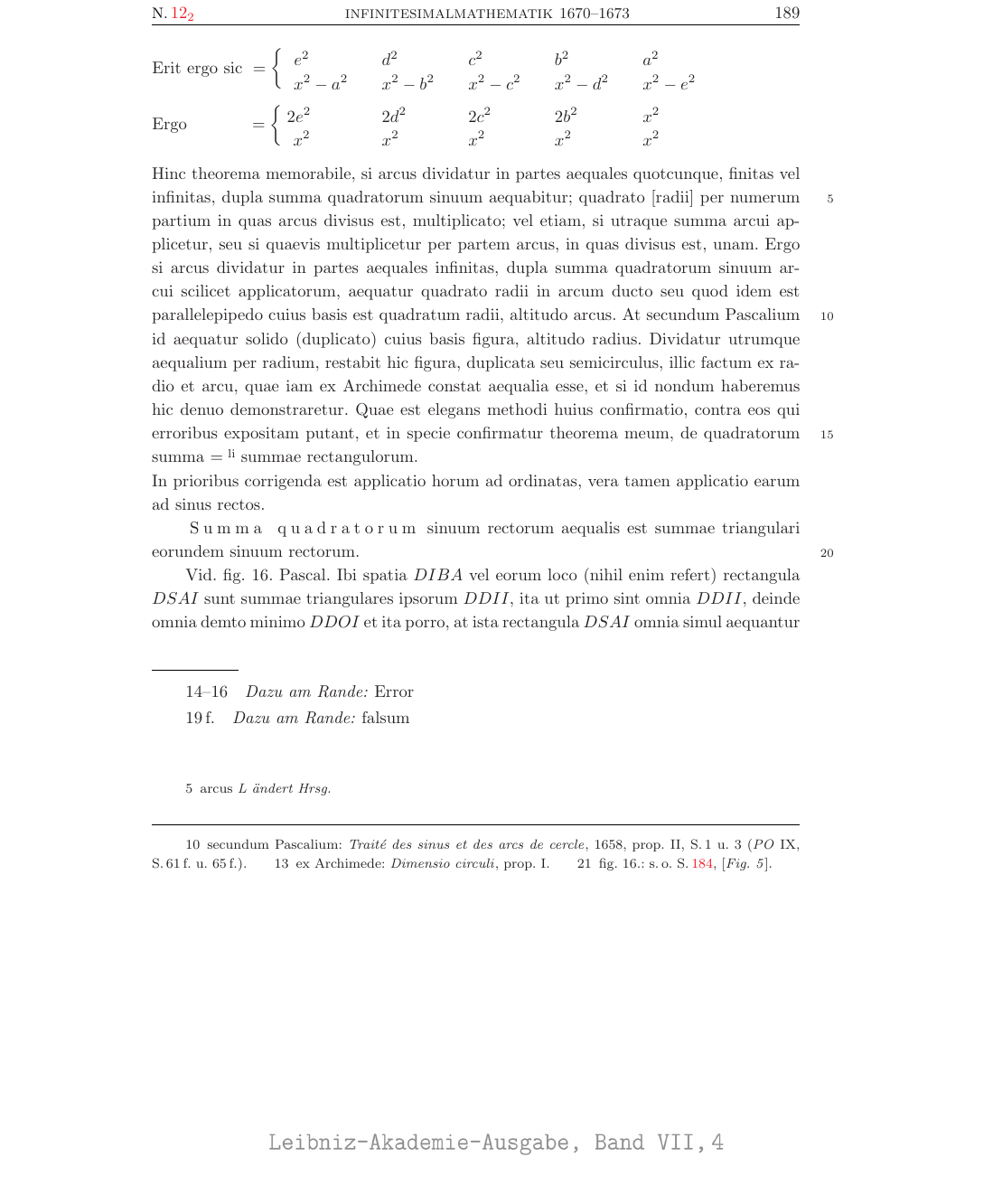
66Erit ergo sic = [e², d², c², b², a² / x² − a², x² − b², x² − c², x² − d², x² − e²]. Ergo = [2e², 2d², 2c², 2b², x² / x², x², x², x², x²].
Thus the equal rows are e², d², c², b², a² and x² − a², x² − b², x² − c², x² − d², x² − e². Therefore the next two rows are 2e², 2d², 2c², 2b², x² and x², x², x², x², x². [The last upper entry is printed x².]
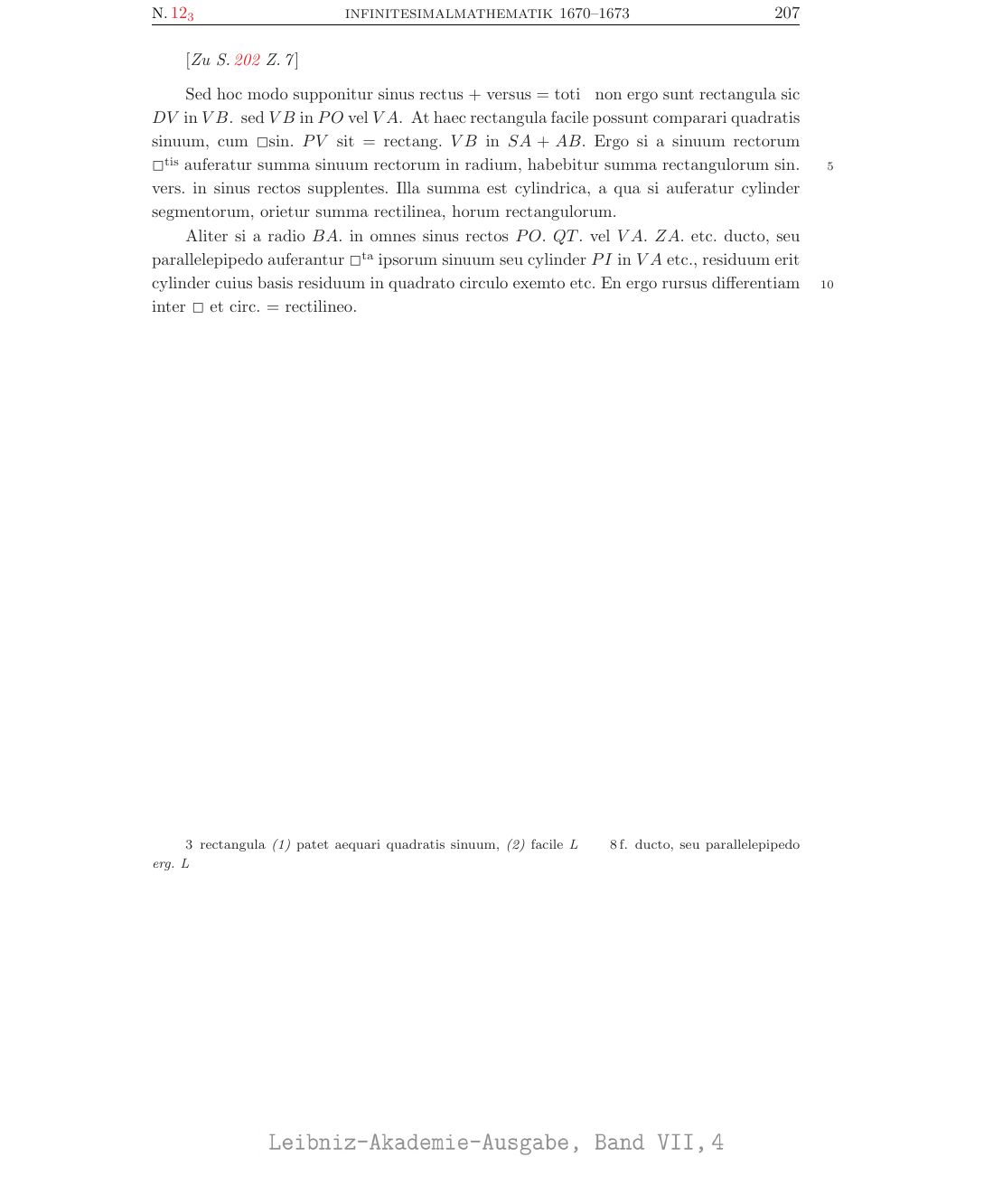
67Hinc theorema memorabile, si arcus dividatur in partes aequales quotcunque, finitas vel infinitas, dupla summa quadratorum sinuum aequabitur; quadrato [radii] per numerum partium in quas arcus divisus est, multiplicato; vel etiam, si utraque summa arcui applicetur, seu si quaevis multiplicetur per partem arcus, in quas divisus est, unam. Ergo si arcus dividatur in partes aequales infinitas, dupla summa quadratorum sinuum arcui scilicet applicatorum, aequatur quadrato radii in arcum ducto seu quod idem est parallelepipedo cuius basis est quadratum radii, altitudo arcus. At secundum Pascalium id aequatur solido (duplicato) cuius basis figura, altitudo radius. Dividatur utrumque aequalium per radium, restabit hic figura, duplicata seu semicirculus, illic factum ex radio et arcu, quae iam ex Archimede constat aequalia esse, et si id nondum haberemus hic denuo demonstraretur. Quae est elegans methodi huius confirmatio, contra eos qui erroribus expositam putant, et in specie confirmatur theorema meum, de quadratorum summa = li summae rectangulorum.
Hence a memorable theorem. Divide an arc into any number of equal parts, finite or infinite. Twice the sum of the squared sines will equal the square of the [radius] multiplied by the number of parts. This holds also if both sums are applied to the arc, each being multiplied by one of its parts. Thus if the arc is divided into infinitely many equal parts, twice the sum of its squared sines applied to the arc equals the square of the radius multiplied by the arc, in other words the parallelepiped with the square of the radius for base and the arc for height. According to Pascal this equals the (doubled) solid whose base is the figure and height the radius. Divide both equal magnitudes by the radius. On one side the doubled figure or semicircle remains, on the other the product of the radius and the arc. Archimedes has already shown these to be equal. If we did not know it, we should have a fresh demonstration here. This is an elegant confirmation of the method against those who think it prone to error. In particular it confirms my theorem equating the sum of the squares with the sum of the rectangles.
68In prioribus corrigenda est applicatio horum ad ordinatas, vera tamen applicatio earum ad sinus rectos. Summa quadratorum sinuum rectorum aequalis est summae triangulari eorundem sinuum rectorum.
The previous application to ordinates must be corrected. Their application to right sines is nevertheless true. The sum of the squares of the right sines equals the triangular sum of those same right sines.
69Vid. fig. 16. Pascal. Ibi spatia DIBA vel eorum loco (nihil enim refert) rectangula DSAI sunt summae triangulares ipsorum DDII, ita ut primo sint omnia DDII, deinde omnia demto minimo DDOI et ita porro, at ista rectangula DSAI omnia simul aequantur
See Pascal’s Fig. 16. There the spaces DIBA, or equivalently the rectangles DSAI, are triangular sums of the DDII. First come all the DDII, then all less the smallest DDOI, and so forth. But all these rectangles DSAI taken together equal—
70Error. Falsum.
[In the margin at lines 14–16.] Error. [At lines 19–20.] False.
71quadratis omnium sinuum. Ergo summae triangulares sinuum, aequantur summae quadratorum sinuum. Idem eodem modo demonstratur in sinubus versis, in trilineo DXB ductis summam triangularem sinuum versorum, et quod idem est summam segmentorum aequari summae quadratorum sinuum versorum.
—the squares of all the sines. Hence the triangular sums of the sines equal the sum of their squares. The same demonstration for the versed sines drawn in the three-sided figure DXB shows that their triangular sum, or equivalently the sum of the segments, equals the sum of the squares of the versed sines.
72Porro summam quadratorum sinuum versorum eodem modo inveniemus quo summam sinuum versorum invenimus; partim per intervalla tangentium, dum nimirum quodlibet segmentum cogitatur super quolibet triangulo illo comprehenso inter duas chordas ex eodem puncto et tangente intervallum eius puncti a tangente erectum, seu in id triangulum ductum; partim per illam methodum, qua summa quadratorum sinuum rectorum, detrahitur a summa quadratorum sinuum, totorum BA. [XI.] in arcum DB. ductorum, residuum erit summa quadratorum versorum, et etiam summa triangularium eorundem.
We shall find the sum of the squares of the versed sines as we found the sum of the versed sines. One way uses the distances of tangents. Imagine each segment erected on, or multiplied by, the triangle between two chords drawn from the same point and a tangent, with the distance of that point from the tangent. Another way subtracts the sum of the squared right sines from the sum of the squares of the whole sines BA, [XI], multiplied by the arc DB. The remainder will be the sum of the squared versed sines and also the sum of their triangular sums.
73Ita qualibet summa sinuum rectorum inventa invenietur quaelibet summa similis sinuum versorum, modo inveniatur quaelibet summa similis sinuum totorum. At quaelibet summa sinuum totorum scilicet in arcum ductorum, invenietur inventa qualibet summa sinuum totorum in distantiam sinuum extremorum [AO.] nam eae erunt inter se semper ut arcus DB. ad illam rectam AO. At vero summae illae simplices, triangulares, pyramidales, tum ipsorum sinuum totorum seu radiorum, tum ipsorum quadratorum, cuborum applicatorum ad AO. semper inveniri possunt, in infinitum et coincidunt cum sinuum rectorum summis, quae proinde etiam inveniri possunt in infinitum. Ergo nihil aliud opus est ad summas sinuum versorum indagandas, quam summas istas sinuum rectorum multiplicare per rationem arcus DB. ad rectam AO. et a producto auferre sinuum rectorum summam similem.
Thus, from any sum of right sines we can find the like sum of versed sines, provided we find the like sum of whole sines. Now any sum of whole sines multiplied by the arc can be found from its counterpart multiplied by the distance [AO] between the extreme sines. The two always stand as the arc DB to the straight line AO. The simple, triangular and pyramidal sums, both of the whole sines or radii and of their squares and cubes applied to AO, can always be found, without end. They coincide with the sums of right sines, which therefore can also be found without end. To discover the sums of the versed sines we need only multiply these sums of right sines by the ratio of the arc DB to the line AO and subtract the like sum of the right sines from the product.
74Hinc intelligi potest summas sinuum rectorum in [arcum] ductas vel totorum in rectam dare figuras quadrato diametri vel radii seu producto ex recta in se commensurabiles; summas sinuum totorum in arcum ductas, dare figuras circulo, id est producto ex recto et arcu commensurabiles[;] summas sinuum versorum in arcum ductas, dare figuras
Thus the sums of the right sines multiplied by the [arc], or of the whole sines multiplied by the straight line, give figures commensurable with the square of the diameter or radius, a straight line multiplied by itself. The sums of the whole sines multiplied by the arc give figures commensurable with the circle, the product of a straight line and an arc. The sums of the versed sines multiplied by the arc give figures—
75verum
[Above “Furthermore,” line 5.] True.
76Non ita de summa quadratorum, cuborum, bene tamen de summa ▽ˡᵃʳⁱᵘᵐ, pyramidalium etc.
[Beside lines 12–13, in a different ductus.] This does not hold for the sum of the squares or cubes, but it does for the triangular and pyramidal sums, etc.
77segmentis commensurabiles, seu dare figuras productis ex arcu in seipsum commensurabiles. Unde intelligi potest: circulos eorumque sectores esse figuras productis ex recta et arcu commensurabiles[;] figuras rectilineas inscriptas vel circumscriptas esse quantitates soli rectae, aut productis ex recta in seipsam ducta commensurabiles; tandem segmenta circuli esse figuras soli arcui, seu productis ex arcu in seipsum ducto commensurabiles. Quod hactenus ostendit nemo.
—commensurable with segments, that is, figures commensurable with products of an arc and itself. Thus circles and their sectors are commensurable with products of a straight line and an arc. Inscribed or circumscribed rectilinear figures are quantities commensurable with the straight line alone, or with products of that line and itself. Finally, circular segments are figures commensurable with the arc alone, or with products of that arc and itself. No one has shown this hitherto.
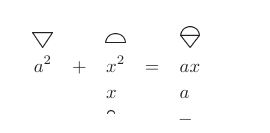
78Nemo enim dedit rationem segmenti ad suam rectam, ut admirari libeat consilium naturae, in obstruendis omnibus aditibus ad tetragonismum. Si enim recta ponatur a. et curva x. circulus erit commensurabilis ax. rectilinea figura inscripta vel circumscripta commensurabilis a². segmentum commensurabile x². Iam segmentum additum figurae rectilineae facit circulum vel eius sectorem ergo aequatio talis oritur a² + x² = ax.
No one has given the ratio of a segment to its straight line. One may well marvel at nature’s design in barring every approach to quadrature. For if a is the straight line and x the curve, the circle will be commensurable with ax, the inscribed or circumscribed straight-sided figure with a², and the segment with x². The segment added to the rectilinear figure makes the circle or its sector. An equation of the form a² + x² = ax therefore arises.
79Nam Euclidis Elementa nobis ostendunt quomodo quaedam figurae rectilineae circulo inscriptae; [quae] scilicet geometrice construi possunt, seu cum angulus geometrice haberi potest sint diametro quem dicamus a. in se ducto, commensurabiles. Archimedes ostendit, quomodo circulus et sectores sint commensurabiles arcui suo (et quidem quoties arcus geometrice haberi potest circumferentiae, quam ponamus dici x), sed ducto in radium. Ego vero hoc loco ostendi, quomodo segmentum quodlibet sit commensurabile arcui suo [quod incredibile videri poterat, nisi demonstrationem haberemus, figuram scilicet mixtilineam ex sola sua curva produci posse (quemadmodum lunula producitur ex sola quadam rectilinea)], et quoties is angulus geometrice habetur circumferentiae.
Euclid’s Elements show how certain rectilinear figures inscribed in a circle, namely [those] that one can construct geometrically, or when the angle can be obtained geometrically, are commensurable with the diameter a multiplied by itself. Archimedes showed how the circle and its sectors are commensurable with their arc multiplied by the radius (and, whenever the arc can be obtained geometrically, with the circumference, which we call x, so multiplied). Here I have shown how any segment is commensurable with its arc [a seemingly incredible thing, had we no demonstration: that a figure with mixed boundaries can be produced from its curve alone, just as a lune is produced from a certain rectilinear figure alone], and, whenever the angle is given geometrically, with the circumference.
80Hinc patet dimensiones figurarum in circulo uno eodemque ad tria summa capita reduci; dimensionem figurarum rectilinearum circuli Euclideam, per radium solum in se partesque suas ductum; dimensionem Archimedeam sectorum, per radium et arcum; in se invicem partesve unum alterius ductos; ac denique dimensionem nostram segmentorum per arcum solum in se partesque suas ductum. Sunt enim primariae figurae circulares: sector (quorum maximus est ipse circulus), triangulum sectoris (ex quorum pluribus fit polygonum inscriptum regulare aut irregulare), ac denique segmentum. Triangulorum dimensionem ex dato radio debemus Euclidi; sectorum, et dato radio et arcu, Archimedi; segmentorum ex dato solo arcu, ausim vendicare mihi.
Thus the measurements of figures in one and the same circle reduce to three principal kinds. Euclid’s measurement of rectilinear figures uses the radius alone, multiplied by itself and its parts. Archimedes’ measurement of sectors uses the radius and the arc, each multiplied by the other or by the other’s parts. Finally, our measurement of segments uses the arc alone, multiplied by itself and its parts. For the primary circular figures are the sector, the greatest sector being the circle itself, the triangle of the sector, several of which make a regular or irregular inscribed polygon, and finally the segment. We owe the measurement of triangles from the given radius to Euclid, and that of sectors from both radius and arc to Archimedes. The measurement of segments from the arc alone I would venture to claim for myself.
81Cum autem sector fiat ex triangulo et segmento iunctis, hinc aequatio ita a² + x² = ax. Sed illa aequatio dare non potest, rationem ipsius a. ad ipsum x. ut cuivis patet. Hinc ad rationem a. ad x. inveniendam opus est adhuc alia quadam aequatione, ut si quemadmodum nos reperimus segmentum gigni ex solo arcu, et Archimedes sectorem ex arcu et radio, alius quispiam inveniat modum producendi segmentum ex arcu et recta, vel sectorem ex arcu solo, vel triangulum ex arcu solo, vel segmentum ex recta sola, quodlibet horum, dabit quadraturam circuli.
Since a sector is formed by joining a triangle and a segment, the equation is a² + x² = ax. But this equation cannot give the ratio of a to x, as is evident to anyone. To discover the ratio we still need another equation. Just as we found that the segment is generated from the arc alone, and Archimedes the sector from arc and radius, let someone find a way of producing the segment from arc and straight line, the sector from arc alone, the triangle from arc alone, or the segment from straight line alone. Any of these will give the quadrature of the circle.
82Porro cum sit a² + x² = ax. erit x² = ax − a². Patet locum huius aequationis esse parabolicum, nam aequatio talis y² = ax − a². est parabolica, ut patet. Iam si ponatur y² = x². non ideo minus aequatio parabolica erit, seu cuius locus est parabola. Id ergo videmur obtinuisse, ut hoc pacto quadratura circuli devenerit problema solidum solubile, et construi possit, quemadmodum problemata solida omnia. Sed in eo malum est, quod una tantum est cognita a². Si quaedam b. aequationem ingrederetur, tunc solvi posset problema ope parabolae, deberet nimirum fieri aequatio talis posito y = x. y² = ax − b². vel x² = [ay] − b².
Since a² + x² = ax, we have x² = ax − a². The locus of this equation is plainly parabolic, for an equation y² = ax − a² is parabolic. Putting y² = x² does not make it any the less an equation whose locus is a parabola. In this way we seem to have reduced the quadrature to a solvable solid problem, constructible like all solid problems. The difficulty is that only a² is known. If some b entered the equation, the problem could be solved by means of a parabola. On putting y = x the equation would have to take the form y² = ax − b² or x² = [ay] − b².
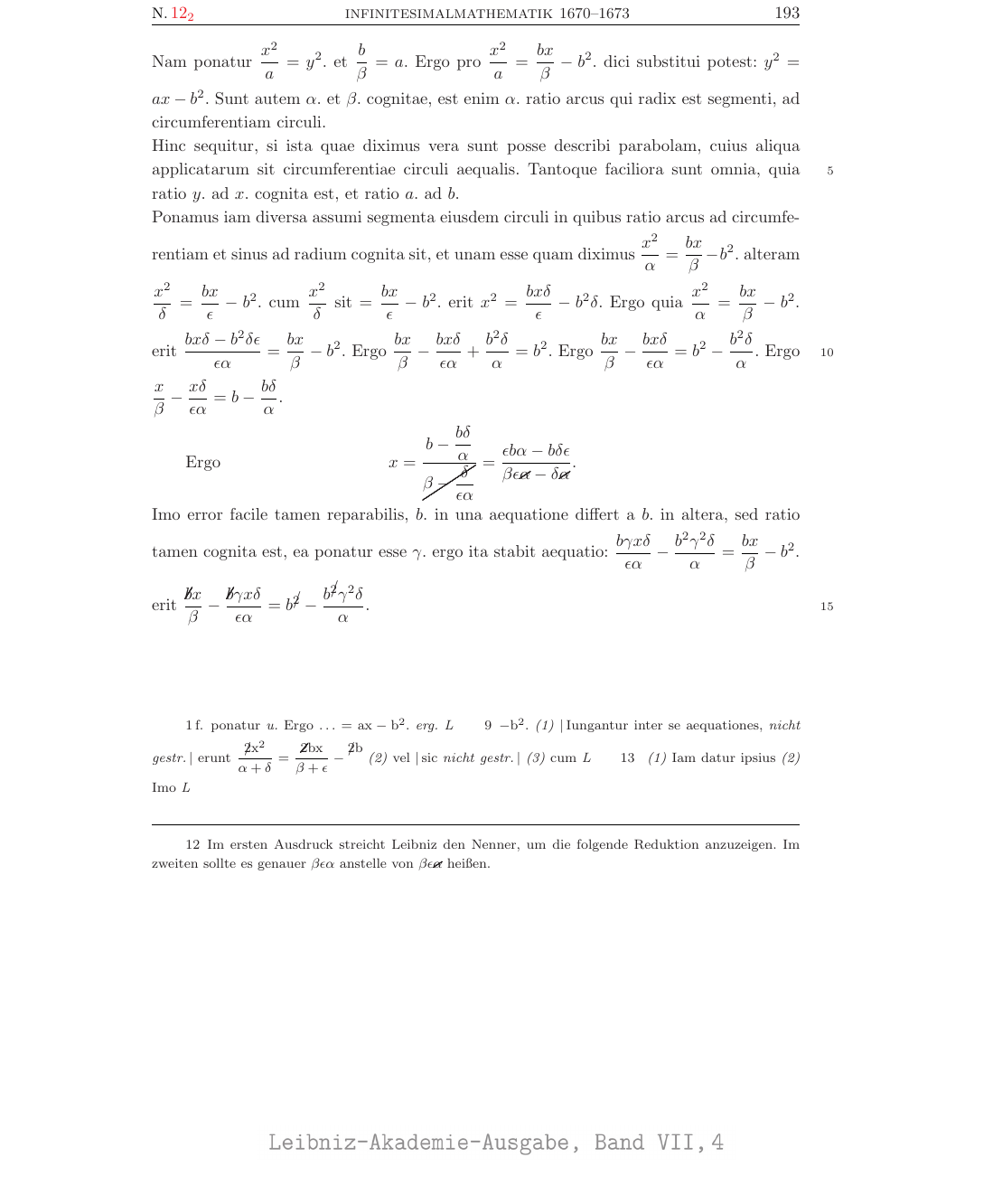
83haberemus solutionem saltem per parabolam, seu locum solidum. Quare si quis exhibere posset segmentum circuli aequale cuidam sectori cuius arcus est radix segmenti demto quodam quadrato cuius radix est alia a radio. Sed his non opus, sufficit prior illa aequatio: x²/α = bx/β − b².
We would at least have a solution by a parabola, a solid locus. Thus, if someone could exhibit a circular segment equal to a certain sector whose arc is the root of the segment less a certain square whose root differs from the radius … But this is unnecessary. The former equation suffices: x²/α = bx/β − b².
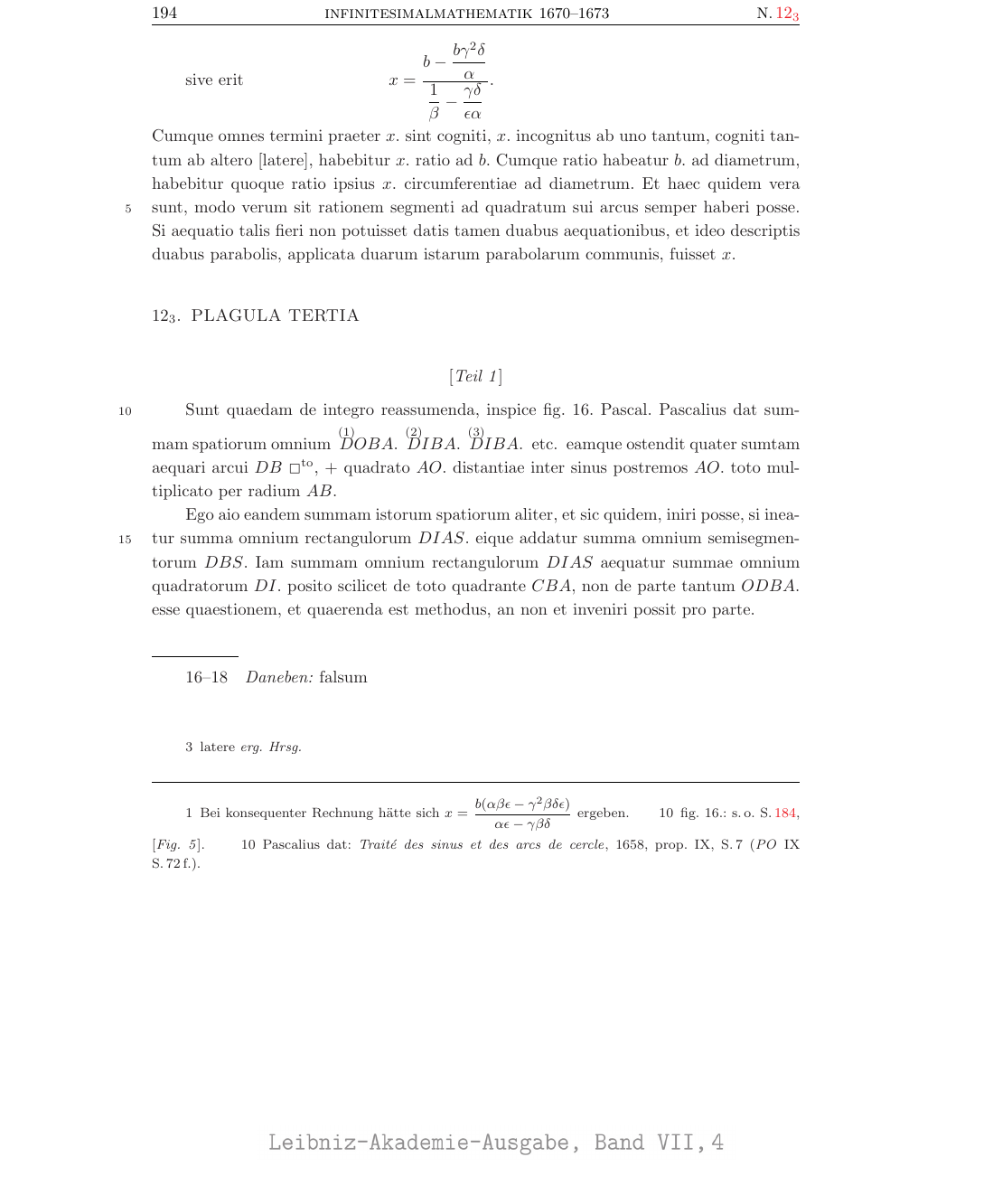
90sive erit x = (b − bγ²δ/α)/(1/β − γδ/(εα)). Cumque omnes termini praeter x. sint cogniti, x. incognitus ab uno tantum, cogniti tantum ab altero [latere], habebitur x. ratio ad b. Cumque ratio habeatur b. ad diametrum, habebitur quoque ratio ipsius x. circumferentiae ad diametrum. Et haec quidem vera sunt, modo verum sit rationem segmenti ad quadratum sui arcus semper haberi posse.
Or x = (b − bγ²δ/α)/(1/β − γδ/(εα)). Since all the terms except x are known, the unknown x is on one side alone and the known terms on the other [side] alone, so the ratio of x to b will be obtained. Given the ratio of b to the diameter, we shall also obtain the ratio of the circumference x to the diameter. All this holds provided it is true that the ratio of a segment to the square of its arc can always be found.
91Si aequatio talis fieri non potuisset datis tamen duabus aequationibus, et ideo descriptis duabus parabolis, applicata duarum istarum parabolarum communis, fuisset x.
Had it been impossible to form such an equation, we should still have had two equations, and consequently two parabolas could have been drawn. Their common ordinate would have been x.
9212₃. Plagula tertia. [Teil 1.]
Third sheet. Part 1.
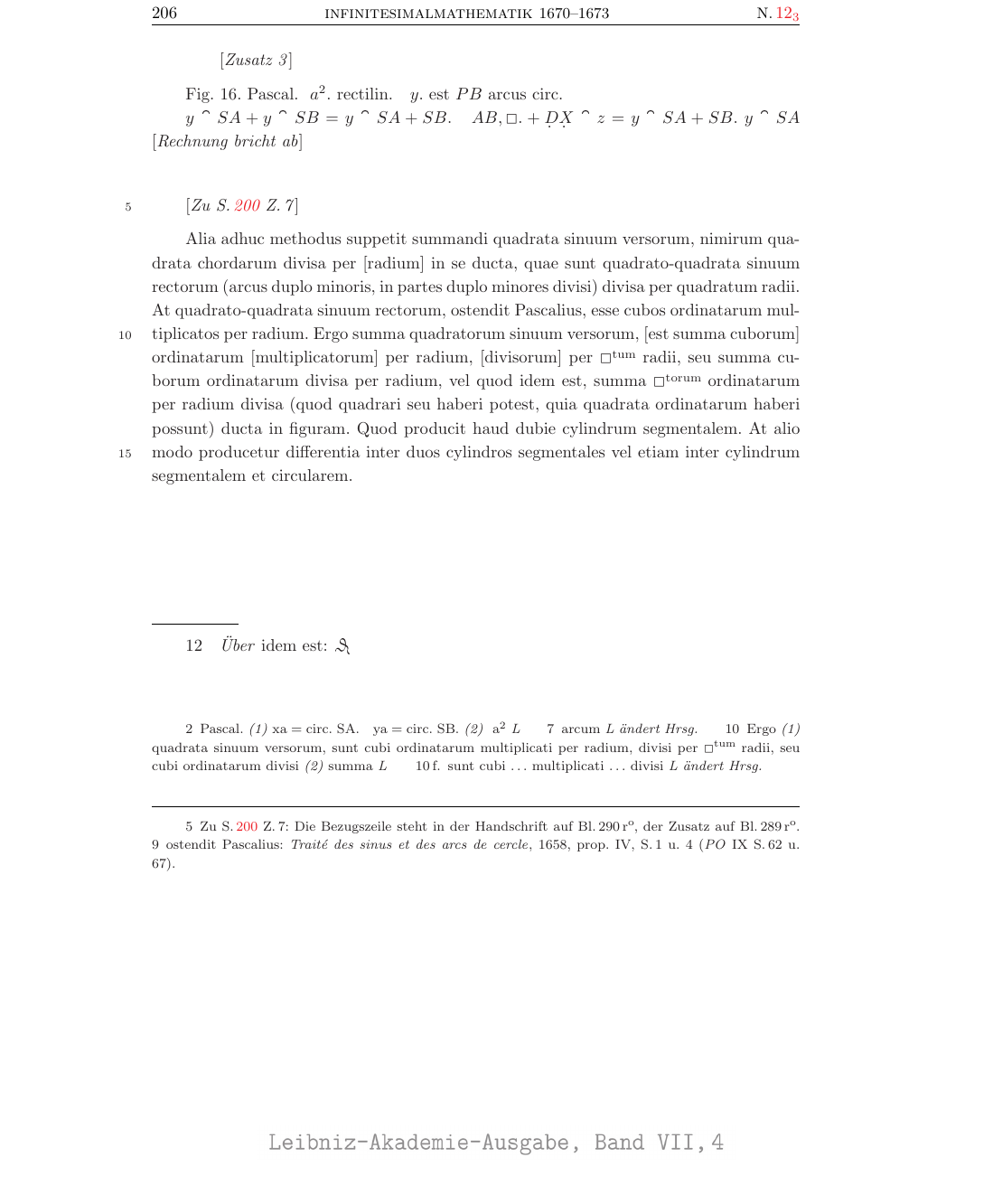
93Sunt quaedam de integro reassumenda, inspice fig. 16. Pascal. Pascalius dat summam spatiorum omnium ⁽¹⁾DOBA. ⁽²⁾DIBA. ⁽³⁾DIBA. etc. eamque ostendit quater sumtam aequari arcui DB □to, + quadrato AO. distantiae inter sinus postremos AO. toto multiplicato per radium AB.
Some things must be taken up afresh. Look at Pascal’s Fig. 16. Pascal gives the sum of all the spaces DOBA, DIBA, DIBA, and so forth (marked 1, 2, 3). He shows that four times their sum equals the square of the arc DB plus the square of AO, the distance between the extreme sines, the whole multiplied by the radius AB.
94Ego aio eandem summam istorum spatiorum aliter, et sic quidem, iniri posse, si ineatur summa omnium rectangulorum DIAS. eique addatur summa omnium semisegmentorum DBS. Iam summam omnium rectangulorum DIAS aequatur summae omnium quadratorum DI. posito scilicet de toto quadrante CBA, non de parte tantum ODBA. esse quaestionem, et quaerenda est methodus, an non et inveniri possit pro parte.
I say this same sum can be obtained differently. Take the sum of all the rectangles DIAS and add that of all the half-segments DBS. Now the sum of the rectangles DIAS equals that of all the squares on DI, provided we are dealing with the entire quadrant CBA and not merely the part ODBA. We must seek a method and see whether it can be found for a part as well.
95falsum
[Beside lines 16–18.] False.
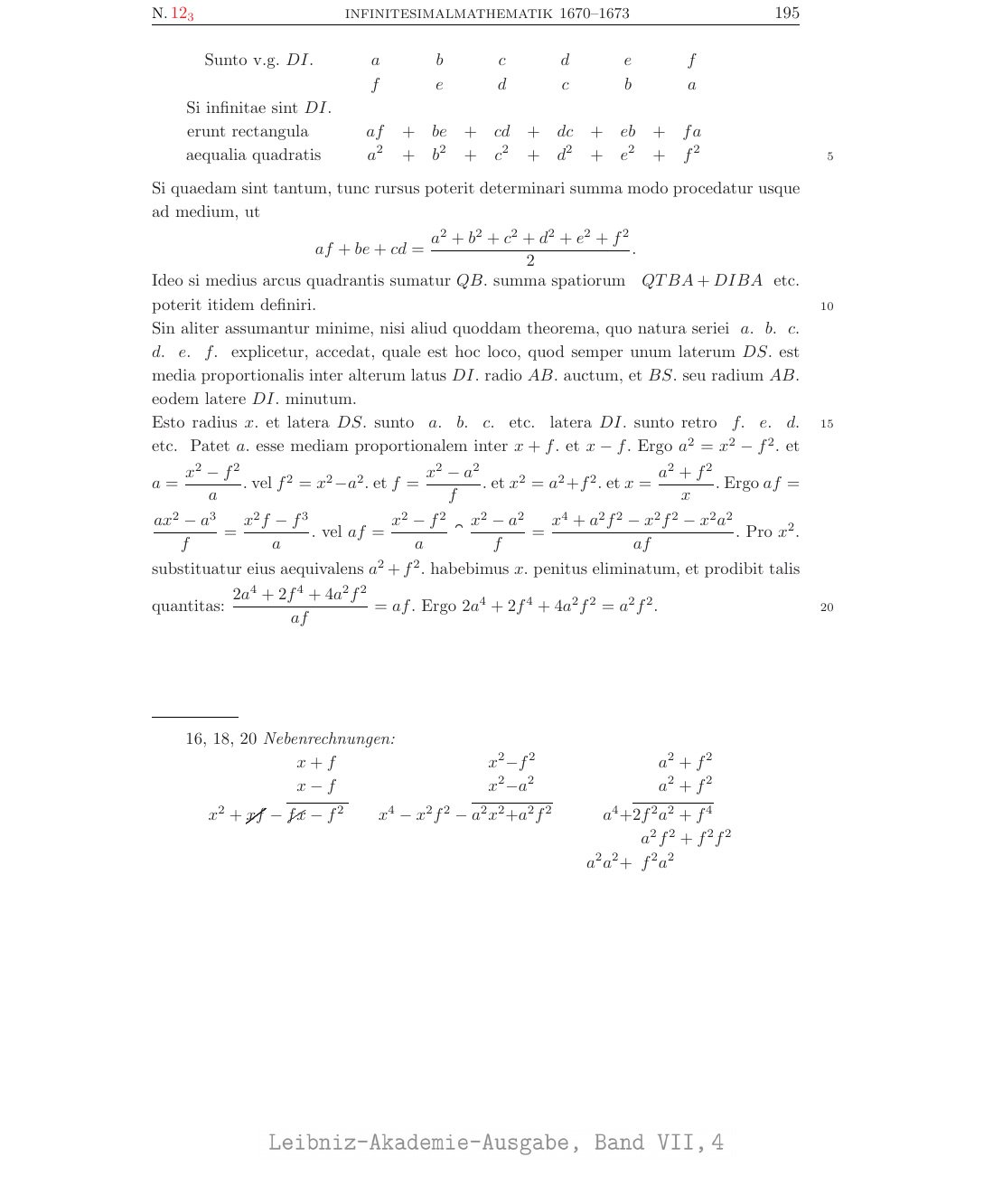
96Sunto v.g. DI. [a b c d e f / f e d c b a]. Si infinitae sint DI. erunt rectangula af + be + cd + dc + eb + fa aequalia quadratis a² + b² + c² + d² + e² + f².
Let the DI, for example, run a b c d e f and in reverse f e d c b a. If there are infinitely many DI, the rectangles af + be + cd + dc + eb + fa will equal the squares a² + b² + c² + d² + e² + f².
97Si quaedam sint tantum, tunc rursus poterit determinari summa modo procedatur usque ad medium, ut af + be + cd = (a² + b² + c² + d² + e² + f²)/2. Ideo si medius arcus quadrantis sumatur QB. summa spatiorum QTBA + DIBA etc. poterit itidem definiri.
If only some are taken, their sum can again be determined provided we go as far as the middle. Thus af + be + cd = (a² + b² + c² + d² + e² + f²)/2. Hence if we take QB, half the quadrant arc, the sum of the spaces QTBA + DIBA, etc., can likewise be determined.
98Sin aliter assumantur minime, nisi aliud quoddam theorema, quo natura seriei a. b. c. d. e. f. explicetur, accedat, quale est hoc loco, quod semper unum laterum DS. est media proportionalis inter alterum latus DI. radio AB. auctum, et BS. seu radium AB. eodem latere DI. minutum.
If they are taken otherwise, it cannot be done unless another theorem is added explaining the nature of the series a, b, c, d, e, f. Here we have such a theorem: one side DS is always a mean proportional between the other side DI augmented by the radius AB, and BS, that is, the radius AB diminished by the same side DI.
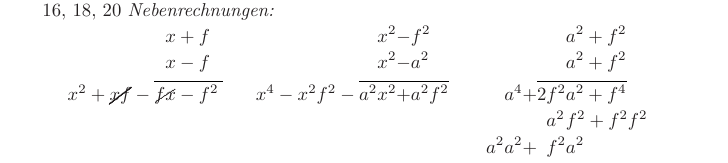
99Esto radius x. et latera DS. sunto a. b. c. etc. latera DI. sunto retro f. e. d. etc. Patet a. esse mediam proportionalem inter x + f. et x − f. Ergo a² = x² − f². et a = (x² − f²)/a. vel f² = x² − a². et f = (x² − a²)/f. et x² = a² + f². et x = (a² + f²)/x. Ergo af = (ax² − a³)/f = (x²f − f³)/a. vel af = ((x² − f²)/a) ⌢ ((x² − a²)/f) = (x⁴ + a²f² − x²f² − x²a²)/(af). Pro x². substituatur eius aequivalens a² + f². habebimus x. penitus eliminatum, et prodibit talis quantitas: (2a⁴ + 2f⁴ + 4a²f²)/(af) = af. Ergo 2a⁴ + 2f⁴ + 4a²f² = a²f².
Let the radius be x, the sides DS be a, b, c, etc., and the sides DI in reverse order f, e, d, etc. Then a is the mean proportional between x + f and x − f. Thus a² = x² − f² and a = (x² − f²)/a. Or f² = x² − a² and f = (x² − a²)/f. Also x² = a² + f² and x = (a² + f²)/x. Hence af = (ax² − a³)/f = (x²f − f³)/a. Or af = [(x² − f²)/a] × [(x² − a²)/f] = (x⁴ + a²f² − x²f² − x²a²)/(af). Substitute a² + f² for x². This eliminates x altogether and gives the quantity (2a⁴ + 2f⁴ + 4a²f²)/(af) = af. Hence 2a⁴ + 2f⁴ + 4a²f² = a²f².
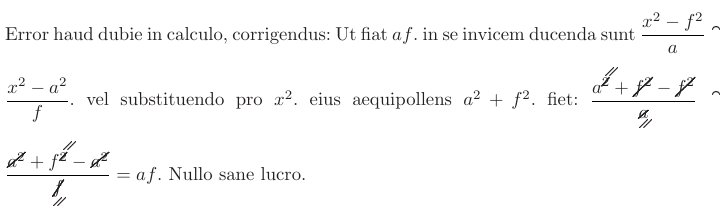
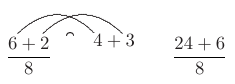
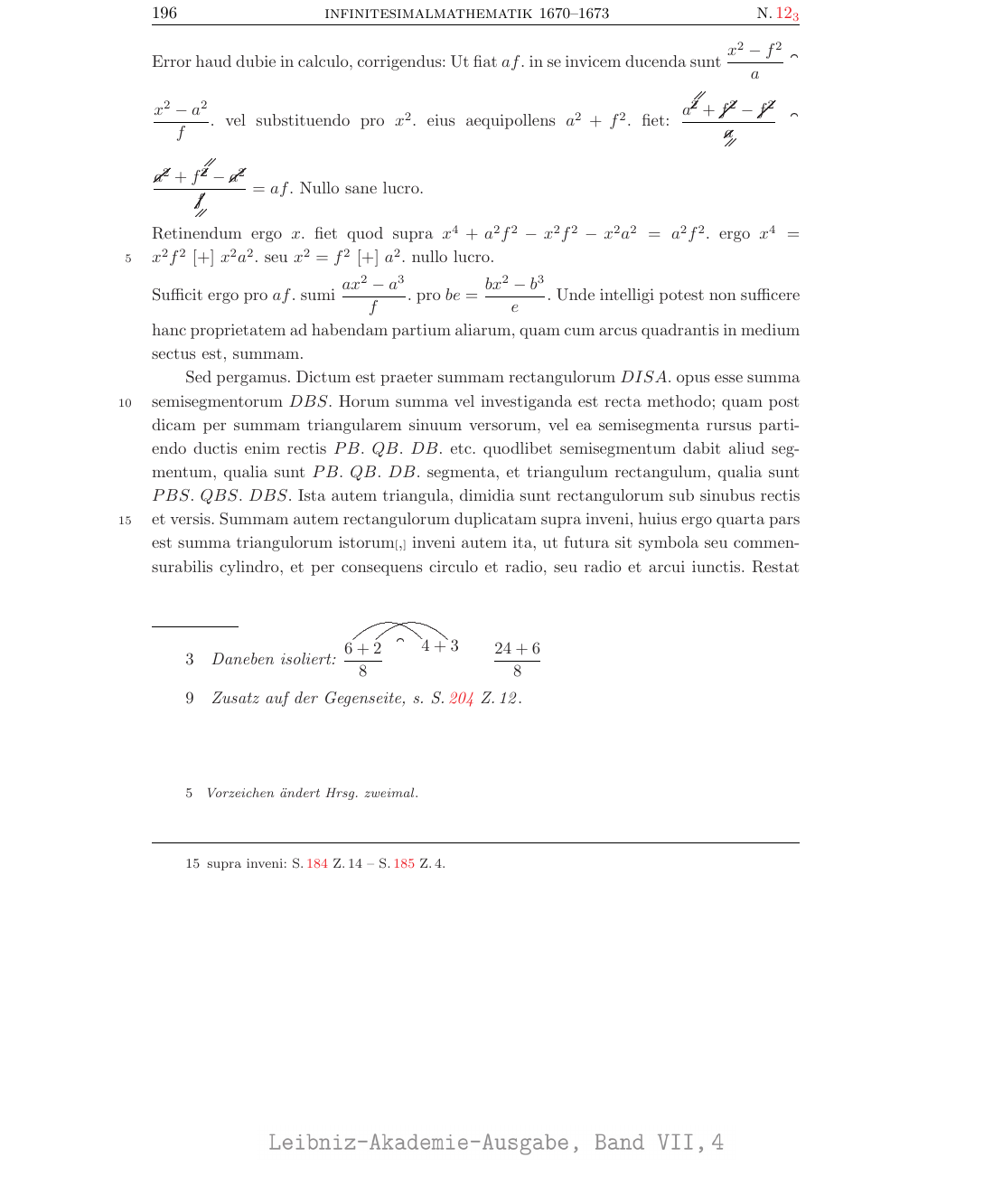
101Error haud dubie in calculo, corrigendus: Ut fiat af. in se invicem ducenda sunt ((x² − f²)/a) ⌢ ((x² − a²)/f). vel substituendo pro x². eius aequipollens a² + f². fiet: ((a² + f² − f²)/a) ⌢ ((a² + f² − a²)/f) = af. Nullo sane lucro.
There is undoubtedly an error in the calculation. It must be corrected. To make af we must multiply (x² − f²)/a by (x² − a²)/f. Substituting a² + f² for x² gives [(a² + f² − f²)/a] × [(a² + f² − a²)/f] = af, with the cancellations shown. We have certainly gained nothing.
102Retinendum ergo x. fiet quod supra x⁴ + a²f² − x²f² − x²a² = a²f². ergo x⁴ = x²f² [+] x²a². seu x² = f² [+] a². nullo lucro. Sufficit ergo pro af. sumi (ax² − a³)/f. pro be = (bx² − b³)/e. Unde intelligi potest non sufficere hanc proprietatem ad habendam partium aliarum, quam cum arcus quadrantis in medium sectus est, summam.
We must therefore retain x. We get the earlier x⁴ + a²f² − x²f² − x²a² = a²f². Hence x⁴ = x²f² [+] x²a², or x² = f² [+] a², with no gain. It suffices then to take (ax² − a³)/f for af and (bx² − b³)/e for be. Thus we see that this property does not suffice to give the sum for other parts than when the arc of the quadrant is bisected.
103Sed pergamus. Dictum est praeter summam rectangulorum DISA. opus esse summa semisegmentorum DBS. Horum summa vel investiganda est recta methodo; quam post dicam per summam triangularem sinuum versorum, vel ea semisegmenta rursus partiendo ductis enim rectis PB. QB. DB. etc. quodlibet semisegmentum dabit aliud segmentum, qualia sunt PB. QB. DB. segmenta, et triangulum rectangulum, qualia sunt PBS. QBS. DBS. Ista autem triangula, dimidia sunt rectangulorum sub sinubus rectis et versis. Summam autem rectangulorum duplicatam supra inveni, huius ergo quarta pars est summa triangulorum istorum[,] inveni autem ita, ut futura sit symbola seu commensurabilis cylindro, et per consequens circulo et radio, seu radio et arcui iunctis. Restat
To proceed, we said that besides the sum of the rectangles DISA we need that of the half-segments DBS. We must find it either directly, as I shall explain later, through the triangular sum of the versed sines, or by dividing the half-segments again. Draw the straight lines PB, QB, DB, and so forth. Each half-segment gives another segment, such as PB, QB, DB, and a right triangle such as PBS, QBS, DBS. These triangles are half the rectangles on the right and versed sines. Above I found twice the sum of the rectangles. One quarter of that is therefore the sum of these triangles. I found it to be related or commensurable with a cylinder, and consequently with circle and radius, or with radius and arc together. It remains—
105invenire summam segmentorum PB. QB. DB. etc. at ea nihil aliud est quam summa triangularis sinuum versorum.
—to find the sum of the segments PB, QB, DB, etc. It is simply the triangular sum of the versed sines.
106Summam autem triangularem sinuum versorum, ut et pyramidalem, etc. invenimus duobus modis: inventa summa triangulari quadratorum chordarum (per summam triangularem quadratorum sinuum rectorum arcus praecedentis), eaque divisa per radium (vel diametrum, videndum in superioribus), ita enim habebitur summa triangularis sinuum versorum; et sic quoque inventa summa triangulari sinuum totorum ab eaque subtracta summa triangulari sinuum rectorum, quia semper sinus versus additus recto facit totum ID + SB = AB. Sed quia fieri potest, ut tota DI. non utamur, sed recta tantum ex punctis D. demissa in aliquam DS. tunc loco sinus totius adhiberi debet sinus versus maximus ut BZ. si arcus sit BD. Patet enim omnes sinus rectos arcus, seu rectas demissas ex D. in QZ. (nam et has appello sinus rectos) additis sinubus versis respondentibus constituere aequales rectas ZB. Summa autem horum sinuum, non datur quidem apud Pascalium, ast ego ita invenio.
We found the triangular sum of the versed sines, and their pyramidal sum and so on, in two ways. First find the triangular sum of the squared chords (through the triangular sum of the squared right sines of the preceding arc) and divide by the radius, or by the diameter: check above. This gives the triangular sum of the versed sines. Or find the triangular sum of the whole sines and subtract that of the right sines. For the versed sine added to the right sine always makes the whole: ID + SB = AB. However, one may use only the line dropped from the points D to some DS instead of the whole DI. In that case the greatest versed sine must replace the whole sine, as BZ when the arc is BD. For all the right sines of this arc, the lines dropped from D to QZ (I call these right sines too), together with their corresponding versed sines make equal lines ZB. Pascal does not give the sum of these sines, but I find it as follows.
107Inventis methodo Pascaliana QT. DI. etc. arcui applicatis (hoc semper intelligitur), ab ea subtrahatur rectangulum QZAT. eidem arcui applicatum, id est recta ZA. in arcum eundem ducta. Hinc intelligi potest aliquid memorabile, nempe summam sinuum DI. truncatorum per aliquam basi parallelam ut QZ. relictis tantum partibus supra DZ. ex methodo Pascaliana non esse commensurabilem summae integrorum. Summa enim integrorum est figura rectilinea a qua detrahitur recta ZA. in arcum QB. ducta seu
Find by Pascal’s method QT, DI, etc., applied to the arc (this is always understood). Subtract the rectangle QZAT applied to the same arc, that is, the straight line ZA times that arc. A remarkable result follows. By Pascal’s method the sum of the sines DI truncated by a line parallel to the base such as QZ, leaving only the parts above DZ, is not commensurable with the sum of the whole sines. For the sum of the whole is a rectilinear figure, from which ZA times the arc QB is subtracted, or—
108At summa triangularis □torum sin. = □arc. ⌢ □rad. etc., auferatur a sum. triang. sin. tot. quae itidem = □arc. Videndum an restet □arc.[,] restabit apparenti.
[In the margin at lines 1–2, in a different ductus.] But the triangular sum of the squares of the sines equals the square of the arc multiplied by the square of the radius, etc. Let it be taken from the triangular sum of the whole sines, which likewise equals the square of the arc. We must see whether the square of the arc remains. To all appearance it will remain.
109NB. NB.
[Emphatic marks beside lines 4–5 and 17.] NB. NB.
110superficies cylindrica seu circulus. Resid. est summa ipsarum DS. haec detracta a circulo quodam seu arcu [QB.] in rectam SB. productum erit aequale segmento seu summae sinuum versorum. Residuum est segmentis circuli commensurabile. Hinc sequitur sinus versos XD. et istos DI. truncatos esse commensurabiles inter se, et circuli segmentis. At summa eorum est recta BZ. arcui applicata quae dat superficiem cylindricam seu circulum. Unde sequeretur ratio quorundam segmentorum ad circulum, seu circulum componi posse ex segmentis, quod durum creditu. Daret enim tetragonismum.
—a cylindrical surface or a circle. The remainder is the sum of the DS. Subtract this from a certain circle, or from the arc [QB] multiplied by the line SB. The product will equal the segment, or the sum of the versed sines. The remainder is commensurable with circular segments. It follows that the versed sines XD and these truncated DI are commensurable with each other and with segments of the circle. Yet their sum is the straight line BZ applied to the arc, which gives a cylindrical surface or a circle. This would give the ratio of certain segments to the circle, or allow the circle to be composed of segments. That is hard to believe, for it would yield quadrature.
111Observo hoc loco etsi in segmento PBS. demissorum ad basin, seu sinuum truncatorum summa rectilineae figurae commensurabilis haberi non possit, haberi tamen potest absolute summa sinuum eius DS. usque ad DZ. Conversa enim intelligatur figura, ut AS. fiat basis CA. altitudo, patet inde a CA. omnes DS. quadrantis haberi item omnes DS. inde a CA. (prima) usque ad QZ. detracta una summa ab altera, cum utraque sit rectilinea, differentia seu summa omnium DS. a QZ. usque ad B. haberi.
Here I observe that although in the segment PBS we cannot obtain a sum of the lines dropped to the base, the truncated sines, commensurable with a rectilinear figure, we can obtain absolutely the sum of its sines DS as far as DZ. Imagine the figure turned so that AS becomes the base and CA the height. Then we have all the DS of the quadrant starting from CA, and also all the DS from the first, CA, to QZ. Both sums are rectilinear. Subtract one from the other and we have their difference, the sum of all DS from QZ to B.
112[Teil 2.] Annotavi ni fallor supra sed quia non satis memini repetam. Summam quadratorum sinuum versorum totius quadrantis methodo quadam particulari sic haberi[:] v.g. quae-
[Part 2.] I noted this above, unless I am mistaken, but as I do not remember it well enough I shall repeat it. There is a particular method of finding the sum of the squared versed sines of the whole quadrant. Suppose, for example, we seek—
114renda est summa quadratorum sinuum AV. AZ. AS. etc. (posito arcum CD. = arcui BQ.). Datur summa □torum ipsorum DS. quae est cylinder et quadratum radii ductum in arcum, quod est etiam cylinder (aut cylindro commensurabilis), nam radii quadratum duci in arcum idem est quod radium duci in arcum, quo facto fieri potest circulus (aut circulo commensurabile) et et productum circulum in radium, quo facto fit cylinder. Residuum ergo summa sinuum rectorum a summa arcuum subtracta erit etiam cylinder, summa ergo quadratorum sinuum versorum radii est cylinder. Eodem modo portionum quarumlibet, ut inter [QZ. et PV.] summam quadratorum sinuum versorum inveniemus.
—the sum of the squares of the sines AV, AZ, AS, etc., taking arc CD equal to arc BQ. The sum of the squares of the DS is given and is a cylinder. The square of the radius multiplied by the arc is also a cylinder, or commensurable with one. For that multiplication amounts to multiplying the radius by the arc, which can give a circle or something commensurable with it, and multiplying the resulting circle by the radius to give a cylinder. The remainder, when the sum of the right sines is subtracted from the sum of the arcs, will therefore also be a cylinder. Thus the sum of the squares of the versed sines of the radius is a cylinder. We shall find the sum of squared versed sines for any portions, such as between [QZ and PV], in the same way.
115Erravi[,] hoc loco SA. non sunt sinus versi, sed recti aequales DI. Alia mihi supra methodus quadrata verorum sinuum versorum inveniendi. Hoc loco autem apparet, ne frustra id persecuti videamur semper quadrata extremorum sinuum rectorum simul sumta aequari quadrato radii ut □OA + □PO = □AD. quod PO. aequatur cuidam DS. penultimae scilicet si PV. est secunda.
I was mistaken. Here the SA are not versed sines. They are right sines equal to DI. Above I have another method for finding the squares of the true versed sines. Yet our pursuit has not been wholly fruitless. The squares of the extreme right sines taken together always equal the square of the radius, as OA² + PO² = AD², since PO equals a certain DS, namely the penultimate if PV is the second.
116Sed ut ad priora redeamus. Nota summa simplex, triangularis, pyramidalis etc. sinuum rectorum, sinuum totorum, sinuum versorum semper conspirant, hae enim sunt differentiae duorum praecedentium. Hinc summa triangularis sinuum versorum seu summa segmentorum certissime haberi potest, simpliciter manent enim semper differentiae, summarum similium. Hinc dari potest cylinder cuius basis segmentum commensurabilis segmentis omnibus sibi super impositis, quod est mirabile. Daturque ratio huius coniformis seu turbinati corporis ad suam isoparallelam. Ista in figura bene exprimenda, et addenda est in ipsa figura aliquid quod exhibeat aequationem vel theoremata intus demonstrata.
To return to what preceded: note that the simple, triangular and pyramidal sums, etc., of the right, whole and versed sines always agree in their relation, since the last are the differences of the first two. Thus the triangular sum of the versed sines, or sum of the segments, can most certainly be obtained. The differences of like sums always remain. Hence one can give a cylinder on a segment as base commensurable with all the segments piled one above another. That is remarkable. The ratio of this cone- or top-shaped body to its isoparallel figure is given. These things must be well expressed in a diagram, and something should be added in the figure itself to exhibit the equation or theorems demonstrated within.
122hinc dabitur 2ac. seu summa rectangulorum, hinc datur et summa rectangulorum sub sinu verso et radio. Sed haec facile aliunde datur.
—2ac will be given, or the sum of the rectangles. Hence the sum of the rectangles on the versed sine and radius is given as well. But this is readily available from elsewhere.
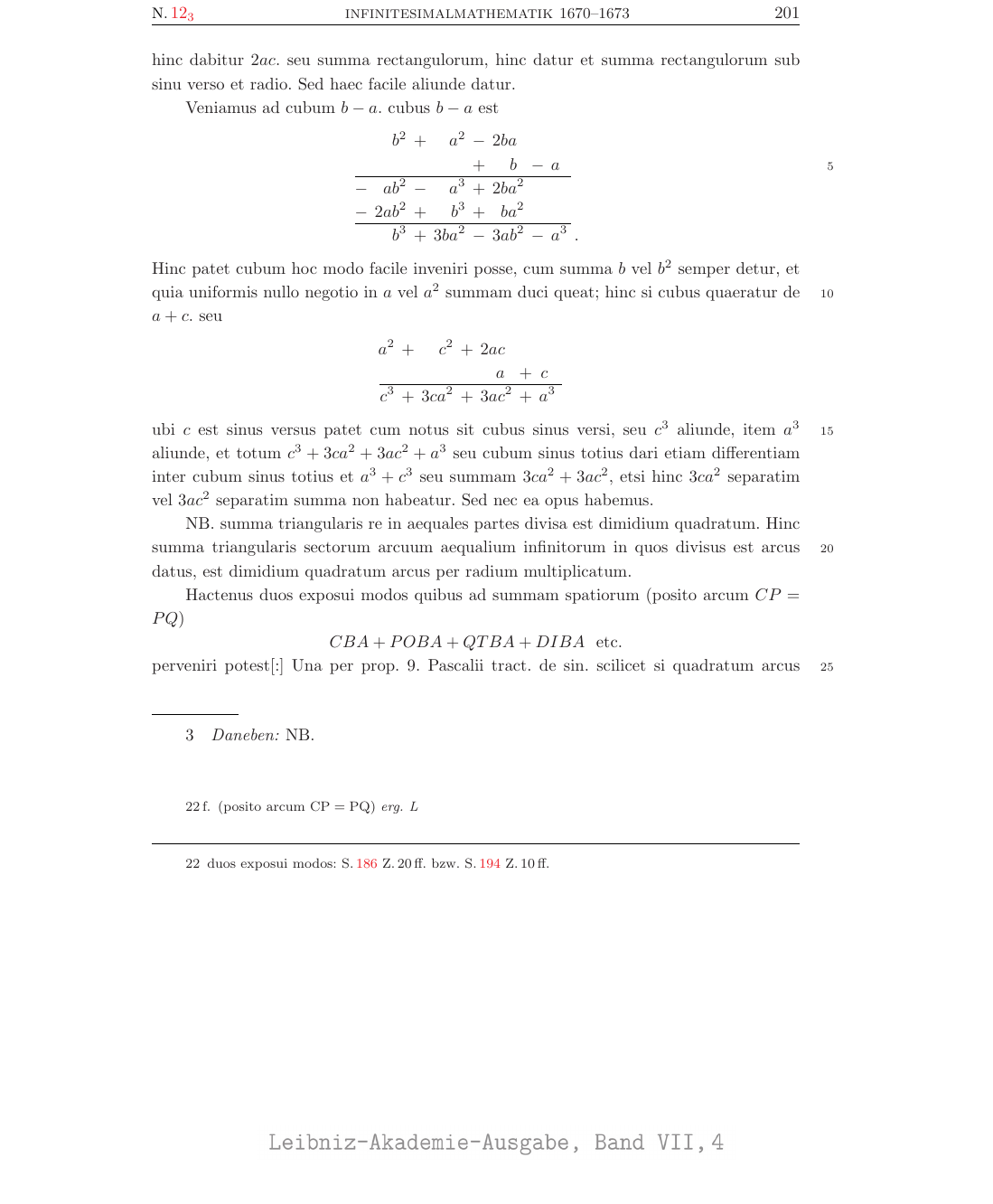
123Veniamus ad cubum b − a. cubus b − a est [b² + a² − 2ba / + b − a / −ab² − a³ + 2ba² / −2ab² + b³ + ba² / b³ + 3ba² − 3ab² − a³].
Let us turn to the cube of b − a. Multiply b² + a² − 2ba by b − a. The partial products, as set down, are −ab² − a³ + 2ba² and −2ab² + b³ + ba². Their sum is b³ + 3ba² − 3ab² − a³.
124Hinc patet cubum hoc modo facile inveniri posse, cum summa b vel b² semper detur, et quia uniformis nullo negotio in a vel a² summam duci queat; hinc si cubus quaeratur de a + c. seu [a² + c² + 2ac / a + c / c³ + 3ca² + 3ac² + a³] ubi c est sinus versus patet cum notus sit cubus sinus versi, seu c³ aliunde, item a³ aliunde, et totum c³ + 3ca² + 3ac² + a³ seu cubum sinus totius dari etiam differentiam inter cubum sinus totius et a³ + c³ seu summam 3ca² + 3ac², etsi hinc 3ca² separatim vel 3ac² separatim summa non habeatur. Sed nec ea opus habemus.
Clearly the cube can readily be found in this way, since the sum of b or b² is always given and, being uniform, can easily be multiplied into the sum of a or a². If we seek instead the cube of a + c, multiply a² + c² + 2ac by a + c to get c³ + 3ca² + 3ac² + a³. Here c is the versed sine. The cube of the versed sine c³ and likewise a³ are known independently, as is their full expression with the mixed terms, the cube of the whole sine. Hence the difference between that cube and a³ + c³ is given, namely 3ca² + 3ac² taken together. The sums of 3ca² and 3ac² are not given separately by this, but we do not need them.
125NB. summa triangularis re in aequales partes divisa est dimidium quadratum. Hinc summa triangularis sectorum arcuum aequalium infinitorum in quos divisus est arcus datus, est dimidium quadratum arcus per radium multiplicatum.
NB. The triangular sum of a magnitude divided into equal parts is half the square. Hence the triangular sum of the sectors of the infinitely many equal arcs into which a given arc is divided is half the square of the arc times the radius.
126Hactenus duos exposui modos quibus ad summam spatiorum (posito arcum CP = P Q) CBA + POBA + QT BA + DIBA etc. perveniri potest[:] Una per prop. 9. Pascalii tract. de sin. scilicet si quadratum arcus 25
So far I have explained two ways of reaching the sum of the spaces CBA + POBA + QTBA + DIBA, etc. (taking arc CP = PQ). One uses proposition 9 of Pascal’s treatise on sines: multiply the square of the arc—
127NB.
[Beside line 3.] NB.
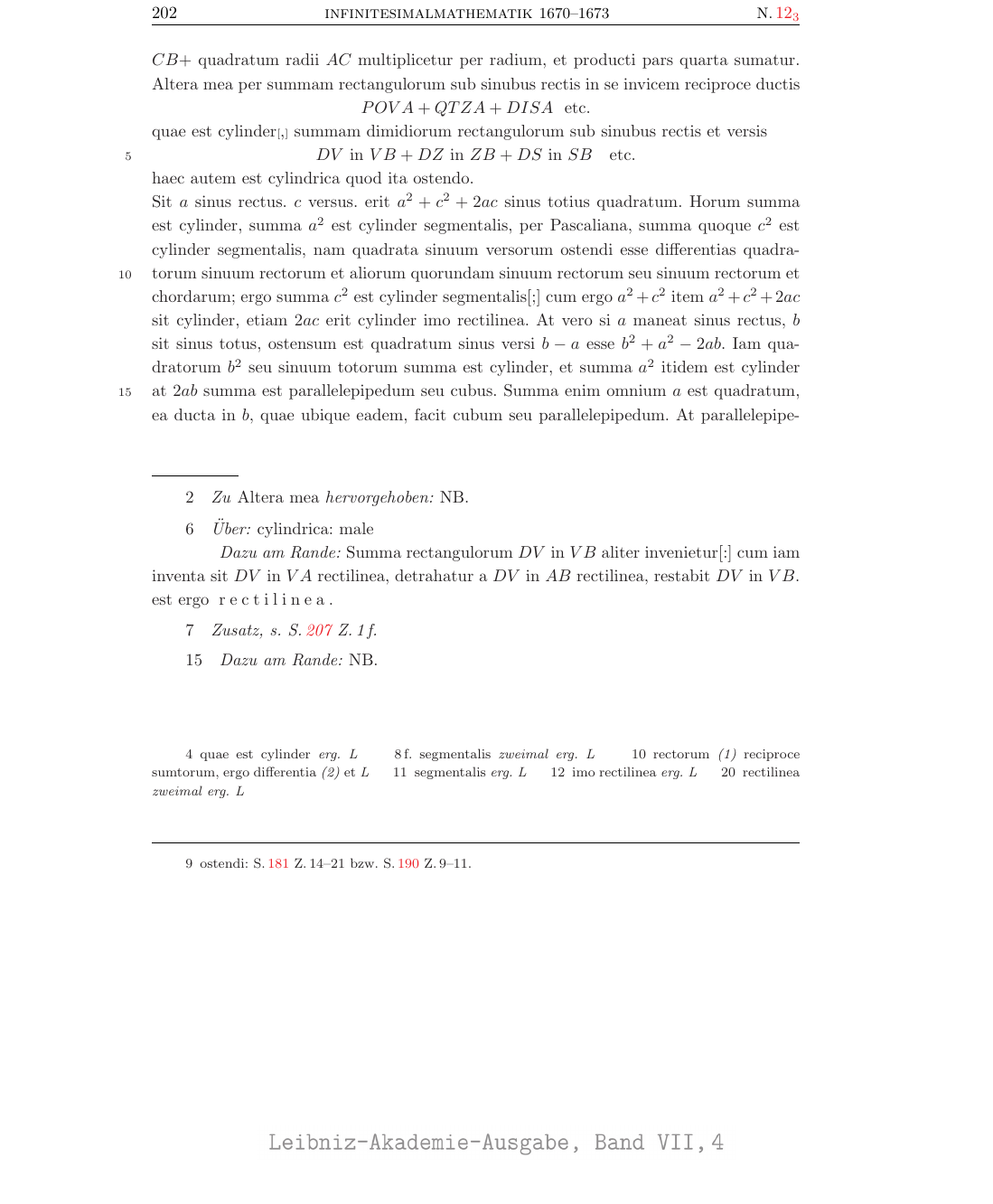
128CB+ quadratum radii AC multiplicetur per radium, et producti pars quarta sumatur.
—CB plus the square of the radius AC by the radius, and take one quarter of the product.
129Altera mea per summam rectangulorum sub sinubus rectis in se invicem reciproce ductis POV A + QT ZA + DISA etc. quae est cylinder[,] summam dimidiorum rectangulorum sub sinubus rectis et versis DV in VB + DZ in ZB + DS in SB etc. haec autem est cylindrica quod ita ostendo.
My other method uses the sum of the rectangles on the right sines multiplied together in reverse order, POVA + QTZA + DISA, etc., which is a cylinder, and the sum of the half-rectangles on the right and versed sines, DV × VB + DZ × ZB + DS × SB, etc. The latter is cylindrical, as I show thus.
130Sit a sinus rectus. c versus. erit a² + c² + 2ac sinus totius quadratum. Horum summa est cylinder, summa a² est cylinder segmentalis, per Pascaliana, summa quoque c² est cylinder segmentalis, nam quadrata sinuum versorum ostendi esse differentias quadratorum sinuum rectorum et aliorum quorundam sinuum rectorum seu sinuum rectorum et chordarum; ergo summa c² est cylinder segmentalis[;] cum ergo a² + c² item a² + c² + 2ac sit cylinder, etiam 2ac erit cylinder imo rectilinea. At vero si a maneat sinus rectus, b sit sinus totus, ostensum est quadratum sinus versi b − a esse b² + a² − 2ab. Iam quadratorum b² seu sinuum totorum summa est cylinder, et summa a² itidem est cylinder at 2ab summa est parallelepipedum seu cubus. Summa enim omnium a est quadratum, ea ducta in b, quae ubique eadem, facit cubum seu parallelepipedum. At parallelepipe-
Let a be the right sine, c the versed. Then a² + c² + 2ac is the square of the whole sine. Their sum is a cylinder. The sum of a² is a cylinder on a segment, by Pascal’s results. The sum of c² is also a segmental cylinder, for I have shown that the squares of the versed sines are differences between the squares of right sines and those of certain other right sines, or between those of right sines and chords. Hence the sum of c² is a segmental cylinder. Since both a² + c² and a² + c² + 2ac are a cylinder, 2ac too will be a cylinder, or rather rectilinear. But if a remains the right sine and b the whole, the square of the versed sine b − a has been shown to be b² + a² − 2ab. The sum of the squares b², of the whole sines, is a cylinder, and the sum of a² likewise. But the sum of 2ab is a parallelepiped or cube. For the sum of all a is a square, which multiplied by the everywhere constant b makes a cube or parallelepiped. But a parallelepiped—
131NB. male.
[Beside “My other method,” line 2.] NB. [Above “cylindrical,” line 6.] Wrong.
132Summa rectangulorum DV in VB aliter invenietur[:] cum iam inventa sit DV in VA rectilinea, detrahatur a DV in AB rectilinea, restabit DV in VB. est ergo rectilinea.
[In the margin.] The sum of the rectangles DV times VB will be found differently. Since DV times VA has already been found to be rectilinear, subtract it from DV times AB, also rectilinear. DV times VB remains. It is therefore rectilinear.
133NB.
[Beside line 15.] NB.
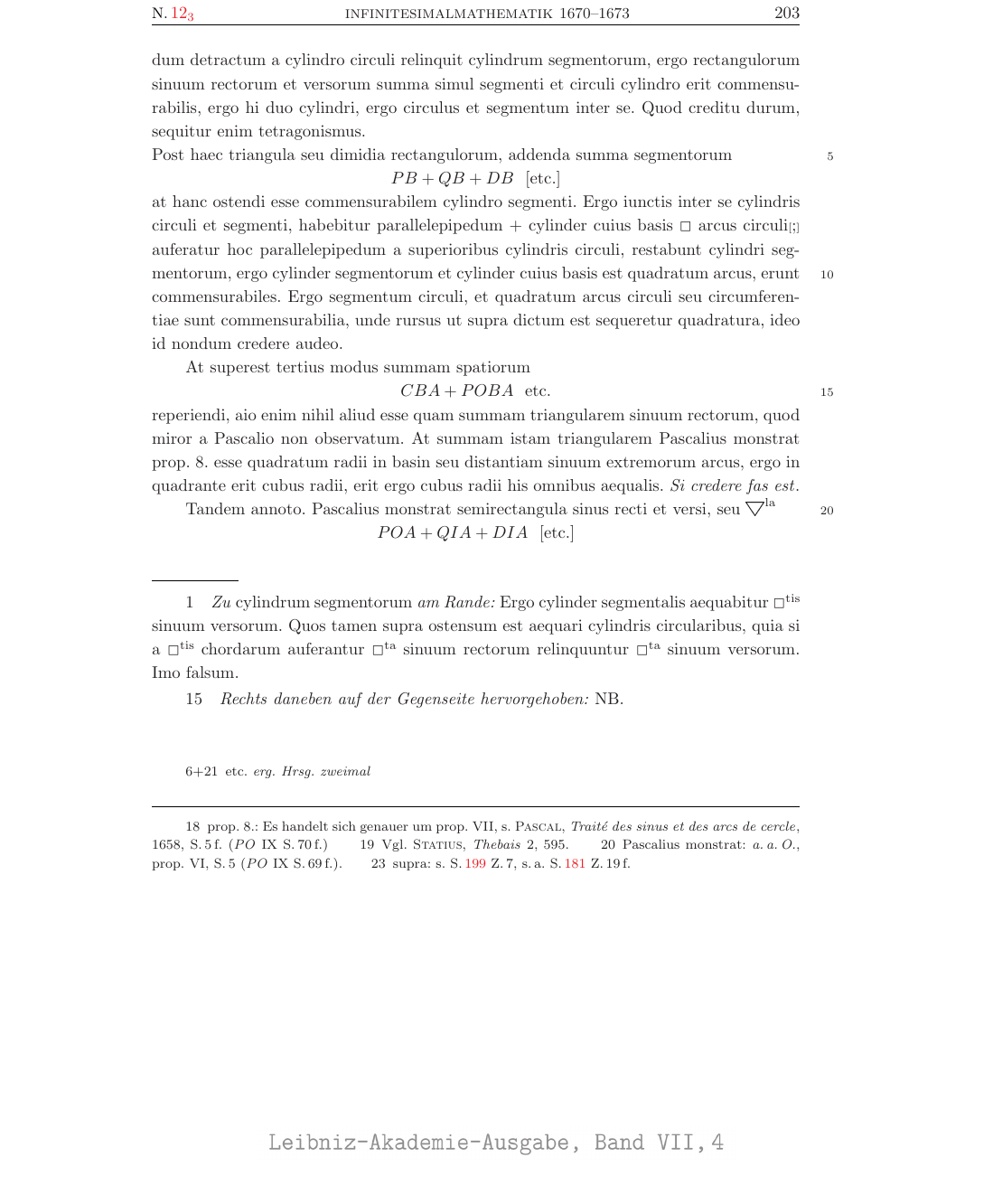
134dum detractum a cylindro circuli relinquit cylindrum segmentorum, ergo rectangulorum sinuum rectorum et versorum summa simul segmenti et circuli cylindro erit commensurabilis, ergo hi duo cylindri, ergo circulus et segmentum inter se. Quod creditu durum, sequitur enim tetragonismus.
—taken from the cylinder on the circle leaves the cylinder on the segments. Hence the sum of the rectangles on the right and versed sines will be commensurable with the cylinder both of the segment and of the circle. Thus the two cylinders will be commensurable with one another, and so will the circle and the segment. This is hard to believe, for quadrature follows.
135Post haec triangula seu dimidia rectangulorum, addenda summa segmentorum PB + QB + DB [etc.] at hanc ostendi esse commensurabilem cylindro segmenti. Ergo iunctis inter se cylindris circuli et segmenti, habebitur parallelepipedum + cylinder cuius basis □ arcus circuli[;] auferatur hoc parallelepipedum a superioribus cylindris circuli, restabunt cylindri segmentorum, ergo cylinder segmentorum et cylinder cuius basis est quadratum arcus, erunt commensurabiles. Ergo segmentum circuli, et quadratum arcus circuli seu circumferentiae sunt commensurabilia, unde rursus ut supra dictum est sequeretur quadratura, ideo id nondum credere audeo.
After these triangles or half-rectangles we must add the sum of the segments PB + QB + DB [etc.]. I have shown it to be commensurable with the cylinder on a segment. Hence by joining the cylinders on the circle and the segment we obtain a parallelepiped plus a cylinder whose base is the square of the circular arc. Take this parallelepiped from the earlier cylinders on the circle and the cylinders on the segments will remain. Thus the cylinder on the segments and the cylinder based on the square of the arc will be commensurable. Therefore the segment of a circle and the square of its arc or circumference are commensurable. As already said, quadrature would follow again, so I do not yet venture to believe this.
136At superest tertius modus summam spatiorum CBA + POBA etc. reperiendi, aio enim nihil aliud esse quam summam triangularem sinuum rectorum, quod miror a Pascalio non observatum. At summam istam triangularem Pascalius monstrat prop. 8. esse quadratum radii in basin seu distantiam sinuum extremorum arcus, ergo in quadrante erit cubus radii, erit ergo cubus radii his omnibus aequalis. Si credere fas est.
There remains a third way of finding the sum of the spaces CBA + POBA, etc. I say it is simply the triangular sum of the right sines, which I am surprised Pascal did not notice. In proposition 8 Pascal shows this triangular sum to be the square of the radius times the base, the distance between the extreme sines of the arc. For a quadrant it will therefore be the cube of the radius. The cube of the radius will equal all these magnitudes, if one may believe it.
137Tandem annoto. Pascalius monstrat semirectangula sinus recti et versi, seu ▽ˡᵃ POA + QIA + DIA [etc.]
Finally I note that Pascal shows the half-rectangles on the right and versed sines, or triangles POA + QIA + DIA [etc.], to be—
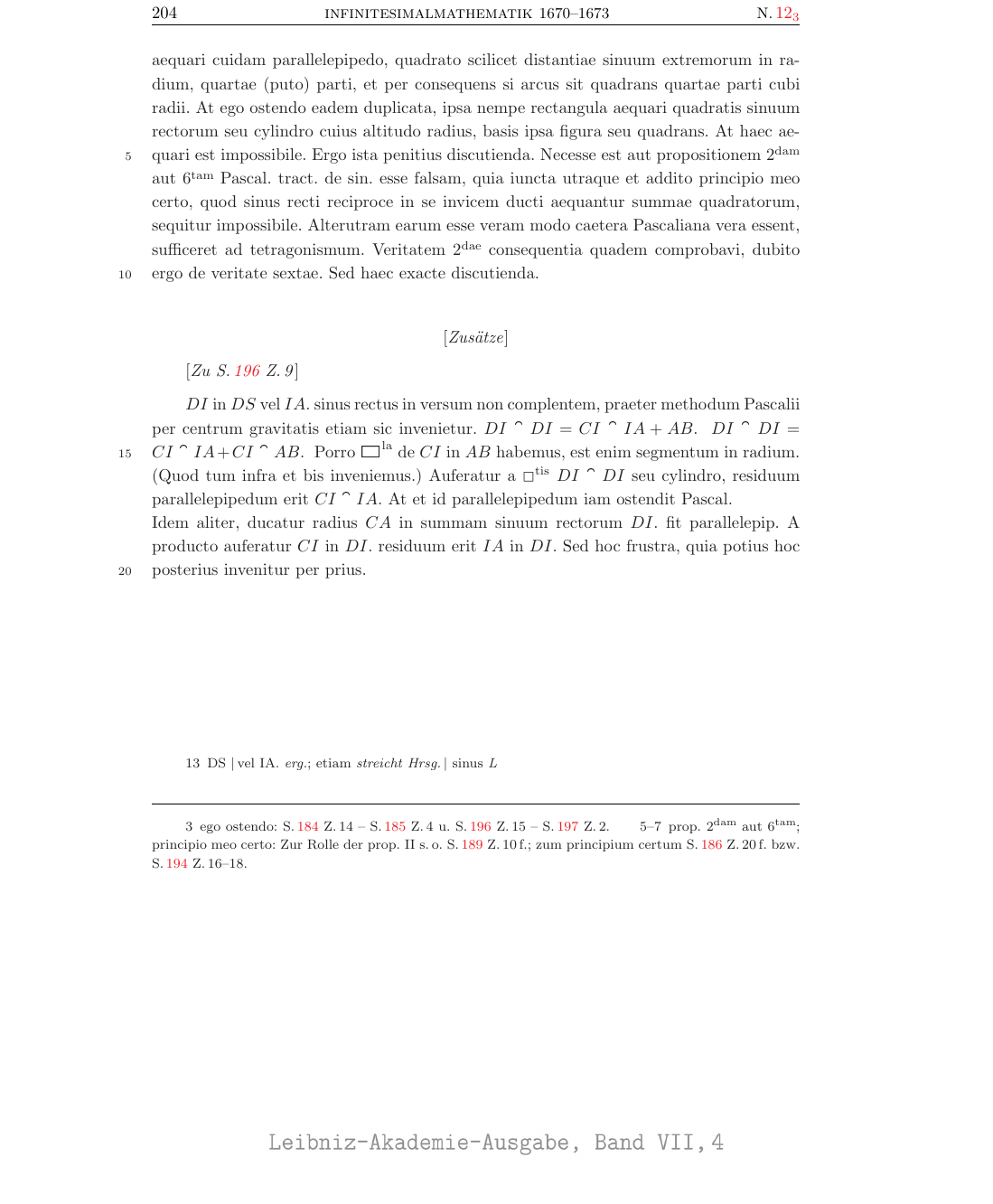
138Ergo cylinder segmentalis aequabitur □tis sinuum versorum. Quos tamen supra ostensum est aequari cylindris circularibus, quia si a □tis chordarum auferantur □ta sinuum rectorum relinquuntur □ta sinuum versorum. Imo falsum.
[Beside “cylinder on the segments,” line 1.] Hence the segmental cylinder will equal the squares of the versed sines. Yet those have been shown above to equal circular cylinders, because removing the squares of the right sines from the squares of the chords leaves the squares of the versed sines. No, that is false.
139NB.
[On the opposite side beside line 15.] NB.
140aequari cuidam parallelepipedo, quadrato scilicet distantiae sinuum extremorum in radium, quartae (puto) parti, et per consequens si arcus sit quadrans quartae parti cubi radii. At ego ostendo eadem duplicata, ipsa nempe rectangula aequari quadratis sinuum rectorum seu cylindro cuius altitudo radius, basis ipsa figura seu quadrans. At haec aequari est impossibile. Ergo ista penitius discutienda. Necesse est aut propositionem 2dam aut 6tam Pascal. tract. de sin. esse falsam, quia iuncta utraque et addito principio meo certo, quod sinus recti reciproce in se invicem ducti aequantur summae quadratorum, sequitur impossibile. Alterutram earum esse veram modo caetera Pascaliana vera essent, sufficeret ad tetragonismum. Veritatem 2dae consequentia quadem comprobavi, dubito ergo de veritate sextae. Sed haec exacte discutienda.
—equal to a certain parallelepiped, namely to one fourth, I think, of the square of the distance between the extreme sines multiplied by the radius, and thus for a quadrant to one fourth of the cube of the radius. But I show that the same magnitudes doubled, namely the rectangles themselves, equal the squared right sines, or the cylinder whose height is the radius and whose base is the figure itself, the quadrant. Yet these cannot be equal. The matter therefore needs closer examination. Either proposition 2 or proposition 6 in Pascal’s treatise on sines must be false, because their combination with my certain principle that the right sines multiplied together in reverse order equal the sum of the squares implies an impossibility. The truth of either one, provided the remaining results of Pascal were true, would suffice for quadrature. I have confirmed the second by a certain consequence, so I doubt the truth of the sixth. But these questions must be examined exactly.
141[Additamenta. Ad p. 196, l. 9.] DI in DS vel IA. sinus rectus in versum non complentem, praeter methodum Pascalii per centrum gravitatis etiam sic invenietur. DI ⌢ DI = CI ⌢ IA + AB. DI ⌢ DI = CI ⌢ IA + CI ⌢ AB. Porro ▭ˡᵃ de CI in AB habemus, est enim segmentum in radium. (Quod tum infra et bis inveniemus.) Auferatur a □tis DI ⌢ DI seu cylindro, residuum parallelepipedum erit CI ⌢ IA. At et id parallelepipedum iam ostendit Pascal.
[Additions. To p. 196, line 9.] DI times DS or IA, a right sine times a versed sine which does not complement it, can also be found as follows, besides Pascal’s method using the centre of gravity. DI × DI = CI × (IA + AB). DI × DI = CI × IA + CI × AB. Now we have the rectangles on CI and AB, for this is the segment times the radius (we shall find this below as well, and twice). Subtract it from the squares DI × DI, or the cylinder. The remaining parallelepiped will be CI × IA. But Pascal has already shown this parallelepiped too.
142Idem aliter, ducatur radius CA in summam sinuum rectorum DI. fit parallelepip. A producto auferatur CI in DI. residuum erit IA in DI. Sed hoc frustra, quia potius hoc posterius invenitur per prius.
Another way of doing the same thing: multiply the radius CA by the sum of the right sines DI and we get a parallelepiped. Subtract CI times DI from the product. IA times DI will remain. But this is fruitless, since it is rather the latter that is found by the former.
Notes on text 357
Manuscript and date. Revised working draft in Leibniz’s hand, LH 35 II 1, fols. 285–290 (Cc 2, no. 617). Three folio sheets, twelve written pages, numbered 1–3 and marked ג (gimel). Most have margins 3.5–4.5 cm wide for subsidiary arguments. The isolated entries on fols. 286r, 289r and 290r appear at p. 179 lines 22–24, p. 196 line 18 and p. 199 lines 22–24 respectively. On the bottom of fol. 290v the end of the third sheet overwrites a separate fragment, written in the opposite direction. That fragment is Academy no. 13, beginning on p. 208. The reference back to no. 9 for the date places this study in the later-assembled, Hebrew-lettered group dated from its contents to spring 1673. Order within the collection does not establish order of composition.
How to read the sums. A right sine is a line segment, with the scale of the radius, and a versed sine is the distance from the endpoint of an arc to the tangent at its other endpoint. For a radius r and central angle θ their lengths are r sin θ and r(1 − cos θ). Whole sine means the radius. A sum can count the lines or can multiply each by an interval of the arc or base. Leibniz changes the interval in the course of the argument. “Triangular” and “pyramidal” refer to repeated sums, as the four rows on p. 185 illustrate. Tetragonismus and quadratura are both rendered “quadrature” where they mean squaring the circle.
Signs and sources. The Latin uses □ for a square and ⌢ for the small multiplication sign. English expands these where possible. Repeated point labels such as ff and dd are labels in Fig. 2. They do not denote products. On p. 192 Leibniz aligns his diagram signs with their algebraic terms. On p. 205 the raised א² is aleph squared, distinct from the sheet mark ג. On p. 206 paired underdots mean “all DX”; the sign above idem est matches destilletur, distilletur on p. 872 (“let it be distilled”). The same distillation sign appears in parentheses after “supplementary arc” on p. 179. The notation key and printed details preserve its form. A printed page heading can divide a sentence. Bracketed placement labels are editorial. They place dispersed additions and error marks beside the appropriate page.
First sheet, pp. 174–180. The point labels in the first diagram are retained even where the argument echoes no. 11 with a different lettering. On p. 175 two occurrences of x² cancel. The apparatus records a change from the area of a “given” to that of a “related” square, and a discarded plan to compare several ways of finding DB. On p. 176 Leibniz changed twice the sum equals the segment into the sum equals twice the segment at lines 4–5. The earlier factor still affects subsequent assertions. The first two expressions on p. 175 give the tangent distance divided by the right sine. Their reciprocals give the order stated in the prose. The chord identity is b²/(2a) = a(1 − cos θ) for b = 2a sin(θ/2). When weighted by arc length, the sum of the versed sines is the integral of r²(1 − cos t) from 0 to θ, or r²(θ − sin θ), twice the area of the segment. For a semicircle it gives πr². The later statement on this page gives only a quadrant, πr²/4. The later note refers to Giovanni Antonio Magini’s Primum mobile (Bologna, 1609). On p. 177 the editors supply “versed” and emend the manuscript’s “multiplied” to “[divided]” by the diameter. The three marginal error marks are separate from the two longer comments. On p. 178 “right” replaced “versed.” On p. 179 the reference is to proposition 1 and its corollary in Pascal’s Traité des sinus et des arcs de cercle (1658). The isolated remark on bisection breaks off. An abandoned transition here already voiced suspicion of a fallacy. The interlinear iusto on p. 180 qualifies “smaller.”
First sheet, pp. 181–186. For corresponding samples the chord is twice the sine of the half-angle, so unweighted chord sums and squared-chord sums have factors 2 and 4. If each line is multiplied by its own interval of arc length, the full-arc interval is twice the half-arc interval. This gives a factor of 4 for first powers and 8 for squares. The first is the factor in the running text. Leibniz’s marginal alternatives and his assertion of universality remain visible. The editors supply si on p. 181. Fig. 3 on p. 182 and Fig. 5 on p. 184 are supplied by the editors from Pascal’s Figs. 32 and 16. On p. 182 they warn that the claim at line 6 holds only with the square of the sine and that the error propagates. Fig. 4 is the drawing in the manuscript although the lettering or arrangement does not fully answer the description. The editors supply “[squares]” and emend “[base]” on p. 183. The statement ascribed to Pascal’s proposition 4 is the corollary of proposition 1: the excess of the arc over the distance between the extreme sines, multiplied by the radius. Leibniz’s doubts refer to his own wording. The Fabri reference is to Opusculum geometricum (1659), proposition V. At p. 185 the editors change “of the arcs” to “[of the sines]”; they also flag “Huygens remarked” as a slip and refer to no. 29, p. 534. The discussion of simple, triangular and pyramidal sums refers to Pascal’s propositions 9 and 11.
Second sheet, pp. 186–194. The second sheet begins partway down p. 186, after the unfinished sentence belonging to the first. The later marginal “it is false” marks the proposed equality of reversed products and squares. For real terms its failure can be checked directly: the sum of the squares minus the sum of the reversed products equals half the sum of the squared differences between terms and their reversed partners. On p. 187 the correction from ordinates to sines withdraws the appeal to the hemisphere. On p. 188 he successively rejects the semicircumference 16x/3 and the alleged proportionality of a, e, x − a. The revised proportions x + a, e, x − a yield e² = x² − a². On p. 189 the last entry in the upper row of the second display is printed x². At line 5 the editors change “arc” to “[radius].” The error mark on the proposed confirmation and the separate “false” on the triangular-sum claim are both authorial. The discussion refers to Pascal, proposition 2, and Archimedes, Measurement of a Circle, proposition 1.
Segments and the attempted quadrature. On p. 190 the editors give XI for XA, AO for AA, and “[arc]” for “radius.” The later addition restricts the claim about higher sums. The square brackets enclosing the aside about a lune on p. 191 are Leibniz’s. The partial retraction on p. 205 must be read with his bold claim on p. 191. In modern terms, a segment of angle θ and radius r has area r²(θ − sin θ)/2. Its ratio to the squared arc is (θ − sin θ)/(2θ²), a function of the angle. Merely writing down a second segment does not supply the required known coefficients. On p. 192 the editors read ay for the manuscript’s ax. On p. 193 the first two denominators are printed as Latin a. The subsequent equations use Greek α. In the display beginning “Ergo x” the first denominator is struck out, and the second contains cancellations which the editors discuss. The writer then observes that the two b’s must themselves differ. The last fraction on p. 194 is printed as a compound fraction. Multiplication through by αβε gives x = b(αβε − γ²βδε)/(αε − γβδ), the consistent form supplied by the editors, provided the denominator is nonzero. They also supply “side” in the accompanying sentence. The result remains conditional on the premise about the segment.
Third sheet, pp. 194–203. The sheet begins on p. 194 below the algebra. The marginal “false” attaches to comparing the squares with the reversed products. The incorrect polynomial on p. 195 and its correction on p. 196 are both kept. For example, if a = 3, f = 4 and x = 5, then x² = a² + f². The earlier last line gives 1,250 = 144, whereas the cancelled product on p. 196 gives 12 = 12. The Academy editors change two minus signs to plus on p. 196. The isolated number sketch and the note referring back from p. 204 belong to different lines. The editors read QB for BP on p. 198, and QZ and PV for QV and PZ on p. 199. The square-on-OA plus square-on-PO equality belongs to right sines after Leibniz explicitly retracts the identification of SA as a versed sine. On p. 200 “right” at line 9 replaced “versed”; the following “versed” remains. The marginal calculation ends with quantities of different dimensions, as printed. On p. 202 the addition “or rather rectilinear” and the marginal male revise the cylindrical interpretation. On p. 203 the reference to Pascal’s proposition 8 is more precisely to proposition 7. The following discussion uses proposition 6. The editors supply “etc.” in two lists. In the marginal note on p. 190 and the line about the half-rectangles on p. 203, the printed triangle sign points down. Its raised endings stand for triangularium and triangula, respectively.
Final additions, pp. 204–207. These refer back to particular lines of the third sheet. The three additions to p. 198, lines 6–7 are on three different manuscript pages: the opposite page, the text page diagonally below, and the page after the next. Only the first of the three is expressly marked as subsequently deleted. Its labels are set over their terms without fraction bars. In the marginal calculation the editors read “[convex]” for “concave” in the first figure; the second remains concave. The third addition breaks off. On p. 206 the editors give “[radius]” for the manuscript’s “arc” and adjust the syntax of the statement about the sum of cubes. That addition on fol. 289r answers the line on fol. 290r and refers to Pascal’s proposition 4, which relates fourth powers of sines to cubes of ordinates. The final addition concerns the choice of the complementary right sine in the rectangles. The provisional conclusions and objections to Pascal are retained as claims made in the course of the draft.
The source is G. W. Leibniz, Sämtliche Schriften und Briefe, Reihe VII, Band 4, 1670–1673: Infinitesimalmathematik, edited by Walter S. Contro and Eberhard Knobloch (Berlin, 2008), no. 12, pp. 174–207. The digital edition is provided by the Akademie der Wissenschaften zu Göttingen through the Leibniz-Archiv, Gottfried Wilhelm Leibniz Bibliothek, Hannover, under CC BY-NC 4.0. All page reproductions and figure details are from that edition. The separate Hannover Berichtigungen zu den Reihen I, III und VII, version 1, start their entries for VII,4 at p. 271. Monadica supplies the English translation and verification.
Hannover source edition · CC BY-NC 4.0
Pascal, corollary of I and proposition IV · Pascal, proposition VII