Editor’s note
Bodenhausen sets out, for the figure Leibniz had sent him, a differential calculation of the elementary parts of Hippocrates's lune. He compares the result with the theorem of Tschirnhaus that part of the lune equals the triangle AGC, or a rectangle with sides AG and half BC and finds that the equations lead to an absurdity. He cannot see where he erred in differentiating and asks Leibniz for help in a jocular closing request. Series III: CC BY-NC 4.0, Leibniz-Archiv Hannover.
Latin and German (A III,6 N.22)
English
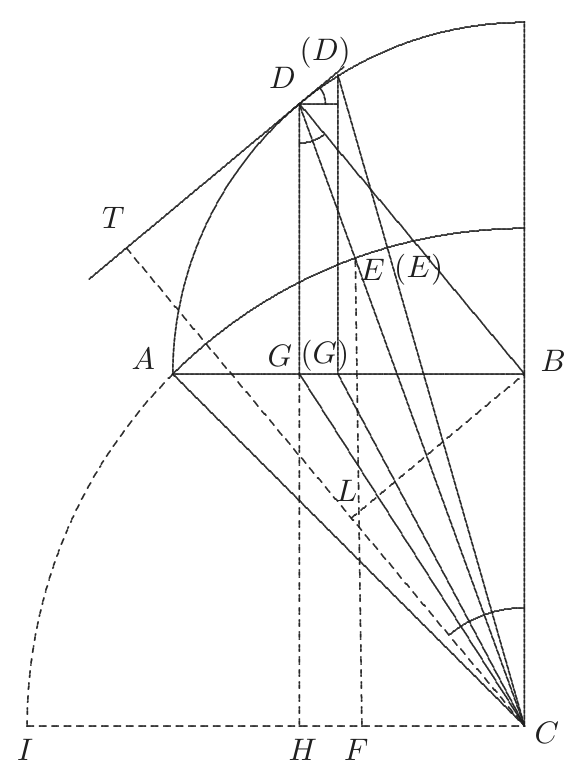
2Positis iisdem ut prius (in figᵃ mihi transmissa) ducatur praeterea per C recta CT parallela ipsi BD, et per E recta EF parallᵃ ipsi DG productae in H. Et sit AB, BC, a. AG, x. GD, y. IF, z. EF, v. Fit D(D) = adx : y. CT = a + y (propter parallelas BD, CT, et propter aequal. CB, BD). Hinc Δ Elem. CD(D) =(1) (a + y), adx : 2y. Sic E(E) = √(2aa), dz : v. Et CE = √(2aa). Hinc Δ Elem. CE(E) =(2) aadz : v.
Keeping the same assumptions as before (in the figure transmitted to me), draw also through C the straight line CT parallel to BD, and through E the straight line EF parallel to DG produced to H. Let AB and BC each be a, AG be x, GD be y, IF be z, and EF be v. Then D(D) = adx : y. CT = a + y (because BD and CT are parallel and CB and BD are equal). Hence the elementary triangle CD(D) =(1) (a + y), adx : 2y. Likewise E(E) = √(2aa), dz : v. And CE = √(2aa). Hence the elementary triangle CE(E) =(2) aadz : v.
3Substit. in 1. et 2. aequ. valor. x = a − √(aa − yy) (propter circ.), v = (aa + ay)/√(aa − ay) (propter sim. Δᵒˢ rectang. DCH, ECF), z = (√(2aa) − (aa + ax)/√(aa − ay)) = √(2aa) − √(aa + ay) (propter eand. similitᵉᵐ). Erit dx = ydy/√(aa − yy). Ergo (a + y), adx : 2y = ((aa + ay)/(2√(aa − ay)), dy) = a/2 √((a + y)/(a − y)), dy =(3) CD(D). Sic dz = ady/(2√(aa + ay)). Ergo aadz : v = (aa√(aa − ay)/((a + y), 2√(aa + ay)), dy) = aa/(2a + 2y) √((a − y)/(a + y)), dy =(4) CE(E).
Substitute in equations 1 and 2 the values x = a − √(aa − yy) (from the circle), v = (aa + ay)/√(aa − ay) (from the similar right triangles DCH and ECF), and z = (√(2aa) − (aa + ax)/√(aa − ay)) = √(2aa) − √(aa + ay) (from the same similarity). This gives dx = ydy/√(aa − yy). Hence (a + y), adx : 2y = ((aa + ay)/(2√(aa − ay)), dy) = a/2 √((a + y)/(a − y)), dy =(3) CD(D). Likewise dz = ady/(2√(aa + ay)). Hence aadz : v = (aa√(aa − ay)/((a + y), 2√(aa + ay)), dy) = aa/(2a + 2y) √((a − y)/(a + y)), dy =(4) CE(E).
4Est autem juxta Dⁿ Tschirnh. pars Lunulae ADEA = Δᵒ AGC sive ▭ᵒ AG in ½BC, h. e.: = (a/2)x. Ergo pars Lunulae elementaris D(D)(E)E = diffᵃᵉ ▭ᵒʳᵘᵐ AG in BC/2, et (AG + dAG) in BC/2, h. e.: = ((a/2)dx) = aydy/(2√(aa − yy)) =(5) CD(D) − CE(E).
Now according to Mr Tschirnhaus the part ADEA of the lune equals the triangle AGC, or the rectangle with sides AG and half BC, that is, (a/2)x. Thus the elementary part D(D)(E)E of the lune equals the difference of the rectangles with sides AG and BC/2, and AG + dAG and BC/2. That is, it equals ((a/2)dx) = aydy/(2√(aa − yy)) =(5) CD(D) − CE(E).
5Ergo aequ. (5) = aequ. (3) − aequ. (4); Quibus utrinque divisis per a/2 dy, et reductis, semper prodit absurdum; idemque fit, si eaedem aequationes explicentur per x.
Therefore equation (5) = equation (3) minus equation (4); when both sides of these are divided by a/2 dy and reduced, an absurdity always results; and the same happens if the same equations are expressed through x.
6Nun weiß ich nicht, wo ich in der 3ten v. 4ten aequ. differentiando gefehlet; in der 1. 2. v. 5. aequ. ist kein fehler. Denn ich wil nicht glauben, daß H. Tsch. geirret, welcher dieses theorema sua methodo inventum so franchement publiciret.
Now I do not know where I have erred in differentiating in the 3rd and 4th equations; in the 1st, 2nd and 5th there is no error. For I will not believe that Mr Tschirnhaus has erred, who publishes this theorem, found by his own method, so frankly.
7Wenn Seinem Tieger (dem nichts in den ersten 3 sprüngen entlauffet, wie ich v. andere wol wißen) etwan eine klawe abfiele, wolte ich darumb gebeten haben, damit ich solche an meine Esels-pfote binden v. den schlawen geometrischen füchsen recht auf die haut greiffen könne, ehe sie mir entwischen.
If perhaps a claw should fall from his tiger (from which nothing escapes in the first three leaps, as I and others well know), I should like to have asked for it, so that I might bind it to my ass's foot and get properly at the cunning geometrical foxes before they escape me.
-
This is an enclosure (a single sheet in Bodenhausen's hand) with no salutation, date or signature, so the usual first row is replaced by a figure row; the figure (referred to as "the figure transmitted to me", i.e. from Leibniz's earlier letters, with letters A to I, T, L and points D, (D), E, (E), G, H, F) shows Hippocrates's lune over a semicircle and is reproduced from the printed p. 62. The edition notes that B and F had different roles in Leibniz's earlier letters (e.g. III, 5 N. 201).
-
Equations (1)–(5) are numbered above the equality signs. These are separate from the edition’s footnote numbers. The table puts the equation label after its equality sign. A horizontal bar over a sum is given by parentheses, stacked fractions by a slash, a comma between factors by a comma, and the division colon by a colon. On p. 63, v has numerator aa + ay, while the numerator within the longer expression for z is aa + ax. The latter x is retained as printed. The numerator of the first fraction after “Ergo (a + y), adx : 2y” is aa + ay. The last comparison uses the triangle AGC and two rectangles, each of height BC/2. The factor dividing both sides in the following line is (a/2)dy.
-
The edition's footnotes give Leibniz's remarks on the sheet: at footnote 1 "because CT = DH"; at footnote 2 "whence the triangles BLC and BGD are congruent"; at footnote 3 a struck-out calculation beside and between the lines (expressing v and z through the ratio v : DH = a√2 : CD, ending in z = 2a√((aa − ay)/(aa − yy)) − a√2 and dz). These are not translated as rows; the third is not reproduced.
-
Bodenhausen's difficulty is that, with Tschirnhaus's theorem that the lune-part ADEA equals the triangle AGC, equivalently the rectangle AG by BC/2 (published by Tschirnhaus in the Acta eruditorum, September 1687), differentiating gives an absurd result; he doubts his own derivation. Presumably the question to Leibniz is whether the error lies in equations 3 and 4. The postscript row is a jocular request for help ("Tiger" for Leibniz).
-
The sheet was enclosed with N. 21 and is answered by N. 41.
(Ours): The original is the digital text layer of A III,6 (Leibniz-Archiv Hannover, CC BY-NC 4.0), main text only; the edition's variants, manuscript description and commentary are not reproduced, and identifications in these notes summarise them. Translation drafted by a worker model and checked by the lane lead against the text layer (automatic word and page checks, plus reading of flagged passages). The figure on p. 62 and the equations and geometrical signs in the main text on p. 63 were subsequently checked against the printed images. The German conclusion was located on p. 64. The note in Leibniz’s hand is distinct from Bodenhausen’s main calculation. Original text: Leibniz, Sämtliche Schriften und Briefe, A III,6 N.22, pp. 62–64 (Leibniz-Archiv Hannover, CC BY-NC 4.0). English translation and notes: Monadica.