19₁. PLAGULA PRIMA
9₁. FIRST SHEET
2Centrum gravitatis res est non mechanica, sed geometrica, potest enim exprimi definitione, in qua nihil mechanicum contineatur. Mechanica definitio est: centrum gravitatis est punctum per quod transeuntes rectae, figurae pondera bisecant. Sed quia non bisecant ipsam figuram, semper, ideo alia opus est definitione. Quia nimirum pondus velut novam superaddit dimensionem, est enim quasi linea nova in omnia puncta ducta, continue crescens instar trianguli, inde a puncto suspensionis ideo lineae ascendent ad superficies, superficies ad solida, solida ad quartam dimensionem. Unde intelligi potest dimensiones illas altiores esse reales; etsi enim non figuris, quantitatibus tamen continuis exprimi possent iisque minime imaginariis.
The centre of gravity is a geometrical matter, independent of mechanics, for it can be expressed by a definition containing nothing mechanical. The mechanical definition is this: the centre of gravity is the point through which straight lines pass that bisect the weights of the figure. But since they do not always bisect the figure itself, another definition is needed. Weight adds, as it were, a new dimension. It is like a new line drawn to all the points, increasing continuously in the manner of a triangle from the point of suspension. Lines will thus rise to surfaces, surfaces to solids, and solids to a fourth dimension. Hence one can understand that these higher dimensions are real. Even if they could not be expressed by figures, they could nevertheless be expressed by continuous quantities, and by quantities that are far from imaginary.
3Nunc superficies easque planas, per exemplum consideremus. Supponatur figurae datae centrum gravitatis velut inventum, et in quolibet circumferentiae puncto erigatur recta plano figurae perpendicularis (Quid si figura sit superficies curva, tum perpendicularis erit plano subtendenti superficiem curvam, vel potius semper erigetur perpendicularis horizonti, quicunque sit situs figurae, res enim redibit eodem, etsi alio atque alio situ, alia sit proditura figura centrobaryca.) rationis cuiusdam α ad diametrum, seu distantiam eius puncti circumferentiae a centro gravitatis, ita scilicet ut semper perpendicularis erectae ad semidiametrum suam ratio sit eadem. Et facilioris operationis causa assumamus erectam semper radio id est distantiae a centro aequalem. Inde extremitates erectarum puncto per diagonales iungantur. Huius figurae ita constitutae ea debet esse proprietas, ut planum quodcunque horizonti perpendiculare, seu lineae directionis gravium parallelum, per centrum transiens eam bisecet. Sed ut ablegemus horizontis etc. nomen, ita erit definitio (quia semper idem manet centrum gravitatis quomodocunque inclinetur figura, positis scilicet lineis directionis inter se parallelis)[:] omnes erectae sunto inter se parallelae, et si figurae planum sit ad planum cui erectae insistunt inclinatum, non ad distantiam a centro proportionales erunt erectae, sed ad distantiam a perpendiculari per planum super quo erectio est et centrum transeunte. Ergo a centro triangulum excrescet, in ratione distantiarum ab ea linea.
Let us now take surfaces as an example, and plane ones at that. Suppose the centre of gravity of a given figure already found. At every point of the circumference erect a straight line perpendicular to the plane of the figure (what if the figure is a curved surface? Then the line will be perpendicular to the plane subtending the curved surface. Or rather, let it always be erected perpendicular to the horizon, whatever the position of the figure. The result will come to the same thing, although different positions will produce different centrobaryc figures). Let it have a certain ratio α to the diameter, that is, to the distance of this point of the circumference from the centre of gravity, so that the ratio of the erected perpendicular to its own semidiameter is always the same. For ease of operation let us take the erected line always equal to the radius, that is, the distance from the centre. Then let the ends of the erected lines be joined to the point by diagonals. The figure thus constructed must have this property: any plane through the centre perpendicular to the horizon, or parallel to the direction of heavy bodies, bisects it. To dispense with the name of the horizon and the like, the definition will be as follows. The centre of gravity always remains the same however the figure is inclined, provided the lines of direction are parallel to one another. Let all the erected lines be parallel. If the plane of the figure is inclined to the plane on which the erected lines stand, they will be proportional to the distance from the perpendicular passing through that plane and the centre, rather than to the distance from the centre. A triangle will therefore grow out from the centre in the ratio of the distances from that line.
4Quodlibet punctum valet lineam erectam, valores punctorum sunt ut distantiae a linea quadam certa, pro arbitrio assumta per centrum figurae transeunte. Lineae erectae sunto parallelae lineae illi assumtae, ac per consequens etiam inter se. Lineae erectae sunto inter se confusae, ac proinde figura plana inclinari quidem potest, in situm perpendicularem seu ut planum aliquod in ipsa figura, rectae directionis assumtae parallelum fiat, erigi non potest; curva autem superficies, v. g. hemisphaerii, ne inclinari quidem etc. Hic est status figurae centrobarycus.
Each point counts for an erected line. The values of the points are as their distances from some fixed line chosen at will through the centre of the figure. Let the erected lines be parallel to the line so chosen and hence also to one another. Let the erected lines coincide with one another. Accordingly a plane figure can indeed be inclined, but it cannot be raised into a perpendicular position, that is, so that some plane in the figure itself becomes parallel to the chosen straight line of direction. A curved surface, for example that of a hemisphere, cannot even be inclined, etc. This is the centrobaryc position of the figure.
5NB. Hoc facto figura data centrobaryce posita intelligi potest, fulta hypomochlio seu recta ad lineam directionis perpendiculari per centrum gravitatis transeunte, sive ea incidat in figuram, sive eam non nisi in puncto secet (quanquam prius si figura plana est regularius). Cumque hinc necesse sit nisum aequalem esse ab utraque figura, etiam erectae nisus exprimentes, utrinque aequalis erunt summae, seu planum quodcunque (id est quaecunque linea pro hypomochlio sumatur) lineae directionis figuram centrobarycam bisecabit. Optimum autem considerare planas, easque ita positas ut linea directionis ipsis sit perpendicularis.
NB. Once this is done, the given figure may be conceived as placed centrobarycally and supported on a fulcrum, that is, a straight line perpendicular to the line of direction and passing through the centre of gravity. This line may lie in the figure or may meet it at only one point (although the former is more regular if the figure is plane). Since the tendencies of the two parts of the figure must then be equal, the sums of the erected lines expressing those tendencies will also be equal on both sides. In other words, any plane of the line of direction, whichever line is taken as the fulcrum, will bisect the centrobaryc figure. It is best, however, to consider plane figures so placed that the line of direction is perpendicular to them.
6Hoc pacto solius circuli figura centrobaryca est figura nota, iam et geometrice descriptibilis continuo motu, est enim residuum cylindri exemto cono eiusdem basis et altitudinis; ac proinde figura circuli centrobaryca, est hemisphaerio aequalis. Porro eam bisecari omni plano per centrum circuli transeunte ad circulum perpendiculari manifestum est.
On these terms it is only for the circle that the centrobaryc figure is a familiar figure, one geometrically describable by continuous motion. It is what remains of a cylinder after removal of a cone of the same base and height. The centrobaryc figure of the circle is consequently equal to a hemisphere. That it is bisected by every plane through the centre of the circle perpendicular to the circle is evident.
7Superficies omnis centrobarycae figurae planae curvilineae est cylindrica truncata. Cuius cylindri basis figura data. Ad figurarum istarum descriptionem imaginari nobis possumus, rectam ferri per peripheriam alicuius figurae, sed inter circumferendum continue crescere aut decrescere, ea ratione, qua radii figurae. A figura centrobaryca abscindi potest cylinder basi figura, altitudine radii minimi. Residuum retinebit easdem leges, ut a plano quolibet centrobaryco bisecetur.
The surface of the centrobaryc solid of any plane curvilinear figure is a truncated cylindrical surface. The given figure is the base of this cylinder. To describe such figures, we can imagine a straight line carried around the perimeter of a figure, continuously increasing or decreasing as it is carried around, in the ratio of the radii of the figure. From the centrobaryc figure one can cut off a cylinder having the figure as base and the smallest radius as height. The remainder will retain the same laws, so that it is bisected by any centrobaryc plane.
8Omnis linea figuram datam bisecans in partes similes et aequales etiam eius centrobarycam ita bisecabit, seu transit per centrum gravitatis, ut sector circuli angulo bisecto.
Every line bisecting a given figure into similar and equal parts will likewise bisect its centrobaryc figure, or, in other words, it passes through the centre of gravity. An example is a sector of a circle when its angle is bisected.
9Omnis figurae quae binis modis secari potest in partes similes et aequales, habetur centrum gravitatis ut circuli qui ita secari potest modis infinitis, ellipsis, etc. Hinc iam NB. etsi rectae per centrum ellipseos transeuntes eam non semper bisecent, plana tamen earum rectarum centrobarycam ellipseos bisecabunt.
The centre of gravity is obtained for every figure that can be cut in two ways into similar and equal parts, such as the circle, which can be so cut in infinitely many ways, the ellipse, and so on. Hence, NB, although straight lines through the centre of an ellipse do not always bisect it, the planes of those lines will bisect the centrobaryc figure of the ellipse.
10Hinc iam innumerabilium segmentorum dissimilium aequalitas haberi potest, et per consequens rectilinea solida plurimis curvilineis aequalia. Non puto rem in ellipsi posse usui esse, quia in ea omnes rectae, per centrum transeuntes etiam ellipsin bisecant. Sed in parabola, forte ad reperiendam rectam curvae parabolicae aequalem. Item in curva cycloeidali, cuius centrum gravitatis dedit nobis post Wrenni dimensionem, Pascalius.
In this way one can establish equality between innumerable dissimilar segments, and consequently obtain rectilinear solids equal to very many curvilinear ones. I do not think this can be of use in the ellipse, since in it all straight lines through the centre also bisect the ellipse. But in the parabola it might serve to find a straight line equal to the parabolic curve. Likewise in the cycloidal curve, whose centre of gravity Pascal gave us after Wren's measurement.
11NB. Lineas non est necesse erigi parallelas lineae directionis, cum lineae alicuius centrum gravitatis quaeritur, sunto modo parallelae inter se et horizonti, et res eodem redibit.
NB. When the centre of gravity of a line is sought, the lines need not be erected parallel to the line of direction. Let them simply be parallel to one another and to the horizon, and it will come to the same thing.
12Centrobaryca ergo circumferentiae est ipse circulus, et peripheriae ellipticae ipsa ellipsis. Imo falsum est, cylindrica superficies cuius basis circumferentia altitudo radius est centrobaryca circumferentiae. Erigi ergo debent, alioqui se confundent. Ellipticae circumferentiae centrobaryca est etiam circumferentia centrobarycae ellipseos. Porro superficies centrobaryca, fit ex ductu basis, id est peripheriae datae figurae, in altitudinem seu maximum, ita divisimus prout progressio radiorum continuo decrescentium docet, si modo ea progressio inveniri seu aequari potest.
The centrobaryc figure of a circumference, then, is the circle itself, and that of an elliptical perimeter the ellipse itself. No, that is false. The cylindrical surface whose base is the circumference and whose height is the radius is the centrobaryc figure of the circumference. The lines must therefore be erected, otherwise they will coincide. The centrobaryc figure of an elliptical circumference is also the circumference of the centrobaryc figure of the ellipse. Further, the centrobaryc surface is formed by multiplying the base, that is, the perimeter of the given figure, by the height or maximum. We have divided it as the progression of the continuously decreasing radii directs, provided that this progression can be found or equated.
14Adde propositionem Hugenii memorabilem: Feratur recta perpendicularis super peripheria figurae planae, quam planum cuius basis recta figuram tangens, inclinatum ad figurae planum angulo semirecto, secet, abscindet cuneum, aequalem solido ex figura in distantiam centri eius gravitatis, a puncto contactus ducta. Hoc iam Pascal.
Add this memorable proposition of Huygens. Let a perpendicular straight line be carried round the perimeter of a plane figure. Let a plane whose base is a tangent to the figure, inclined at half a right angle to the plane of the figure, cut that line. It will cut off a wedge equal to the solid obtained by multiplying the figure by the distance of its centre of gravity from the point of contact. Pascal had this already.
15Prop. 1. Hugenii de centro oscillationis: Ponderibus quotlibet ad eandem partem plani existentibus, si a singulorum centris gravitatis agantur in planum illud perpendiculares, hae singulae in sua pondera ductae tantundem simul efficient, ac perpendicularis a centro gravitatis [ponderum] omnium in planum idem cadens, ducta in pondera omnia.
Proposition 1 of Huygens on the centre of oscillation. Given any number of weights on the same side of a plane, drop perpendiculars to the plane from their several centres of gravity. The sum of the products of the individual perpendiculars by their weights is equal to the perpendicular dropped to the same plane from the common centre of gravity of all [the weights], multiplied by all the weights.
16[Fig. 1. Semicirculus AB, chordae AC, AD, AE.]
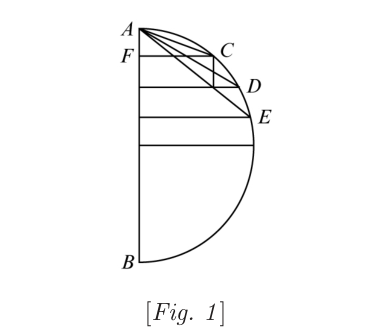
[Fig. 1. Semicircle on AB with chords AC, AD and AE and a horizontal ordinate from F.]
17AB = a. AC or AD or AE is b. The distance from the tangent is b²/(2a). Now AF = α, a minimum or point. FC is the square root of the product of a − α and α, that is, √(aα − α²). And FC² = aα − α² (1 or 4). Now b² = a(1 or 2)α − (1 or 4, etc.)α² + (1 or 4 …
19… etc.)α². Hence b² = a times (1 or 2 or 3, etc.)α. Since the distances from the tangent are b²/(2a) = a·α(1 or 2, etc.)/(2a), they are α(1 or 2, etc.)/2, that is, half the abscissas from the vertex. Divide FC by α, or √(α²). The result is √(a/α − 1).
20Iam AC. CD. DE. etc. duci intelligantur in α. producto dimidiato bis, fiet totus semicirculus. Nota si chordae ducantur in a vertice abscissas producto quadripartito habetur semicirculus, si in applicatas habetur superficies cylindrica cuius basis arcus semicirculi, altitudo distantia centri gravitatis eius arcus a centro circuli.
Now let AC, CD, DE, etc., be multiplied by α. Halving the product twice gives the whole semicircle. Note that if the chords are multiplied by the abscissas from the vertex, one quarter of the product gives the semicircle. If they are multiplied by the ordinates, one gets the cylindrical surface whose base is the semicircular arc and whose height is the distance of the centre of gravity of that arc from the centre of the circle.
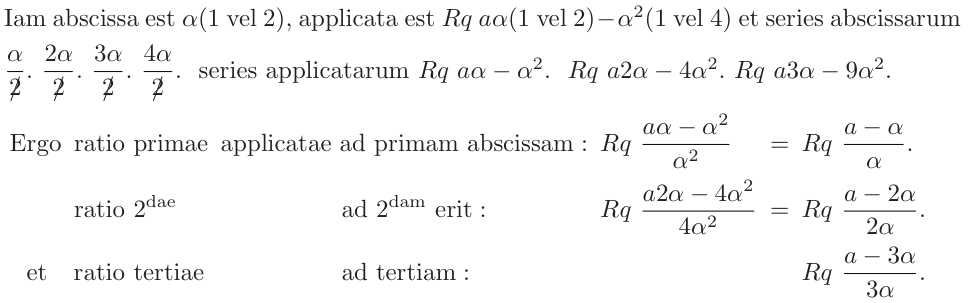
21Now the abscissa is α(1 or 2), and the ordinate is √[aα(1 or 2) − α²(1 or 4)]. The series of abscissas is written α, 2α, 3α, 4α with each denominator 2 cancelled. The series of ordinates is √(aα − α²), √(a·2α − 4α²), √(a·3α − 9α²). The ratios of the first, second and third ordinates to their respective abscissas are √[(aα − α²)/α²] = √[(a − α)/α], √[(a·2α − 4α²)/(4α²)] = √[(a − 2α)/(2α)], and √[(a − 3α)/(3α)].
22Iam constat cum non eadem est ratio partium ad partes, nec totorum rationem iniri posse. Illud vero hactenus non repertum est, rationibus partium non iisdem manentibus, sed certo modo crescentibus, inire rationes summarum, ut si sint a b c d e ad a b c d e. 1 2 3 4 5 1 1 1 1 1 Hoc vero tanto minus inveniri potest, quando ipsis a. b. c. d. e. ratio non constat.
It is plain that where the parts do not stand in the same ratio to the parts, the ratio of the wholes cannot be calculated either. What has so far escaped discovery is how to obtain the ratio of the sums when the ratios of the parts vary but increase in some definite manner. For example, take a, b, c, d, e with the numbers 1, 2, 3, 4, 5 beneath them, against the same terms with 1, 1, 1, 1, 1 beneath them. This can be found still less readily when the ratio among a, b, c, d, e themselves is unknown.
23Sed et illud est pulcherrimum theorema Hugenii; si datis in plano punctis quotlibet ex centro gravitatis illorum circulus quilibet describatur et ab omnibus punctis datis, ducantur lineae rectae ad punctum aliquod in circuli illius circumferentia sumtum, erit summa quadratorum ab omnibus semper aequalis eidem plano, seu eadem, ubicunque assumatur illud punctum in circumferentia. Ergo si puncta forent infinita, semper solidum produceret idem.
There is also this very beautiful theorem of Huygens. Given any number of points in a plane, draw any circle about their centre of gravity. Join all the given points to a point taken on its circumference. The sum of the squares on all those lines will always equal the same plane area, that is, it will be the same wherever the point is taken on the circumference. Thus if the points were infinite in number, the same solid would always be produced.
25[Fig. 2. Circulus et ellipsis centro a.]
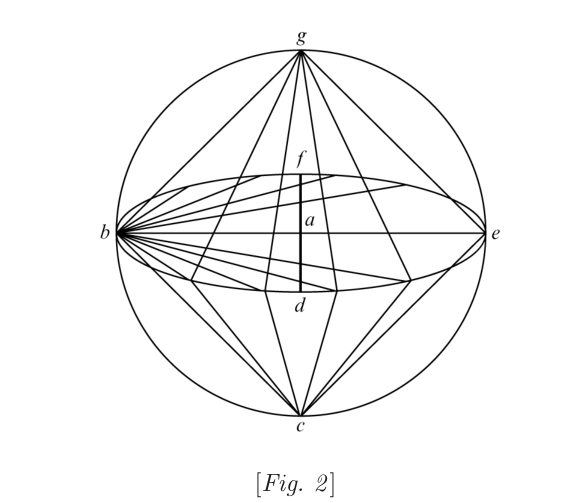
[Fig. 2. A circle and ellipse about a, with lines drawn from points of the ellipse to b, c and g.]
26Hoc ita applicare placet ellipseos centro a. quo describatur circulus ab ellipsi circumscriptus[,] sumatur in eius circumferentia praeter b. aliud punctum c, et aliud g, et ab omnibus circumferentiae ellipticae punctis ducantur rectae versus b. Deinde ab omnibus circumferentiae ellipticae punctis ducantur rectae versus c. quod ut sit distinctius: ab latere bde. ducantur versus c. et loco earum quae ex latere bfe ducendae essent versus c. ne prioribus confundantur, ducantur ex bde versus g. Summa 2ᵗᵒʳᵘᵐ omnium rectarum ex bfed in b. aequatur summae quadratorum omnium rectarum ex bde in c. et in g. Ergo dimidium unius aequatur dimidio alterius, seu omnes ex bde in b. aequantur omnibus ex bd in c et g.
I should like to apply this as follows. About the centre a of the ellipse draw a circle circumscribed by the ellipse. Besides b, take another point c on its circumference and another g. Draw straight lines from all points of the elliptical circumference towards b, then from all its points towards c. To make this clearer, draw the lines from side bde towards c, and, to avoid confusion with the earlier ones, replace those that would have been drawn from side bfe towards c by lines from bde towards g. The sum of the squares of all the lines from bfed to b equals the sum of the squares of all those from bde to c and to g. Thus half the one equals half the other, or all those from bde to b equal all those from bd to c and g.
27Ex prima Hugenii regula colligi potest propositio talis: Si cylindricum quodcunque secetur per planum quodcunque, truncus abscissus aequabitur alii cylindrico cuius basis sectio, altitudo recta a centro sectionis ducta ad basin trunci abscissi perpendicularis.
From Huygens’s first rule one may infer the following proposition. If any cylindrical solid is cut by any plane, the truncated portion cut off will equal another cylindrical solid whose base is the section and whose height is the perpendicular from the centre of the section to the base of the portion cut off. [Leibniz writes ‘Error’ above this proposition.]
29Eodem modo superficies trunci abscissi aequabitur superficiei cylindrici alterius, cuius basis peripheria sectionis, altitudo recta sub centro sectionis ad basin trunci abscissi. Hinc dari potest cylinder ellipticus aequalis alii cylindro, cuius basis segmentum circuli. Imo deest aliquid, truncus tum cylindri cuius basis segmentum circuli aequabitur cylindro elliptico, at quid si iungantur duo trunci, aequabuntur cylindro elliptico, ergo totus cylinder cuius basis segmentum circuli aequari poterit cylindrico elliptico, ergo et circulari, ergo segmenti ratio dabitur ad circulum si vera hactenus diximus. Imo deest semper aliquid, necesse est enim sectionem ut sit ellipsis integra non incipere a recta basin terminante; si enim inciperet ab ea, fieret segmentum ellipseos. Quid si posset haberi abscissione ista semiellipsis etsi segmentum sit v. g. segmentum quadrantis, rursus triumpharemus. Imo detegeretur aliquid si aliud segmentum ellipseos abscindi posset, quam est segmentum circuli quod est cylindri basis. An vero necesse est semper segmentum sectionis esse simile segmento basis? Quod si est foret rursus theorema notabile, verum non tantum in circulo sed generaliter in omnibus, sectionibus cylindricorum.
In the same way the surface of the portion cut off will equal the surface of another cylindrical figure whose base is the perimeter of the section and whose height is the straight line below the centre of the section to the base of the portion cut off. This could give an elliptical cylinder equal to another cylinder with a circular segment for its base. Yet something is missing. It is then a truncated part of the cylinder on a circular segment that will equal an elliptical cylinder. But what if we join two such portions? They will equal an elliptical cylinder. Thus the whole cylinder on a circular segment could be equated to an elliptical cylinder, hence to a circular one, and we would have the ratio of the segment to the circle, if what we have said is true. Something is still missing. For the section to be an entire ellipse, it must not begin at the straight line bounding the base, since beginning there would give a segment of an ellipse. What if this cut could give a semiellipse even when the segment is, for example, the segment of a quadrant? We should triumph again. Indeed something would be discovered if one could cut off an elliptical segment other than the circular segment forming the cylinder’s base. Must the segment of the section always be similar to the segment of the base? If so, this in turn would be a noteworthy theorem, true generally for all sections of cylindrical solids, as well as in the circle.
30Porro hinc patet ratio exhibendi rationem circumferentiae ellipticae ad circularem, iunctis inter se duobus superficierum truncis. Et ita semper exhiberi potest ratio sectionis ad basin cylindrici, si datur centrum gravitatis sectionis, et ratio peripheriae sectionis ad peripheriam basis, si datur peripheriae sectionis centrum. Vicissim datis iam aliunde rationibus figurarum et peripheriarum, basis et sectionis, dabitur centrum gravitatis sectionis. Imo iam proferri ultra potest speculatio, secetur scilicet cylindricum per curvam ut per superficiem sphaericam sectio erit quaedam superficiei curvae secantis portio sed terminata singulari quodam modo. Data ratione peripheriae ellipticae ad circularem, videtur inveniri posse ratio superficiei sphaeroeidis ad superficiem hemisphaerii, at hac inventa habetur quadratura circuli et hyperbolae.
This also suggests how to exhibit the ratio of the elliptical circumference to the circular one by joining two truncated portions of the surfaces. In this way the ratio of a section to the base of a cylindrical solid could always be shown if the centre of gravity of the section is given, and the ratio of the perimeter of the section to the perimeter of the base if the centre of the perimeter of the section is given. Conversely, if the ratios of the figures and of the perimeters of the base and the section are known from elsewhere, the centre of gravity of the section will be given. The investigation can be carried further still. Cut the cylindrical solid by a curved surface, for instance a spherical one. The section will be a portion of the cutting curved surface, bounded in a particular manner. Given the ratio of the elliptical perimeter to the circular, one might find the ratio of the surface of a spheroid to that of a hemisphere. With this one would have the quadrature of the circle and the hyperbola.
31Figura aliqua aut plana est, aut non plana, si plana, tunc alteri plano utcunque producto aut parallelum est eius planum, aut perpendiculare, aut inclinatum. Si parallelum est, tunc res per se manifesta nullo inde lucro, cylindricum enim factum ex figura erecta ex eius centro gravitatis ducta ad figuram perpendiculari est utique aequale eidem rectae in totam figuram ductae, quia plano ubique aequidistans. Sin figura sit plano perpendicularis, sumenda est recta in illo plano, quam scilicet rectae in figura producto secant, seu quae in planum figurae productum incidit. Cuiuslibet puncti figurae distantiae ab ea recta super ipso puncto figurae erigantur perpendiculares ad figurae planum, solidum inde ortum, vel figura inde orta aequalis erit distantiae centri gravitatis ab illa recta in figuram ductae. Porro investigandum per aequationes, quae sit talis figurae sic erectae terminatio, ut inde inveniatur quae sit sectio, qua ille truncus a cylindro eiusdem figurae abscindi intelligi potest, futura[;] curva plerumque non planum, aliquando tum et planum, ut si figura tangat illam rectam, quo casu incidemus in exemplum quod solum consideravit Hugenius de cuneo abscisso. Is autem cuneus abscissus non tantum aequabitur ut observatum Hugenio, ducta in basin recta perpendiculari ex centro gravitatis basis ad planum sectionis, sed et ducta sectione in rectam ex eius centro gravitatis in basin perpendicularem.
A figure is either plane or non-plane. If plane, its plane is parallel, perpendicular or inclined to another plane produced in any way. If parallel, the matter is self-evident and nothing is gained. The cylindrical solid made from the figure by erecting the perpendicular to it through its centre of gravity equals that same line multiplied by the whole figure, since it is everywhere equidistant from the plane. If the figure is perpendicular to the plane, take in that plane a straight line that the lines in the extended figure cut, or that meets the extended plane of the figure. At every point of the figure erect, perpendicular to its plane, a line equal to the distance of that point from the straight line. The solid or figure thus produced will equal the figure multiplied by the distance of its centre of gravity from that line. We must investigate by equations how such an erected figure is bounded, to find the section by which this portion may be understood to be cut from a cylinder of the same figure. It will generally be a curved surface, sometimes also a plane, as when the figure touches the straight line. This brings us to the only example Huygens considered, the wedge cut off. As Huygens observed, this wedge will equal the base multiplied by the perpendicular from its centre of gravity to the plane of the cut. It will also, on this argument, equal the section multiplied by the perpendicular from its centre of gravity to the base.
33Esto basis a². sectio b². recta ex centro basis x. recta ex centro sectionis z. Erit a²x = b²z. Ergo a²/b² = z/x. Ergo a²/z = b²/x. Iam si basis sit semicirculus, sectio sit semiellipsis (vel aliter segmentum simile), dabitur ratio a²/b². Ergo dabitur et ratio duarum illarum centra gravitatis determinantium. Hic videndum an per analysin accedentibus aliis theorematis iam inveniri possit quaenam illae esse debeant, si aliis quibuslibet assumtis ratio illa non potest obtineri. Debent enim esse aequales distantiis punctorum baseos in quae perpendiculariter incidunt a puncto contactus rectae supradictae. Addendum autem illud theorema, cuius ope videtur investigari posse dato centro gravitatis semicirculi centrum gravitatis semiellipseos, quodsi a praesenti principio est independens, ita veniemus ad determinationem.
Let the base be a², the section b², the line from the centre of the base x, and that from the centre of the section z. Then a²x = b²z, so a²/b² = z/x and a²/z = b²/x. If the base is a semicircle and the section a semiellipse (or, in another case, a similar segment), the ratio a²/b² is given. The ratio of the two lines determining the centres of gravity will therefore also be given. We must see whether, by analysis and with additional theorems, one can find what those two lines must be, since no other choices may give that ratio. They must equal the distances, from the point of contact of the aforesaid line, of the points of the base on which they fall perpendicularly. We must also add the theorem by which it seems possible, given the centre of gravity of the semicircle, to investigate that of the semiellipse. If it is independent of the present principle, we shall thus arrive at a determination.
34Similiter videtur necesse esse, in casu cunei abscissi, quando basis est circulus et sectio ellipsis, et figura data seu basis rectam ex qua ponderat tangit, ut scilicet ellipsis secans, sit circulo basi aequalis. Vid. fig. prop. 7. Hug. ubi apparet demissam ex centro sectionis M in basin cui perpendicularis est incidere in F. et contra erectam perpendiculariter ex basi in F incidere in M. Ergo cum z = x. erit a² = b². Quod est impossibile, cum ellipseos 2z² diameter maxima sit Rq 2a². et eius diameter minima ipsa a. Semper enim diameter minima sectionis est diam. basis. Error in eo quod posueram duci in figuram obliquis rectis. Quod falsum. Ideo sic dicendum: Si eaedem rectae quae cuneum faciunt ex sectione productae potius intelligantur perpendiculariter totum aequabitur sectioni illi in z = x ductae, ergo ductae illae lineae oblique vel perpendiculariter, sunt ut bases, seu figurae. Sed sic cadunt illa quae de comparatione peripheriae ellipticae et circularis dici poterant, aliaque id genus. Illud notandum videtur: semper erectam ex centro gravitatis baseos perpendiculariter, transire per centra gravitatis omnium sectionum cylindrici, hinc dato centro gravitatis baseos dabitur omnium illarum sectionum, ut in parabolarum dabitur et ellipsium parabolicarum. Potes iungere duas parabolas in cylindrum.
Likewise in the cut wedge, when the base is a circle and the section an ellipse and the given figure or base touches the line from which it hangs, it seems necessary that the cutting ellipse should equal the base circle. See the figure for Huygens’s proposition 7. The line dropped from M, the centre of the section, perpendicular to the base falls on F, and conversely the perpendicular erected at F in the base falls on M. Thus z = x would give a² = b². This is impossible, since the greatest diameter of the ellipse 2z² is √(2a²) and its least diameter is a itself. The least diameter of the section is always the diameter of the base. The error lay in supposing multiplication of the figure by oblique straight lines. That is false. Say instead that if the same lines making up the wedge are imagined to extend perpendicularly from the section, the whole will equal that section multiplied by z = x. The lines so drawn obliquely or perpendicularly are therefore as the bases or figures. But then the proposed comparison of the elliptical and circular perimeters and similar results fall away. This seems worth observing. The perpendicular erected from the centre of gravity of the base always passes through the centres of gravity of all the sections of the cylindrical solid. Hence the centre of gravity of the base gives that of all those sections. For instance, given it for parabolas, it will also be given for parabolic ellipses. You can join two parabolas into a cylinder.
36[Fig. 3a, 3b. Librae et figurae suspensae.]
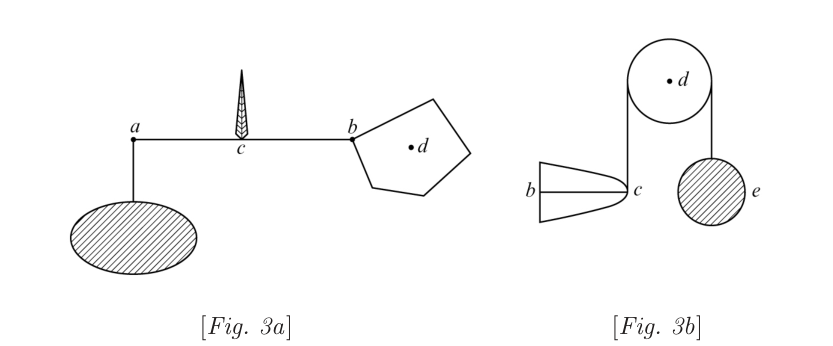
[Figs. 3a and 3b. At left a lever with a figure at each end. At right a wedge and two circular figures.]
38Nota [:] Figura centrobaryca [,] sic generaliter appello factam ex distantiis a fulcro, sive id punctum sive recta sive planum c. in figuram ductis, libere suspensa ex a. aequiponderat figurae fixae ex b. si ac = cb. ergo eidem figurae ex centro gravitatis suspensae. An sic potius[:] ut in figura b. data[,] fixa in c. fulcrum descendere vult, non possit, nisi linea recta elevet e. quae repraesentet centrobarycam. Sed nec hoc placet.
Note. By ‘centrobaryc figure’ I mean generally the figure made by multiplying a figure by the distances from a fulcrum c, whether a point, a straight line or a plane. Freely suspended from a it balances the figure fixed at b if ac = cb, and thus balances that same figure suspended from its centre of gravity. Or should it be put this way? As in the given figure b fixed at c the fulcrum tends to descend, it cannot do so unless it raises in a straight line e, which is to represent the centrobaryc figure. But this too does not please me.
399₂. PLAGULA SECUNDA
9₂. SECOND SHEET
40[Fig. 1. Arcus acb, adb et figura sinuum.]
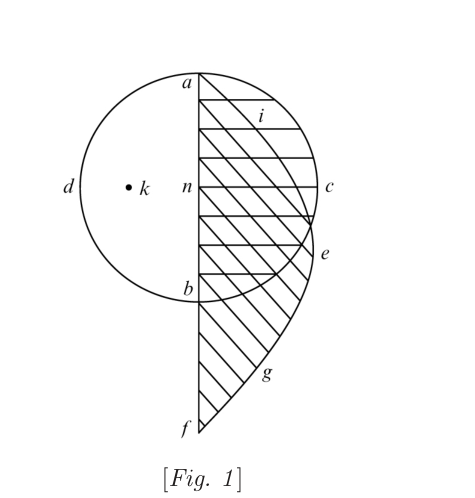
[Fig. 1. Two semicircular arcs, with ordinates on one side and centre of gravity k on the other.]
41Esto fulcrum ab. super quo aequiponderent arcus aequales et similes acb. adb. Ex punctis arcus acb. erigantur distantiae eorum a fulcro habebimus isostaticam[,] sic enim appellare placet arcus acb. scilicet superficiem cylindricam truncatam super eo erectam[,] intelligatur arcus acb. in rectam extendi, eique applicari sinus, ita ut basis seu linea media sit radius. Manifestum est figuram sinuum, de qua extat tractatus P. Fabry esse ipsam arcus isostaticam. Haec iam figura sinuum constituatur horizonti perpendicularis, et fulcro ita aiegf. applicetur, ut ab eo distet minimo, seu linea minore quavis data, necesse est eam aequiponderare tunc arcui adb. nec miretur quisquam lineam aequiponderare figurae, quia scilicet et distantia lineae infinities maior quam figurae. Iam arcus adb. ponderat velut ex centro suo gravitatis quod ponatur esse k. Ergo si ducatur arcus adb. in distantiam centri sui gravitatis a fulcro k. nempe nk. superficies producta quae erit curva cylindrica (cui circulus aequalis dari potest) aequabitur figurae sinuum. Iam figura sinuum semicirculi aequatur ut ait P. Fabry quadrato radii duplicato, hinc intelligi potest quomodo ex supposita quadratura circuli centrum gravitatis arcus adb. haberi possit (distat ut mox dicam a centro [n]. semicirculo per diametrum diviso seu arcu quadrantis).
Let ab be the fulcrum about which the equal and similar arcs acb and adb balance. At the points of the arc acb erect lines equal to their distances from the fulcrum. We shall have what I choose to call the isostatic figure of the arc acb, namely the truncated cylindrical surface erected on it. Imagine the arc acb straightened out and its sines applied to it so that the base or middle line is the radius. It is evident that the figure of sines, about which Father Fabri wrote a treatise, is the very isostatic figure of the arc. Set this figure of sines perpendicular to the horizon and apply it, aiegf, to the fulcrum at a minimum distance, that is, a line smaller than any given line. It must then balance the arc adb. Let no one be surprised that a line can balance a figure, since the distance of the line is infinitely greater than that of the figure. The arc adb weighs as though from its centre of gravity, which we take to be k. Thus, if the arc adb is multiplied by the distance of its centre of gravity from the fulcrum k [sic], namely nk, the surface produced, a curved cylindrical surface to which an equal circle can be given, will equal the figure of sines. The figure of sines of the semicircle, says Father Fabri, equals twice the square of the radius. From this we see how, assuming the quadrature of the circle, we can obtain the centre of gravity of the arc adb. As I shall say shortly, its distance from the centre [n] is the semicircle divided by the diameter, or the arc of the quadrant [sic].
43Regula generalis: figura isostatica data aequatur datae in distantiam centri gravitatis a fulcro ducto. Nam idem intelligi potest verum esse, etsi superficies non linea seu arcus assumtus fuisset.
General rule. The given isostatic figure equals the given figure multiplied by the distance of its centre of gravity from the fulcrum. The same reasoning applies if a surface had been taken in place of a line or arc.
44Figura isostatica, idem quod momentum.
[Addition.] An isostatic figure is the same thing as a moment.
46[Fig. 2. Circulus, semicirculus et radii.]
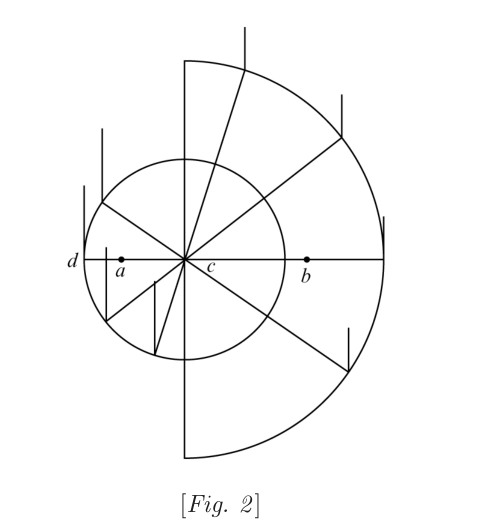
[Fig. 2. A circle and two right-hand semicircular outlines with radii through the common centre c.]
47Hinc si figura quaedam secetur recta per centrum gravitatis eius ducta, una quaedam portio in distantiam centri gravitatis huius portionis a centro gravitatis totius ducta, aequatur suae isostaticae, sed ita factae ut basis eius in semicircularem aequalem transformata, eique distantiae illae punctorum a centro gravitatis superpositae intelligantur[;] ita quia hic non videtur opus centro gravitatis portionis, aequiponderat (non aequatur tamen) si ipsa data ex altera parte in radium huius circuli ducta intelligatur. Radius autem circuli huius determinatur eo, quia necesse est deflecti in semicirculum. Sed est in his aliquid dubitationis, cur enim necesse est in semicirculum deflecti? Imo recte puto, ideo ut determinari possit, quantum a minimo absit. Et est semper eadem quantitas superficiei curvae cylindricae vel quasi, utcunque eam flectas. Iam centris gravitatis utrinque repertis superficierum cylindricarum alterius integrae cuius centrum b. alterius truncatae cui radii scilicet applicati sunt, figurae istae adhuc aequiponderabunt, ac proinde erunt ut distantiae centrorum gravitatis novorum a priore illo centro totius c. sc. ut ac. ad cb. Ergo si utraque dividatur per radium cd. prodibit illic arcus ille initio datus cuius isostaticam quaesivimus; ab altera parte isostatica per radium divisa, et haec erunt ut duae istae distantiae a centro gravitatis dicto. Universalissimae sunt hae propositiones et subtilissimae.
Hence, if a figure is cut by a straight line through its centre of gravity, any one portion multiplied by the distance of that portion’s centre of gravity from that of the whole equals its own isostatic figure. Construct it, however, by transforming its base into an equal semicircular line and imagining the distances of the points from the centre of gravity set upon it. Thus, since the centre of gravity of the portion seems unnecessary here, it balances (without, however, being equal to it) the given figure on the other side conceived as multiplied by the radius of this circle. The radius of the circle is determined by the requirement that the line be bent into a semicircle. There is some doubt here. Why must it be bent into a semicircle? On reflection I think this is right, so that one may determine how far it departs from the minimum. The magnitude of the curved cylindrical surface, or something like it, is always the same however one bends it. Find on each side the centre of gravity of the cylindrical surface, the one complete with centre b, the other truncated, to which the radii were applied. The figures will still balance, and will therefore be as the distances of the new centres of gravity from the old centre c of the whole, namely as ac to cb. Divide each by the radius cd. On one side there results the original arc whose isostatic figure we sought. On the other there is the isostatic figure divided by the radius. These will be as those two distances from the said centre of gravity. These propositions are of the utmost generality and subtlety.
49Porro quod supra dixi de linea sinuum potest transferri ad omnes lineas applicatarum, ut sunt applicatae quoque parabolae. Hinc intelligi potest dato nobis curvae parabolicae centro gravitatis, datum iri, eius longitudinem vel contra. Hinc cum habeamus pure centrum gravitatis curvae cycloeidalis eiusque curvae aequalem rectam, habebimus eius superficiei cylindricae truncatae aequalem figuram rectilineam, seu aequale rectangulum. Ergo rectangulum aequale figurae applicatarum eius. At figura applicatarum eius est ad ipsam cycloeidalem, ut curva cycloeidalis ad altitudinem eius. At haec ratio datur, igitur. Si quadrari potest linea applicatarum cycloeidis, etiam quadrata erit cycloeis. Quadrata autem cycloeide quadratus erit circulus. Quare si omnia ista vera essent, maxime illud de ratione figurae applicatarum ad figuram ipsam, haberemus quadraturam. Consideratio linearum applicatarum, ubi eadem videntur producere diversum, illustrare potest quae Galilaeus de rarefactione cum ostendit punctum sed quod reapse conus est minor quolibet dato esse ingenti circumferentiae circuli, infinitae 0. aequale
What I said above about the line of sines may be transferred to all lines of ordinates, including the ordinates of the parabola. Thus, given the centre of gravity of the parabolic curve, its length would be given, or conversely. Since we have outright both the centre of gravity of the cycloidal curve and a straight line equal to the curve, we shall have a rectilinear figure or rectangle equal to its truncated cylindrical surface, hence a rectangle equal to its figure of ordinates. But its figure of ordinates is to the cycloidal figure as the cycloidal curve to its height. That ratio is given, therefore … If the line of ordinates of the cycloid can be squared, the cycloid too will have been squared. With the cycloid squared, the circle will have been squared. If all this were true, especially the assertion about the ratio of the figure of ordinates to the figure itself, we should have the quadrature. Considering lines of ordinates, where the same things seem to produce different results, can throw light on Galileo’s remarks about rarefaction, where he shows that a point, which in reality is a cone smaller than anything given, is equal to the immense circumference of a circle, to an infinite 0. [The sentence breaks off in this form.]
50Si centrum gravitatis paraboloeidis curvae rectificatae haberi potest, etiam ipsa figura eius paraboloeidis poterit quadrari.
If the centre of gravity of the rectified paraboloidal curve can be obtained, the figure of that paraboloid itself can also be squared.
51Si in figura quadam quadrabili ut parabola detur centrum gravitatis curvae, dabitur recta curvae aequalis. Quod ita ostendo. Esto altitudo figurae curvilineae quadrabilis a. eius summa seu area b². distantia centri gravitatis curvae ab altitudine seu axe, quam notam pono c. quantitas curvae esto x. Quaeramus figuram applicatarum[,] ea ita est ad figuram ipsam, ut curva eius ad axem, erit ergo b²x/a. At eadem figura applicatarum est xc. Sed ita non perveniemus ad aequationem, cum utrobique possit deleri x. Ergo ostendetur c = b²/a. Ergo habebimus aliud theorema[:] distantiam centri gravitatis curvae a vertice aequari areae eius per axem divisae seu rectangulum sub axe et distantia centri gravitatis eius ab axe aequari areae curvae. Hinc omnium curvarum, quarum figurae quadrari possunt, reperiri potest centrum gravitatis. Et contra quarum curvarum habetur centrum gravitatis, earum figurae quadrari possunt, hinc rursus cycloeidis quadratura sequitur.
If in a quadrable figure such as the parabola the centre of gravity of the curve is given, a straight line equal to the curve will be given. [Leibniz writes ‘Wrong’ above this.] I show it as follows. Let the height of the quadrable curvilinear figure be a, its sum or area b², the distance of the centre of gravity of the curve from the height or axis c, which I assume known, and the magnitude of the curve x. Seek the figure of ordinates. It is to the figure as its curve is to its axis, so it will be b²x/a. Yet that same figure of ordinates is xc. This will not give us the equation we want, since x cancels on both sides. We shall therefore obtain c = b²/a. Thus we shall have another theorem, that the distance of the centre of gravity of the curve from the vertex equals its area divided by its axis, or that the rectangle on the axis and the distance of its centre of gravity from the axis equals the area of the curve. Hence the centre of gravity can be found for all curves whose figures can be squared. Conversely, if we have the centre of gravity of the curve, its figure can be squared. From this the quadrature of the cycloid follows once again.
53Porro hinc inveniri potest quam rationem habeant distantiae centrorum gravitatis diversarum curvarum, quando tum axium, tum arearum ratio habetur, erunt enim distantiae centrorum in ratione composita, ut arcus semicirculi ad arcum semiellipseos. Hinc si accedant Guldiniana de via centri gravitatis dabitur ratio superficiei sphaeroeidis lati ad superficiem sphaeroeidis compressi, quo posito si vera sunt Hugeniana de his superficiebus, data quadratura circuli vel ellipseos datur quadratura hyperbolae aut curvae parabolicae et vicissim. Ait enim Guldinus fieri ex curva in viam centri gravitatis ducta. Iam cum detur ratio sphaeroeidum ad sphaeras vel circulorum ad ellipses, dabitur et ratio distantiarum centrorum gravitatis ab axibus. Ergo erunt superficies sphaeroeides ad superficiem sphaerae in composita distantiarum centrorum grav. et arcuum generantium. Iam arcus generantes sphaeroeidem latam et compressam sunt aequales, ergo earum superficies sunt ut distantiae centrorum ab axi. Quarum ratio datur, dabitur ergo et ratio superficierum sphaeroeidis lati et compressi. Ex his iam datis dabitur ratio arcus circuli ad curvam parabolicam.
One may also find from this the ratio of the distances of the centres of gravity of different curves, provided the ratios both of their axes and of their areas are known. The distances of the centres will be in the compound ratio, for instance in the case of the semicircular arc and the semielliptical arc. Add Guldin’s results on the path of the centre of gravity. One will have the ratio of the surface of the broad spheroid to that of the compressed spheroid. On this assumption, if Huygens’s results about these surfaces are true, the quadrature of the circle or ellipse gives the quadrature of the hyperbola or parabolic curve, and conversely. For Guldin says that the surface is produced by the curve multiplied by the path of its centre of gravity. Since the ratio of the spheroids to spheres, or of circles to ellipses, is given, the ratio of the distances of the centres of gravity from the axes will be given too. Thus the spheroidal surfaces will be to the surface of the sphere in the compound ratio of the distances of the centres of gravity and of the generating arcs. The arcs generating the broad and compressed spheroids are equal. Their surfaces are therefore as the distances of the centres from the axis. Their ratio is given, and so the ratio of the surfaces of the broad and the compressed spheroid will be given. From these results one will have the ratio of a circular arc to the parabolic curve.
54Videndum iam an eadem applicari ita possint, ut ex dato centro gravitatis figurae totius, inveniri possit area, vel contra, et per consequens ex uno horum, area, centrum areae, centrum curvae, reliqua. Caeterum hinc illud quoque intelligi potest curvas ipsas cognitas, nihil in hoc quidem loco seu quantum ex praesenti theoremate colligi potest ad caetera cognoscenda conferre, nisi et eorum centra gravitatis cognoscantur. Et vicissim ex omnibus caeteris non posse, ope huius quidem theorematis colligi curvas. Sed altera methodus ipsarum centra, et alia Guldini etc. forte aliquid conferunt. Caeterum haec omnia ex eo pendent[:] Figuram applicatarum esse ad ipsam figuram ut curva ad verticem, ut in linea sinuum. Hoc posito restabunt nobis tantum recta aequalis arcui elliptico, et curvae hyperbolicae. Quodsi etiam reperta quadratura constat ratio superficierum sphaeroeidum longorum ad sphaericas. Iam tum habebitur et ratio ellipticae ad circularem seu rectam, ut adeo sola curva hyperbolica sit superfutura.
We must now see whether the same reasoning can be applied to find the area from the centre of gravity of the whole figure, or conversely, and hence to find the rest from any one of these three, the area, its centre, or the centre of the curve. It can also be understood that knowledge of the curves themselves contributes nothing here towards knowing the rest, at least so far as the present theorem goes, unless their centres of gravity are also known. Conversely, from all the other data the curves cannot be inferred by this theorem. But the other method, their centres, and the other results of Guldin and so forth may contribute something. All this depends on the figure of ordinates being to the figure itself as the curve is to the vertex, as in the line of sines. On this assumption there will remain for us only the straight line equal to the elliptical arc and to the hyperbolic curve. If, with the quadrature found, the ratio of the surfaces of elongated spheroids to spherical surfaces is also known, then the ratio of the elliptical line to the circular or straight line will be obtained, so that only the hyperbolic curve will remain.
56Quodsi alia arte dato centro curvae recta ei aequalis haberi potest, cum posita hyperbolae quadratura detur centrum curvae eius, tunc et recta eius curvae aequalis habebitur. Sed omnia haec ex hypothesi.
If by some other means a straight line equal to a curve can be obtained when its centre is given, then, since the quadrature of the hyperbola gives the centre of its curve, a straight line equal to that curve will also be obtained. But all this is hypothetical.
57Si hactenus ratiocinata vera sunt habemus centrum gravitatis superficiei hemisphaerii, imo et quadrantis hemisphaerii. Nam altitudo hemisphaerii basi perpendiculariter erecta ad horizontem est circulus, eo dividatur area hemisphaerii, prodibunt ⅔ radii. His ergo distat centrum gravitatis superficiei hemisphaerii a basi. Etiam quadrantis hemisphaerii, distabit enim ⅔ partibus radii (divisa scilicet area quadrantis hemisphaerii per basin, quadrantem semicirculi). Hinc centra gravitatis hemisphaerii et duorum quadrantium hemisphaerii sunt in eadem recta. Hinc videntur et dari posse centra gravitatis omnium superficierum segmentorum, distabunt nimirum a basi tertia parte sinus versi, sed non semisegmentorum, distabunt enim a basi tertia parte sinus versi, sed non scimus qua parte sinus recti distent ab altitudine seu sinu verso. Hinc et centrum gravitatis superficiei coni determinari potest distare a basi ⅓ altitudinis, ideoque absolute habetur. At superficiei semiconi non habetur, etsi enim detur distantia eius a basi semiconi, quia datur ratio semiconi ad semicirculum, non tamen datur distantia ab altitudine coni seu triangulo, nisi supposita ratione areae coni ad triangulum generans, quae vero ratio cognosci non potest, nisi simul et quadratura circuli habeatur.
If our reasoning so far is true, we have the centre of gravity of the surface of the hemisphere, indeed of a quadrant of the hemisphere. For the height of the hemisphere erected perpendicular to the base towards the horizon is a circle. Divide the area of the hemisphere by it. The result will be two thirds of the radius. By this much, then, the centre of gravity of the surface of the hemisphere is distant from the base [sic]. The same for the quadrant of the hemisphere. It will be two thirds of the radius away, taking the area of the quadrant of the hemisphere divided by the base, a quadrant of the semicircle. Thus the centres of gravity of the hemisphere and of two quadrants of the hemisphere lie on the same straight line. It seems that the centres of gravity of all the surfaces of segments could also be given, since they will be a third of the versed sine away from the base. This is insufficient for half-segments. They will be a third of the versed sine away from the base, but we do not know by what fraction of the right sine they are distant from the height or versed sine. One can thus determine also that the centre of gravity of the surface of a cone is one third of its height away from its base, and so it is obtained outright. We lack it for the surface of a half-cone. Although its distance from the base of the half-cone is given, since the ratio of the half-cone to the semicircle is given, its distance from the height of the cone, or triangle, is not given unless the ratio of the area of the cone to the generating triangle is assumed. That ratio cannot be known without also having the quadrature of the circle.
58Cum detur quadratura parabolae, dabitur quoque centrum gravitatis curvae parabolicae, nimirum distabit a basi ⅔ axis. Iam datur superficiei conoeidis aequalis circulus per inventa Hugenii. Et per inventa Guldini superficies conoeidis parabolici fit ex ductu curvae parabolicae generantis in viam sui centri gravitatis seu ex rectangulo sub circuli circumferentia (cuius radius est distantia centri ab axe) et curva parabolica. Ponatur circuli circumferentia esse z. curva parabolica esse x. erit superficies conoeidis zx. At vero eadem est aequalis circulo cuius radius datur a. ergo eius circumferentiae ratio dabitur ad z. ea ratio esto β. Ergo zx = za/β. ergo x = a/β. Curvae ergo semiparabolicae dabitur ratio ad rectam, si scilicet ex praedictis eius centrum gravitatis detur. Nimirum non tantum centrum gravitatis datur curvae parabolicae, sed et curvae semiparabolicae.
Since the quadrature of the parabola is given, the centre of gravity of the parabolic curve will likewise be given. Its distance from the base will be two thirds of the axis. [Leibniz marks this ‘Error’.] Now Huygens’s discoveries give a circle equal to the surface of the conoid. By Guldin’s discoveries the surface of the parabolic conoid is generated by multiplying the generating parabolic curve by the path of its centre of gravity, that is, by taking the rectangle under the parabolic curve and the circumference of the circle whose radius is the distance of its centre from the axis. Put the circumference of the circle equal to z, the parabolic curve to x. The conoid’s surface will be zx. But it also equals the circle whose radius a is given. Hence the ratio of its circumference to z will be given. Let that ratio be β. Then zx = za/β and x = a/β. Thus the ratio of the semiparabolic curve to a straight line will be given, if its centre of gravity is given by the foregoing. That is to say, the centre of gravity of the semiparabolic curve as well as that of the parabolic curve is given.
60Hinc iam habemus et quadraturam hyperbolae ex istis scilicet positis; habebimus etiam superficiei fusi parabolici aequalem circulum. Posita iam hyperbolae quadratura facile cum Hugenio inveniemus superficiei conoeidis hyperbolici aequalem circulum. Hinc iam porro habebimus curvae hyperbolicae aequalem rectam, quia data hyperbolae quadratura habemus eius curvae centrum gravitatis, ergo et viam centri gravitatis curvae rotatae, ergo rectangulum sub circumferentia circuli et curva hyperbolica, aequale rectangulo sub circumferentia circuli et recta quadam cognita, ergo curvae hyperbolicae rectam cognitam aequalem.
With these assumptions we now also have the quadrature of the hyperbola. We shall have a circle equal to the surface of the parabolic spindle as well. Assuming the quadrature of the hyperbola, it will be easy to find with Huygens a circle equal to the surface of the hyperbolic conoid. Thus we shall also obtain a straight line equal to the hyperbolic curve. Given the quadrature of the hyperbola we have the centre of gravity of its curve, and hence the path of the centre of gravity of the curve as it revolves. Consequently the rectangle under the circular circumference and the hyperbolic curve equals the rectangle under the circular circumference and a certain known straight line. We therefore have a known straight line equal to the hyperbolic curve.
61Hinc etiam facile invenientur superficies conoeidis cycloeidalis, et conoeidis figurae sinuum. Illa quidem supposita, haec ne supposita quidem circuli quadratura. Imo utrobique eam supponi necesse est.
The surfaces of the cycloidal conoid and of the conoid of the figure of sines will likewise be easily found. For the former one assumes the quadrature of the circle, for the latter one need not even assume it. No, it must be assumed in both cases.
62Hinc iam videtur sequi quae figurae quadrari possunt, quarumque per consequens datur centrum gravitatis curvarum, in iis dari curvis aequales rectas, supposita circuli quadratura. Nam superficies [curva] fit ex linea curva et arcu circuli, per consequens posita quadratura, ex linea curva et recta cognita. Iam videtur area solidi superficie curva contenti produci posse ex superficie curva et replicata. Dubito tamen, imo id erroneum. Credo id ergo omittendum est.
It now seems to follow that, for figures which can be squared and for whose curves the centre of gravity is consequently given, straight lines equal to their curves are given, assuming the quadrature of the circle. For the [curved] surface is produced by the curved line and a circular arc, and hence, given the quadrature, by the curved line and a known straight line. Now it seems that the content of the solid enclosed by the curved surface could be produced from the curved surface folded back. Yet I doubt this. Indeed it is erroneous. I therefore think it should be omitted.
64[Fig. 3. Figura abe, axis ab, applicatae.]
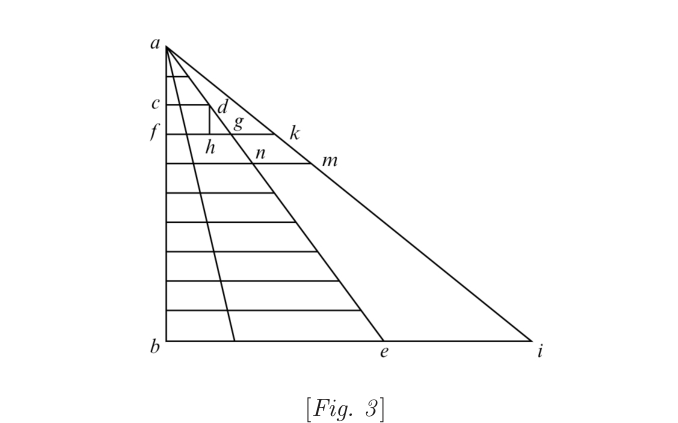
[Fig. 3. A bounded figure on ab, with horizontal ordinates, and the adjacent construction extended to i.]
65Si sit figura quaevis abe. in qua ad axem ab. applicatae cd. be. etc. sunt perpendiculares[;] eaedemque applicatae in terminationem earum ae. ducantur[,] producetur figura quam vocare liceat lineam applicatarum, quae erit ad datam abe. ut ae. ad ab. Huius exemplum est linea sinuum a Fabrio considerata. Hinc si omnes illae cd. be. ita circumagi intelligantur ut ex obliquis ad ae. fiant perpendiculares, manifestum est productum maius quam ante fore. Unde sequitur ex eodem fieri maius modo minus. Sed ratio huius rei est quia nunquam figura dividitur in lineas, semper in trapezia tantum; trapezia autem ista intelligantur minora quolibet dato, quo facto patet trapezium cdfg. si recta cf. et chorda dg. intelligantur minores quibuslibet rectis datis a rectangulo cfdh. non differre nisi puncto, et si omnia ista puncta in tota figura negligantur, non nisi lineam negligi. Ergo censeatur trapezium cfdg. aequale rectangulo cdf. vel cfg. vel potius utrique, seu cd. fg. censeantur aequales quantum ad huius rectanguli productionem. Ergo rectangulum cf. ductae in fg. ad rectangulum dg. ductae in fg. est ut cf. ad dg. Hinc si semper eadem esset ratio chordae ad altitudinem seu [dg. ad cf.] demonstrata esset propositio.
Let abe be any figure in which the ordinates cd, be, etc., are perpendicular to the axis ab. If these same ordinates are multiplied by their boundary ae, one produces a figure which may be called the line of ordinates. It will be to the given figure abe as ae is to ab. An example is the line of sines considered by Fabri. If all those lines cd, be are imagined to turn so that, from being oblique to ae, they become perpendicular to it, the product will plainly be greater than before. It follows that the same things produce now a greater, now a smaller quantity. The reason is that a figure is never divided into lines but only into trapezia. Suppose these trapezia smaller than anything given. If the line cf and the chord dg are taken smaller than any given straight lines, the trapezium cdfg differs from the rectangle cfdh by only a point, and if all such points in the whole figure are neglected, one neglects only a line. Let the trapezium cfdg then be reckoned equal to the rectangle cdf or cfg or rather to both, that is, let cd and fg be reckoned equal for producing this rectangle. Thus the rectangle formed by cf multiplied by fg is to that formed by dg multiplied by fg as cf to dg. If the ratio of the chord to the height, that is [dg to cf], were always the same, the proposition would be demonstrated.
66Sed ut huic quoque defectui mederi tentemus ita procedendum est: ae. etiamsi curva sit deflexa in rectam, et applicatae prioris antea obliquae ipsi, nunc ipsi quoque rectae intelligantur. Dividatur huius lineae applicatarum altitudo seu ae. recta vel in rectam extensa in quotcunque partes aequales, ab. in totidem. Eaeque partes intelligantur esse minores qualibet assignabili, erunt rectangula singula ad singula in composita altitudinum et basium. Sunt autem altitudines semper eaedem, et quidem ut figurae, at basium ratio continue variat. Ergo nondum sufficiens remedio malum.
To try to remedy this defect too, proceed as follows. Even if ae is curved, let it be bent into a straight line. The ordinates of the first figure, formerly oblique to it, are now to be understood as at right angles to it as well. Divide the height of this line of ordinates, that is, ae either straight or stretched into a straight line, into any number of equal parts, and ab into as many. Imagine these parts smaller than any assignable. Each rectangle will be to its counterpart in the compound ratio of the heights and bases. The heights are always the same, and indeed as the figures, whereas the ratio of the bases continually varies. The remedy is still insufficient for the difficulty.
68Ergo aliter et sic quidem procedatur[:] sumatur in ipsa figura applicatarum radius pro altitudine, deflexa pro basi, et aequisecetur radius seu altitudo, tam in figura applicatarum, quam in figura data. Et sit bi = ae. extensae[;] manifestum est, cum sint duo triangula eiusdem basis [,] fore ut altitudines[,] nam ut be. ad ei. ita fg. ad gk.
Try another procedure. In the figure of ordinates itself take the radius as the height and the line bent round as the base. Divide the radius or height equally both in the figure of ordinates and in the given figure. Let bi equal the straightened ae. It is evident, since there are two triangles on the same base, that they will be as their heights, for be is to ei as fg is to gk.
69Obi.[:] sed ista vera forent, si duae illae figurae essent triangula.
Objection. This would be true if the two figures were triangles.
70Respondeo[:] etsi non sint triangula, seu etsi ae. et ai. non sint rectae, sunt tamen figurae homogeneae, id est ut est be. ad ei. ita est fg. ad gk.
I reply that even if they are not triangles, that is, even if ae and ai are not straight, the figures are nevertheless homogeneous. That is to say, be is to ei as fg is to gk.
71Hoc probandum. An sic probari potest. Omnes applicatae utriusque figurae sunt sinus crescunt ergo utrobique ut sinus, ergo figurae sunt homogeneae, cumque sint eiusdem basis, erunt ut altitudines. Sed opus est methodo exactiore et plane convincente.
This must be proved. Can it be proved as follows? All the ordinates of both figures are sines, and in both cases increase as sines. The figures are therefore homogeneous and, since they have the same base, will be as their heights. Yet we need a more exact and thoroughly convincing method.
72[Fig. 4a, Blindzeichnung, et Fig. 4b.]
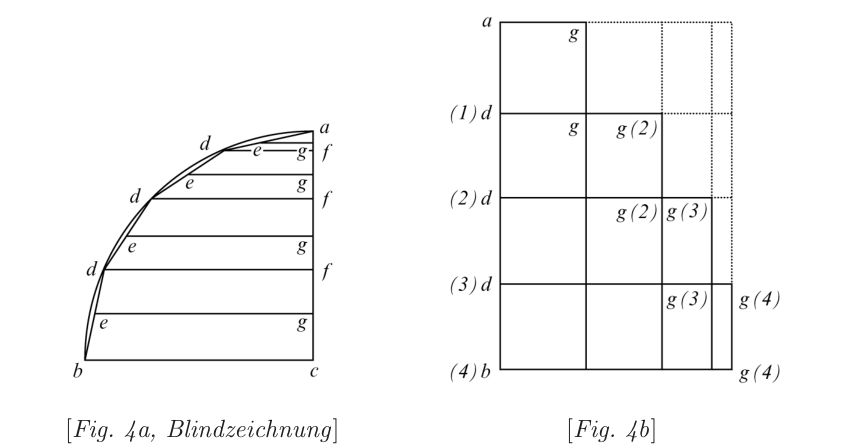
[Figs. 4a and 4b. At left the drawing labelled Blindzeichnung in the edition, with ordinates of a quadrant. At right the divisions rearranged in a rectangular figure.]
73= distantiae centri gravitatis arcus quadrantis ab axe, ductae in arcum quadrantis.
[Addition to Fig. 4b.] Equals the distance of the centre of gravity of the quadrant arc from the axis, multiplied by the quadrant arc.
75Now suppose z + x + u + t … = a, the terms corresponding to gg(2), g(2)g(3), g(3)g(4), etc. Multiply by b in this way, zb + 2xb + 3ub + 4tb, etc. = ? [=] x.
76Hoc x. si detrahatur rectangulo sub AB et BG. habebitur residuum figura sinuum. Cum autem b. sit punctum, ideo summa linearum: gg(2) ⌢ 1 + g(2)g(3) ⌢ 2 + g(3)g(4) ⌢ 3 (ducta in b.) aequabitur differentiae inter rectangulum AGB et lineam applicatarum propositam. Ipsa linea applicatarum eodem modo composita intelligi potest ex iisdem terminis, sed inverso modo, ut quod in uno est ultimum et per maximum numerum multiplicandum in altero sit primum et per unitatem multiplicatur. Ponatur divisio non esse nisi in 4 partes erit haec dispositio[:]
Subtract this x from the rectangle on AB and BG. The remainder will be the figure of sines. Since b is a point, the sum of the lines gg(2)·1 + g(2)g(3)·2 + g(3)g(4)·3, multiplied by b, equals the difference between rectangle AGB and the proposed line of ordinates. The line of ordinates itself can be conceived as made of the same terms in reverse order. What comes last in the one and must be multiplied by the greatest number comes first in the other and is multiplied by one. Let the division be into only four parts. The arrangement will be as shown.
77Rectangle. For the successive lengths g(3)g(4), g(2)g(3), gg(2), the coefficients of b in the figure of ordinates are 1, 2, 3, and in the remainder 3, 2, 1. Their sums for the whole rectangle ABG(4) are 4, 4, 4, each multiplied by b.
78Porro rectangulum istud totum si curva data ponatur arcus quadrantis aequabitur semicirculo.
If the given curve is taken to be the arc of a quadrant, that whole rectangle will equal a semicircle.
79Porro si in ad. vel dd. etc. non ducatur eg. sed totum edgf. idem utique prodibit, et erit recta, et erit dg(2). rectang. ad degf rectang. ut de. ad gf. Sunt autem de. semper eaedem, at fg. diminuuntur.
Further, if we multiply ad or dd, etc., by the whole edgf instead of by eg, the result will in any event be the same and will be a straight line. The rectangle dg(2) will be to the rectangle degf as de is to gf. The lengths de are always the same, while fg diminishes.
80DE = [AE] esto a.[,] fg. esto x.[,] EG vel [DF ] esto z. Rectangula ita crescent in trilineo dato:
Let DE = [AE] be a, let fg be x, and let EG or [DF] be z. The rectangles in the given trilinear figure will increase as follows.
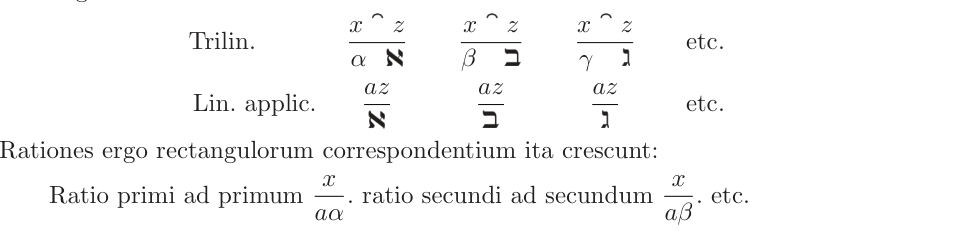
81In the trilinear figure the successive products are (x/α)(z/א), (x/β)(z/ב), (x/γ)(z/ג), etc. In the line of ordinates the successive terms are az/א, az/ב, az/ג, etc. The ratios of the corresponding rectangles thus run as follows. First to first, x/(aα), second to second, x/(aβ), and so on.
83Figurae sinuum aequalem exhibuit Pascalius, Ettonville traité des sinus, prop. [1]. Et quidem ostendit esse aequalem quadrato radii. Quo posito haberi poterit centrum gravitatis arcus quadrantis, productum scilicet ex quadrato radii per arcum quadrantis diviso. Ponatur radius esse a. eius quadr. a². arcus quadrantis x/4. erit x. circumferentia et erit 4a²/x = distantiae centri gravitatis ab axe et basi.
Pascal exhibited an area equal to the figure of sines in Dettonville’s Treatise on Sines, proposition [1]. He showed that it equals the square of the radius. Given this, the centre of gravity of a quadrant arc can be obtained by dividing the square of the radius by the quadrant arc. Let the radius be a, its square a², the quadrant arc x/4. Then x is the circumference and 4a²/x is the distance of the centre of gravity from the axis and from the base.
84Invenimus figurae sinuum versorum aequale semper segmentum circuli, imo si quando omnes sinus versi summantur totum semicirculum. Unde summa omnium sinuum versorum aequalis summae omnium ordinatarum. Summa sinuum versorum est summa triangularis partium in quas secatur axis a sinubus ad axem. Summa simplex earum partium est ipse axis. Summa earum partium pyramidalis erit summa ipsorum segmentorum. Hinc aliae quoque summae colligentur iuxta tractatum Pascalii de his summis. Hinc illud sequitur elegantissimum, si primus sinus versus sumatur semel, 2ᵈᵘˢ bis, tertius ter etc. idem plane produci, seu summam aequari segmento.
We have found that a circular segment always equals the figure of versed sines, indeed the whole semicircle when all the versed sines are summed. Hence the sum of all the versed sines equals the sum of all the ordinates. The sum of the versed sines is the triangular sum of the parts into which the axis is cut by the sines to the axis. The simple sum of these parts is the axis itself. Their pyramidal sum will be the sum of the segments themselves. Other sums too can be deduced according to Pascal’s treatise on these sums. A very elegant consequence follows. If the first versed sine is taken once, the second twice, the third three times, etc., precisely the same result is produced, that is, the sum equals the segment.
85[Fig. 5. Bilanx ab cum perpendicularibus de, bc.]
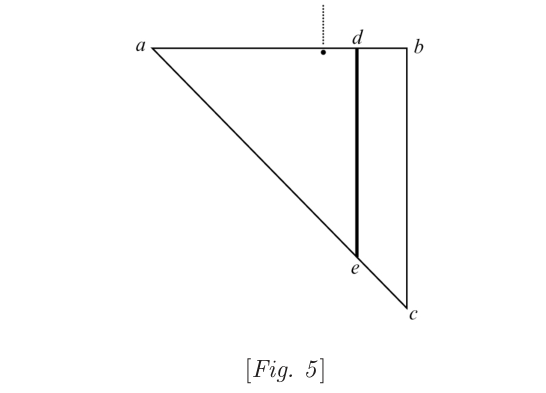
[Fig. 5. The horizontal balance ab, with verticals de and bc meeting the oblique side.]
87Sit iam [summa] partium in quas axis dividitur abc. Sit quasi bilanx ab. ex qua pendent pondera id est lineae illae seu sinus recti bc. de. etc. Quodsi iam reperiri posset punctum aequilibrii[,] brachium unum (a quo latere series triangularis incipit) ductum in summam partium aequabitur summae totorum seu triangulari, seu segmento. Hinc si illa partium ratio posset dari, daretur non tantum quadratura sed et sectio angulorum universalis res ⟨praestantior⟩ quadratura.
Let abc now be the [sum] of the parts into which the axis is divided. Let ab be a sort of balance from which weights hang, namely the lines or right sines bc, de, etc. If the point of equilibrium could be found, one arm (on the side from which the triangular series begins) multiplied by the sum of the parts would equal the sum of the wholes or the triangular sum, that is, the segment. If the ratio of those parts could be given, one would obtain both the quadrature and a universal division of angles, something ⟨more excellent⟩ than quadrature.