1[S. 67] Willibrordi Snellii regulam Refractionis ex Manuscriptis tribus eius libris opticis apud filium visis refert Isaacus Vossius lib. de Luce Cap. 16.
Isaac Vossius reports Willebrord Snell’s rule of refraction in chapter 16 of his book on light, from three manuscript books on optics by Snell which he saw in the possession of Snell’s son.
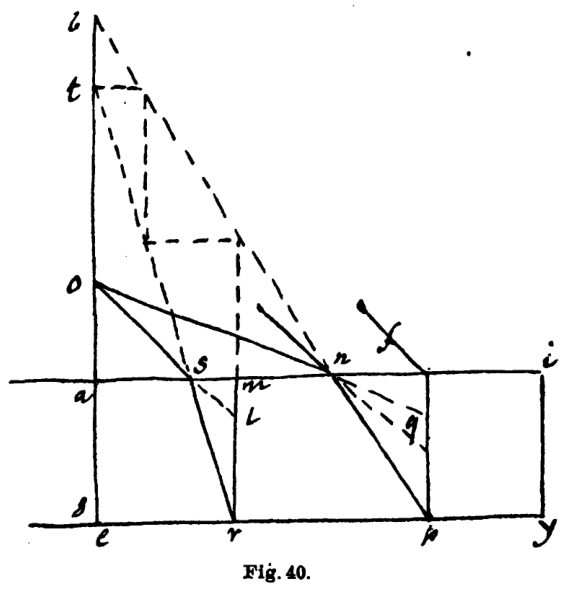
2Sit vas parallelepipedum aquae plenum AEIY, oculus in o positus, rem in E sitam non videbit suo loco, sed altiorem velut in g et rem in r sitam velut in l et in p sitam velut in q idque ea conditione ut radius verus ae sr np ad apparentem ag sl nq eandem servet rationem.
Let AEIY be a vessel in the shape of a parallelepiped, full of water. An eye placed at o will see an object at E above its true position, as if at g, an object at r as if at l, and one at p as if at q. The condition is that each true ray, ae, sr or np, bears the same ratio to the corresponding apparent ray, ag, sl or nq.
3Hanc eius sententiam ex naturali aliqua causa deducere, difficile videtur, nam obstaculum medii densioris videri poterat debere corpus facile apparere potius remotius, quam propius debilitando radios, quasi ex longinquo venirent, et si dimensio sumenda in altitudine, cur ratio itinerum habetur. Neque enim apparet, cur eadem medii resistentia faciat rationem eandem radiorum. Si regula haec vera est, etiam pro medio oai continuando rs versus t; et pn versus b. Erit so ad st, ut on ad nb. sed hoc obiter.
It seems difficult to derive this view of his from a natural cause. One might think that the obstruction offered by the denser medium would readily make the body appear farther away rather than nearer, by weakening the rays as if they came from a distance. And if the measurement is to be taken vertically, why use the ratio of the paths? It is hardly evident why the same resistance of the medium should produce the same ratio of the rays. If the rule is true, then for the medium oai as well, on prolonging rs towards t and pn towards b, so will be to st as on is to nb. But this in passing.
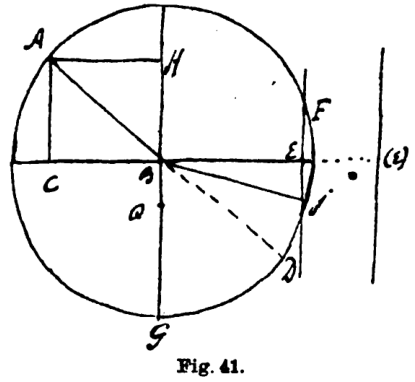
4Cartesius in dioptricis ita procedit. corpus vel lumen linea AB incidens in medium CEG, cuius superficies CE, in ipsam impingit secundum duas diversas determinationes CB et HB et quidem medium non opponitur directioni CB, sed directioni HB. Ponamus, resistentiam medii CEG esse duplam resistentiae prioris medii AHB. Utique perrumpendo linteum CBE (vel irrumpendo in medium CEG) perdit dimidiam suae velocitatis partem, atque adeò duplum temporis ei impendendum est, ut infra B ad aliquod punctum circumferentiae (verbi gratia J vel D) pertingat (nam cum linea BJ vel BD sit aequalis lineae AB et velocitas sit dimidia prioris, duplo tempore opus habebit ad ipsam lineam, qualis est BJ vel BD, percurrendam).
Descartes proceeds as follows in his Dioptrics. A body or light falling along AB upon the medium CEG, whose surface is CE, strikes that surface with two distinct determinations of motion, CB and HB. The medium offers resistance to the direction HB alone. Suppose that the resistance of CEG is twice that of the first medium AHB. In breaking through the cloth CBE (or breaking into the medium CEG), the body loses half its speed. It must therefore spend twice the time reaching some point on the circumference below B, for instance J or D. For BJ or BD equals AB, and at half its former speed it will take twice the time to travel such a line as BJ or BD.
5Sed [S. 68] cum nihil ex dispositione, qua dextrorsum ferebatur, intereat, in duplo istius temporis, quo à linea AC pervenit in HB, duplum eiusdem itineris in eandem partem conficere debet eodemque momento, quo accedit ad circumferentiam infra B, etiam accedet ad punctum E posito BE esse duplum ipsius CB ac proinde, si per E ducatur parallela ipsi AC, nempe FEJ, erit radius BJ refractus quaesitus. Quodsi punctum E cadat extra diametrum seu circulum, ut in (E), ita ut parallela per E ducta circulum secare non possit, impossibile est fieri refractionem et fiet reflexio perinde, ac si superficies CE fuisset solida.
But since it loses none of its disposition to move to the right, in twice the time it took to go from the line AC to HB it must cover twice the distance in the same direction. At the very moment it reaches the circumference below B, it will also have reached E in its rightward progress, taking BE to be twice CB. Accordingly, if a parallel to AC, namely FEJ, is drawn through E, BJ will be the refracted ray sought. If E falls beyond the diameter, outside the circle, as at (E), so that the parallel through E cannot cut the circle, refraction is impossible. Reflection will occur just as if the surface CE had been solid.
6Sic occurrunt nonnullae difficultates. Quamvis haec potissima est: si potentia, qua corpus vel radius tendit à B versus C, manet integra, sequitur tantum potentiam, quà tendit à B versus G, diminui, adeoque fieri duplo minor et itaque, quo tempore corpus percurrit CB, eodem percurret BM aequalem ipsi BC. Sed eodem tempore tantùm infra B usque ad Q, posito BQ esse dimidium ipsius AC, vel saltem quadratum ipsius BQ esse dimidium quadrati AC.
Several difficulties arise here. This is the chief one. If the power by which the body or ray tends from B towards C remains intact, it follows that only the power by which it tends from B towards G is diminished, and so becomes half as great. Hence, in the time the body takes to travel CB, it will travel BM equal to BC. But in the same time it will descend below B only as far as Q, taking BQ to be half of AC, or at least the square of BQ to be half the square of AC.
7Nam cum Cartesius ipse potentiam, quae tendit versus E conservavit integram, utique fatendum est illi, potentiam solam, qua corpus tendit versus G, diminui, nec proinde liberum est illi, diminuere postea potentiam seu dicere, corpus dimidia celeritate pervenire à B ad circumferentiam, qua venit à circumferentia ad B; nam ille motus ad circumferentiam vel à circumferentia jam conatum à B ad E in se continet. Nam verbi gratia conatus à B ad J componitur à conatu à B ad E et à conatu ab E ad J, quod si ergo totus conatus à B ad circumferentiam, B ad J, dimidius fit, etiam totus conatus à A ad B fit dimidius. Et quemadmodum conatus à circumferentia superiore ad centrum B composuerat ex uno parallelo, alteri perpendiculari ita conatus à centro ad circumferentiam inferiorem ex duobus his conatibus componere debebat.
For since Descartes himself has kept the power directed towards E intact, he must of course admit that only the power by which the body tends towards G is diminished. He is consequently no longer at liberty to diminish the power afterwards, or to say that the body travels from B to the circumference at half the speed with which it came from the circumference to B. That motion to or from the circumference already includes the endeavour from B towards E. For example, the endeavour from B to J is compounded of that from B to E and that from E to J. If, then, the whole endeavour from B to the circumference, B to J, is halved, the whole endeavour from A to B is halved as well. Just as he had compounded the endeavour from the upper circumference to the centre B out of one parallel and one perpendicular endeavour, so he ought to have compounded the endeavour from the centre to the lower circumference out of these two.
8Sed error sine dubio ortus est ab eius errore generali, quod separari possit determinatio à vi. Nam ita videtur sentire vim universam absolutè sumtam esse dimidiatam adeoque corpus dimidia celeritate ferri, sed vim respectivam, seu vim, qua tendit à B versus E conservari. sed quomodo vis respectiva conservari possit integra, si diminuatur vis absoluta, id equidem non capio. Nam vim respectivam considero, ut partem vis absolutae.
But the error doubtless arose from his general error of thinking that determination can be separated from force. He seems to think that the whole force, taken absolutely, is halved, so that the body moves at half speed, while the relative force, or the force by which it tends from B towards E, is conserved. How the relative force can be preserved entire if the absolute force is diminished, I for my part do not grasp. For I consider the relative force a part of the absolute force.
9Praeterea non video, quomodo dicere possit, partem superficiei aquae certum facere angulum ad radium, si lumen in motu materiae subtilis consistit, cuius ratione profecto aqua, utrumque nobis plana videatur, innumeras habeat inaequalitates. Hinc colligo, lumen non posse esse seu usque adeò subtilem adeòque non posset à nobis percipi, quem angulum ad corpora à nobis aut natura sensibili polita habent. Certè enim, si materiam subtilem respiciens [!] more Cartesii, fortasse in paucissimis locis aquae, vel vitri superficies vera superficiei sensibili illi respondebit, quam nos imaginamur et supponimus, respondebit ob valles et monticulos innumerabiles.
Further, I do not see how he can say that part of the surface of the water makes a definite angle with the ray, if light consists in the motion of subtle matter. In relation to that matter the water surely has innumerable irregularities, however flat it may appear to us. From this I infer that light cannot be [of a medium] so very subtle; otherwise we could not perceive what angle [the rays] make with bodies polished by us or by nature to the level perceptible to our senses. For surely, if one considers subtle matter in Descartes’s fashion, perhaps at very few places will the true surface of the water or glass correspond to that perceptible surface we imagine and assume, on account of its innumerable valleys and little hills.
10Unde sequitur luminis actionem in aliquo liquore valde facto crasso subsistere, cuius respectu montes illi et valles negligi possunt, et planitiem [S. 69] superficiei non impedire censentur, quemadmodum montes et valles non censentur impedire rotunditatem terrae. Et haec ratio demonstrat, mea sententia, impossibile esse, ut lumen sit actio primi elementi, sed videtur lumen esse actio liquoris cuiusdam, qui in comparatione nostra subtilis est, sed satis crassus et à primis principiis remotus est, adeoque et causa specialiore indiget.
It follows that the action of light subsists in some comparatively coarse fluid, in relation to which those mountains and valleys can be disregarded and are judged no obstacle to the flatness of the surface, just as mountains and valleys are judged no obstacle to the roundness of the earth. In my view this reasoning shows that light cannot be the action of the first element. Light appears to be the action of a certain fluid which is subtle in relation to us, but fairly coarse and far removed from first principles, and hence also requires a more particular cause.
11Tertia est difficultas in Cartesii sententia, quod non explicat, quomodo lumen in medio rariore vel molliore majorem resistentiam inveniat. nam tametsi dicat, parietes pororum corporis mollis magnam impetus partem intercipere, tamen non apparet, quomodo id pertineat ad extimam superficiem, cum ea differentia non in superficie, sed in ipso corpore sentiri tantùm possit.
A third difficulty with Descartes’s view is that he does not explain how light encounters greater resistance in a rarer or softer medium. Although he says that the walls of the pores of a soft body intercept a large part of the impetus, it does not appear how this bears on the outermost surface, since that difference can be felt only in the body itself.
12Quarta est, etsi ponamus, in vim luminis a resistentia diminuti parere refractionem à perpendiculari, non tamen apparet, quomodo postea iterum vim amissam recipiat, cum denuo corpore refringente egreditur.
The fourth is that even if we suppose that the reduction of the force of light by resistance produces refraction away from the perpendicular, it is still unclear how the light afterwards recovers the force it lost when it emerges again from the refracting body.
13Itaque concludo sententiam Cartesii de refractione non esse demonstratam. Contra ponamus, servari conatum perpendicularem tantùm nimirum, seu corpus eodem tempore, quo percurrit latitudinem BM (aequalem ipsi CB) descendere de B in Q, ita ut BQ sit in certa ratione ad AC, sequitur refractiones non sinibus BE, sed sinibus versis esse mensurandas, sinibus rectis manentibus iisdem.
I conclude, then, that Descartes’s view of refraction has not been demonstrated. Suppose instead that only the perpendicular endeavour is conserved: that is, that in the same time in which the body traverses the width BM (equal to CB) it descends from B to Q, with BQ in a fixed ratio to AC. It follows that refractions are to be measured by versed sines, rather than by the sines BE, the ordinary sines remaining the same.
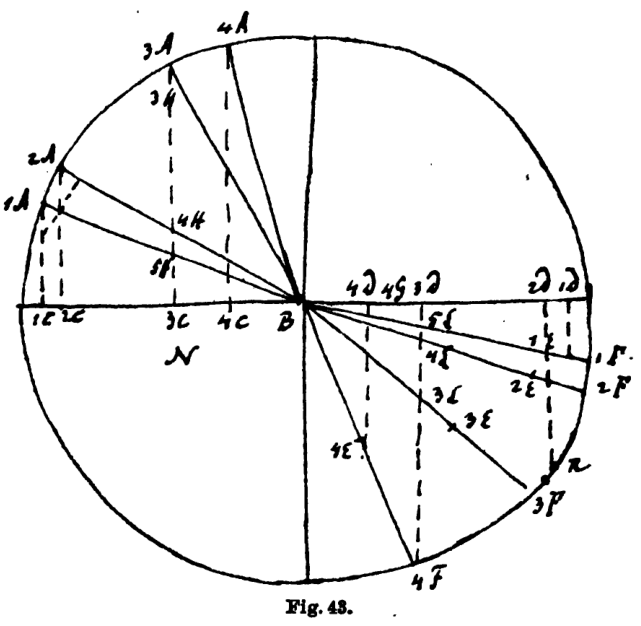
14In nova figura ex puncto A (verbi gratia 1 A, 2 A, 3 A) radius incidit in B. inde refringitur in E. ponamus, sinum CB ante refractionem aequari sinui post refractionem, erit sinus anguli complementi DE dimidius sinus complementi AC. Verum, si ad circumferentiam usque producantur radii refracti BE, nempe usque ad F, patet eandem sinuum versorum rationem, seu rationes AC ad FG constantem non manere.
In the new figure a ray falls from a point A (for instance 1A, 2A or 3A) upon B, and from there it is refracted to E. Suppose the sine CB before refraction equals the sine after refraction. Then DE, the sine of the complementary angle, will be half AC, the sine of the complement. But if the refracted rays BE are prolonged to the circumference, that is, as far as F, it is clear that the ratio of the versed sines will no longer be the same, that is, the ratio of AC to FG will no longer be constant.
15Videamus, quae sit curva transiens per puncta E, si per puncta F transeat circulus. item videamus, quae fit ratio AC ad FG. Sit BC aeq. x, AB aeq. a et AC ergo √(a² − x²), erit BD etiam x et DE aeq. (m/n)√(a² − x²). Ergo curva 1 E, 2 E, 3 E etc. erit Ellipsis, qualis esset, quae transeat per puncta, rectas AC in constanti rationi secantia, et BE erit √(x² − (m²/n²)a² − (m²/n²)x²) ergo FG/DE ⊓ a/BE seu FG aeq. (a·DE)/BE.
Let us see what curve passes through the points E, if a circle passes through the points F. Let us also see what ratio AC bears to FG. Let BC equal x and AB equal a. Then AC is √(a² − x²), BD is also x, and DE equals (m/n)√(a² − x²). Hence the curve 1E, 2E, 3E, and so forth will be an ellipse, such as would pass through the points dividing the straight lines AC in a constant ratio. And BE will be √(x² − (m²/n²)a² − (m²/n²)x²). Hence FG/DE equals a/BE, or FG equals (a·DE)/BE.
16[S. 70] Quemadmodum autem hypothesi nostra puncta radiantia in circulum cadentia servata constante ratione refringuntur non in circulum, sed in Ellipsin. ita contra, si linea recta utamur, refringentur in lineam rectam. itaque nostra Hypothesis simplicius enuntiari potest assumta linea recta.
In our hypothesis, when the radiating points lie on a circle and the ratio is kept constant, refraction gives an ellipse in place of a circle. Conversely, if we use a straight line, refraction will give a straight line. Our hypothesis can therefore be stated more simply by taking a straight line.
17Sint enim puncta radiantia H in recta HN perpendiculari ad refringentem superficiem CBD et ponantur, omnia puncta refringi in rectam priori parallelam LM seu notantur puncta L, quibus radii HB refracti in BL secant rectam LM, manifestum est ex prioribus, sinuum LM ad sinus NH respondentes fore rationem constantem, seu ita esse 3 HN ad 3 LM, ut 2 HN ad 2 LM. Sed videntur, an per progressum experimenti HN ad LF inveniri. Notabiliter differt certè à Cartesiana nostra hypothesis, ex Cartesiana radius 2 AB refringitur in BR, ex nostra in 3 F.
Let the radiating points H lie on the straight line HN perpendicular to the refracting surface CBD. Suppose all the points are refracted onto LM, a straight line parallel to the first; that is, mark the points L where the rays HB, refracted along BL, cut LM. From what precedes it is plain that the sines LM will bear a constant ratio to their corresponding sines NH: 3HN will be to 3LM as 2HN is to 2LM. But [it remains to be seen] whether the course of the experiment can establish HN to LF. Our hypothesis certainly differs markedly from the Cartesian one: on the Cartesian hypothesis the ray 2AB is refracted along BR, on ours towards 3F.