1[S. 70] xbri 1677. Cartesius refractionem et reflexionem explicat comparatione pilae. Missa nunc sanè reflexione, quae sic satis commodè per pilam explicari potest, modo alia tamen accedant. Ostendam, Cartesium nullo modo refractionem explicuisse.
December 1677. Descartes explains refraction and reflection by comparison with a ball. Let us set reflection aside for now. A ball can explain it quite conveniently in this way, provided other considerations are added. I shall show that Descartes has altogether failed to explain refraction.
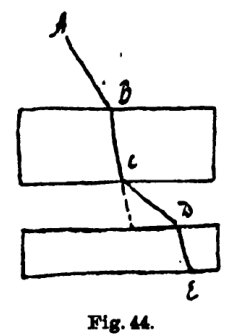
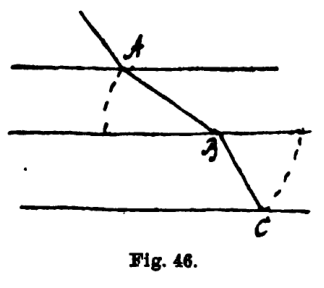
2Constat radium lucis AB in medium densius illapsum refringi ad perpendicularem in BC atque ubi rursus ingressum restitui in viam CD, parallelam priori AB, modo scilicet plana refringentia sint parallela. Hoc ille ita explicat pro radio lucis. sumamus pilam B, quae in Tabula polita BC decurrens occurrit alteri CD tapete instratae, ubi difficilior paulo motus fit, adeoque pergens in ea per rectam CD ob majus obstaculum à perpendiculari nonnihil declinat.
It is known that a ray of light AB entering a denser medium is refracted towards the perpendicular along BC and that, when it enters again [the former medium], it is restored to a path CD parallel to its first path AB, provided the refracting planes are parallel. Descartes explains it thus. In place of the ray of light let us take a ball B which, rolling along the polished board BC, meets another, CD, laid with carpet. Its motion there becomes a little more difficult, and so, continuing on it along the straight line CD, it departs somewhat from the perpendicular because of the greater obstacle.
3Eodem modo ponendo radium facilius in vitro, ut BC, quàm in aëre, ut CD progredi. vitrum tabulae politae, aërque tabulae tapete instratae locum habebit adeoque radius exiens ex vitro in aërem à perpendiculari declinabit. Plausibile hoc est et plerisque satisfecit, sed non mihi, cum enim variis de refractione olim tentatis Hypothesibus vidissem, plerasque ex eo refutavi, quod in nonnullis daretur, regressus seu conversio, constitui idem experiri in Cartesiana, et sanè comperi non satisfacere, quod ita ostendo.
Suppose in the same way that the ray advances more easily in glass, as along BC, than in air, as along CD. Glass will take the place of the polished board and air that of the carpeted board. The ray emerging from glass into air will accordingly depart from the perpendicular. This is plausible and has satisfied most people. It has not satisfied me. In my earlier trials of various hypotheses about refraction, I had refuted most of them by considering a return or reversal in certain cases. I resolved to make the same trial of the Cartesian hypothesis and found that it fails, as I shall now show.
4Verum est, pilam recta BC venientem intelligi posse motum compositâ directione ex perpendiculari ad planum refringens in C et horizontali ad hoc planum parallela et motu parallelo salvo minùs per resistentiam solum perpendicularem patet unde fieri refractionem à perpendiculari. Sed si pila in medio difficiliori CD pergens, tandem rursus priori nempe faciliori, accurate tunc non recuperabit amissam directionis perpendicularis celeritatem, sola enim medii facilitas celeritatem non auget.
A ball coming along the straight line BC can indeed be conceived as having a motion whose direction is composed of one perpendicular to the refracting plane at C and a horizontal one parallel to that plane. If the parallel motion is preserved and resistance diminishes only the perpendicular one, we see how refraction away from the perpendicular comes about. But if the ball travels in the more difficult medium CD and finally comes again into the former, easier one, it will not then recover precisely the speed it has lost in the perpendicular direction. The mere ease of passage afforded by the medium does not increase speed.
5Ponamus enim, pilam tormento excussam perforare maceriam inque ea virium partem amittere, utique eas ingressu in aërem non temperabit. Quod tamen necesse esset, nam manente semper motu horizontali debeat intentio perpendicularis, ut fiat refractio ad perpendicularem. quae, cum ita sint, certum est, Cartesium veram refractionis causam non reddidisse.
Suppose, for example, that a ball fired from a gun passes through a wall and loses part of its force in doing so. On entering the air it will certainly not adjust that force of itself. Yet something of the kind would be necessary. If the horizontal motion remains constant, there must be an intensification in the perpendicular direction for refraction towards the perpendicular to occur. That being so, it is certain that Descartes has not given the true cause of refraction.
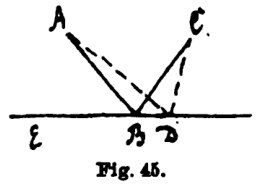
6[S. 71] Ptolemaeus et Heron aliique veteres alio usi sunt principio facillimo scilicet via, qua scilicet radiatio à dato puncto ad datum punctum pervenire potuit. nempe à puncto A radius à superficie BD reflexus pervenit in C, quaeritur, qua via seu qualenam sit punctum B, est quaestio quasi per algebram sive modus quaerendi inversus, alioqui enim directè procedendo et posito radio AB, quantum punctum B debere sumi tale, ut recta AB + BC aggregatum sit aliorum quorumlibet aggregatorum, ut AD + DC (alio scilicet quolibet puncto D sumto) minimum. Quod facile ostenditur fieri, si anguli ABE et CBD sint aequales.
Ptolemy, Hero and other ancients used another very simple principle, namely the path by which radiation could reach a given point from a given point. A ray from A, reflected from the surface BD, reaches C. By what path, or what sort of point must B be? The question is put as if by algebra, as an inverse way of seeking the solution. For, proceeding directly and taking the ray AB as given, the point B must be taken so that the straight lengths AB + BC have the least sum of all such sums, for instance AD + DC for any other point D. It is readily shown that this happens if the angles ABE and CBD are equal.
7Idque aliquando ita explicabam: fingamus in puncto B esse aërem compressum, eumque subito laxari conabitur in omnes partes et ita etiam ab A versus C, per B vel D. reperiendo ex variis autem nisibus ille demum effectum suum sortietur, quo omnia fiunt facillimo modo, id est quo ictus facillime perveniet in C. Verum quod Ptolemaeo objectum est, id etiam huic ratiocinationi objici potest, nimirum in concavo sphaerico ponendo, quod reflexio fiat, angulis aequalibus ad tangentem non fore aggregatum omnium possibilium ex directo et reflexo ab A ad C compositorum minimum. Et paralogismus in eo erat, quod improprie dicimus, ex omnibus nisibus eligi, commodissimum sortiri effectum; nam ipse nisus jam est aliquis effectus.
I once explained this as follows. Imagine compressed air at the point B and let it suddenly expand. It will strive in every direction, and so also from A towards C by way of B or D. Of the several tendencies, the one by which everything happens most easily will finally produce its effect, that is, the one by which the impulse will most easily reach C. But the objection raised against Ptolemy can also be made against this reasoning. Suppose reflection takes place in a spherical concavity. Even with equal angles to the tangent, the sum of the direct and reflected paths from A to C will not be the least of all the possible sums. The fallacy lay in our saying, improperly, that the most convenient of all the tendencies is chosen to take effect. The tendency is itself already an effect of some kind.
8Quaerendus est ergo modus explicandi, ita ut appareat tangentis tantùm habendam rationem. ponamus ergo punctum quidem C esse sic satis à B remotum, sed punctum A propemodum ei incumbere seu rectam AB esse, quantum satis est, parvam, patet objectionem cessaturam, poterit enim referri ad tangentem tantùm. Imo enim in finem etiam C ipsi B, quantum satis est, admovere possumus.
We must therefore seek an explanation which shows that only the tangent need be considered. Suppose the point C is sufficiently distant from B, but A lies almost upon B, or, in other words, AB is as short as is needed. Plainly the objection will cease to apply, for the matter can be referred to the tangent alone. Indeed, for this purpose we can bring C as close as necessary to B as well.
9Sunt autem ista non in punctis remotis, sed in ipso contactu et nisu aestimanda, ac proinde in punctis, quantùm satis est, propinquis, ut pro punctis infinitè parvam habentibus distantiam seu plane incumbentibus sumi possit, id est, ut idem proveniat, utrumque minora assumantur. Natura ergo suspensa nisus suos non alio exercet modo, quàm quo quam minimum immutatur, seu quo quam minimum amittitur virium, id est facillimo. Eamque ratiocinationem pariter ratiocinationi et refractioni applicari posse patet.
These things must be reckoned at the contact and in the tendency itself, and therefore at points close enough to stand for points at an infinitely small distance or lying exactly upon one another. That is, the same result should follow as both distances are taken smaller. Nature, then, while the outcome is still in suspense, exerts its tendencies in the way in which it undergoes the least possible change or loses the least possible force, that is, in the easiest way. Plainly this reasoning can be applied alike to reflection [conjecture] and to refraction.
10In pila autem locum cur non habeat, quod hic in refractione ostendimus. haec ratio est, quod hic quasi infiniti sunt nisus, inter se invicem luctantes optimamque eligentes operandi rationem, nempe radiationes ab eodem puncto ad alia varia aequè remota. At pila, cum ipsa pereat, nec his de nisibus sermo sit, non quaeritur, à quo venerit puncto, sed in quo nunc sit, quoque celeritate ex directione pergat ire. At de virium propagatione agitur sive diffusione cuiusdam liquidi, alia ratio [S. 72] esse videtur. Nam alii omnes radii ab aliis punctis venientes ad idem punctum et ex hoc exituri cogent nos tandem tale quippiam eligere, ut effectus sit similis causae, in plano, seu cum similiter se habet ad planum, sed hoc paulo obscurius.
Why should what we have shown here for refraction fail to hold for a ball? Here there are virtually infinitely many tendencies contending with one another and selecting the best way of acting, namely radiations from one point to various other points equally distant. With a ball, however, since the ball itself perishes [as printed] and these tendencies are not at issue, the question is where it is now and with what speed and in what direction it continues, regardless of the point from which it came. Where the propagation of forces or the spreading of a fluid is concerned, the case [p. 72] seems different. All the other rays coming from other points to the same point and about to leave it will compel us in the end to choose something such that the effect resembles the cause, on a plane or where it stands in the same relation to the plane. But this is somewhat obscure.
11Cum pila movetur privato motu, non est quaestio de via facillima, sed determinata, hoc loco determinatio sumitur non ex privato, sed publico; item quia hoc non motus, sed conatus sive impulsus ratio habetur.
When a ball moves with a motion of its own, we ask what path is determined for it, irrespective of which path would be easiest. Here the determination is taken from what is common to all, instead of from the individual, and what is reckoned here is the endeavour or impulse.
12Illud certum est, si pila venit ex A in C, via non facillima, seu utique aliquando elegit, quod non erat commodissimum; quod non est mirum, quia non poterat providere obstacula, quae ponenda essent, pila ergo recta fertur ad aliquod punctum. ideo cum pila ad aquae superficiem venit, in ipsam aquam agit plus minusve pro modo obliquitatis, ut solent omnes ictus. Unde si nimia est obliquitas, potius repellitur, quam penetrat.
This much is certain. If the ball came from A to C by a path other than the easiest, then at some point it chose what was less advantageous. That is no wonder, since it could not foresee what obstacles were going to be put in its way. The ball therefore travels straight towards some point. When it comes to the surface of water it acts on the water more or less according to its obliquity, as impacts generally do. Hence if the obliquity is too great, the ball is driven back instead of penetrating.
13Et hic res, ni fallor, manifesta est, sed in actionibus publicis seu in nisibus omnia sunt recipienda, fitque ut commodissima ratio eligatur. Sed hic tamen rursus difficultas est, nam reapse non semper in lumine eligitur commodissima, ut in concavo.
Here the matter is clear, if I am not mistaken. But in a common action, or in the tendencies, everything must be taken into account, and so the most advantageous course comes to be chosen. Yet here the difficulty arises again, since light does not in fact always take the most advantageous course, as in the case of the concavity.
14Lumen sit vis quaedam, quam corpus illuminatum recipit. Corpus quo magis illuminatur extensivè, hoc minus illuminatur intensivè. Id est, quo plures partes impressionem luminis recipiunt, hoc minor est impressio in singulis.
Let light be a certain force received by the body that is illuminated. The more extensively a body is illuminated, the less intensively it is illuminated. That is, the more parts receive the impression of light, the smaller the impression in each.
15Nam eadem vis in plura subjecta distributa in singulis fit debilior. Quod in motu manifestum sit, nam si corpus aliquod in plura corpora impingat, debilior est motus in singulis, etsi vis sit eadem.
For the same force distributed among more recipients becomes weaker in each of them. This is evident in motion. If a body strikes several bodies, the motion in each is weaker although the force is the same.
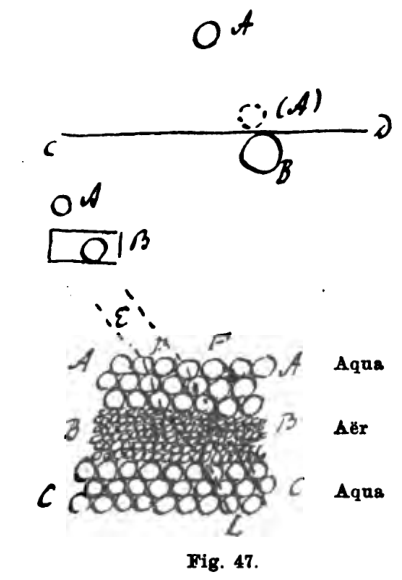
16Ponamus esse corpora A, et alia his multo minora atque ideo arctius ac plus molis in pari spatio continentia B, denique alia C, ipsis corporibus A similia. Percutiatur materia A ictu EFG, qui in G occurrens materiae B vim imprimet suam; sed quia majorem eam imprimit moli, ideò debilior erit impetus in singulis partibus, adeoque ictus perpendicularis [S. 73] debilitabitur salvo conatu horizontali, huic enim, ut ex natura ictus notum est, soli resistitur. Unde oritur refractio à perpendiculari. Contrà ictus GH in H occurrens materiae C, majores adeoque minus spatium implentes globos habenti, minori moli communicabitur adeoque majorem imprimit ipsis celeritatem, eam scilicet, quae erat in materia A; unde HL et EF parallelae.
Suppose there are bodies A, other bodies B much smaller than these and therefore packed more closely and containing more bulk in the same space, and finally other bodies C like the bodies A. Let matter A receive an impulse EFG. Meeting matter B at G, the impulse impresses its force upon it. Since the bulk on which it impresses that force is greater, the impetus in the individual parts will be weaker. Thus the perpendicular impulse [p. 73] will be weakened, while the horizontal endeavour is preserved: for it is this alone that is resisted, as is known from the nature of impact. Hence arises refraction away from the perpendicular. Conversely, the impulse GH, on meeting at H the matter C, whose globules are larger and hence fill less of the space, will be communicated to less bulk. It therefore imparts to them a greater speed, namely the speed there was in matter A. Hence HL and EF are parallel.
17Quae omnia pulcherrimè ad lumen quadrant. Ut enim plus est in B materiae, ictum recipientis, ita plus est in aëre materiae illuminabilis. Utque in B salva vi in toto minuitur impressio perpendicularis in singulis partibus, ita in aëre eodem manente lumine, singuli tamen radii retunduntur, sed ad perpendicularem refringuntur. Restitutio autem fit ad eundem angulum, si aërem B rursus excipiat aqua C etce. Porro et in perpendiculari radio in medium illuminabilius intrante necessaria aliqua fit diffractio seu disgregatio et contra congregatio, si in minus illuminabile medium intretur. Unde opinor, colorum origo est.
All these things fit light very well. Just as there is more matter in B to receive the impact, so in air there is more matter capable of illumination. And as in B, while the total force is preserved, the perpendicular impression in the separate parts is diminished, so also in air, although the light remains the same, the individual rays are beaten back and yet are refracted towards the perpendicular. The original angle is restored if water C again succeeds the air B, and so on. Even with a perpendicular ray entering a medium more capable of illumination, some diffraction or dispersal necessarily occurs, and conversely a gathering together if it enters a medium less capable of illumination. Here, I think, is the origin of colours.
18Experimenta optimè fient in plano ope lapillorum rotundorum ac planorum, quales in alea vulgò adhibentur. Ubi majores minoribus interponi et experimenta jucunda institui possunt. Hoc modo in terminis experientur.
The experiments will best be made on a plane with little round, flat counters of the kind commonly used in games. Larger ones can be put among smaller ones and some pleasing experiments made. In this way they will make trial at the boundaries.