1[S. 74] Data curva FF invenire curvam QQ talem, ut omnes radii, qui paralleli incidunt in FF, ut DF, inde refringantur in punctum B.
Given the curve FF, find a curve QQ such that all the rays incident on FF in parallel, like DF, are then refracted to the point B.
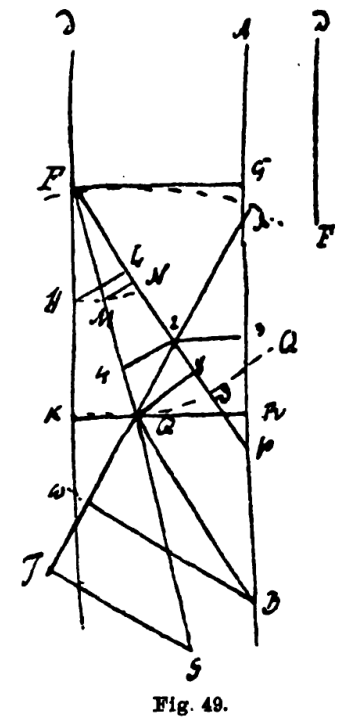
2Per punctum B ducatur recta radiis DF parallela, nempe BG et ex puncto datae curvae F ad eam ducatur perpendicularis. erit BG abscissa, FG ordinata, illa appelletur x, haec y, et cum datur curvae natura, dabitur et relatio inter x et y. Sit FP perpendicularis ad curvam, axi occurrens in P. dabitur et GP (per methodum inveniendi tangentes curvae datae), nempe FG : GP :: dx̄ : dȳ.
Through B draw a straight line parallel to the rays DF, namely BG. From F on the given curve draw the perpendicular to it. BG will be the abscissa and FG the ordinate. Call the former x and the latter y. Since the nature of the curve is given, the relation between x and y will also be given. Let FP be normal to the curve and meet the axis at P. GP is also given, by the method of finding tangents to a given curve: FG is to GP as dx is to dy.
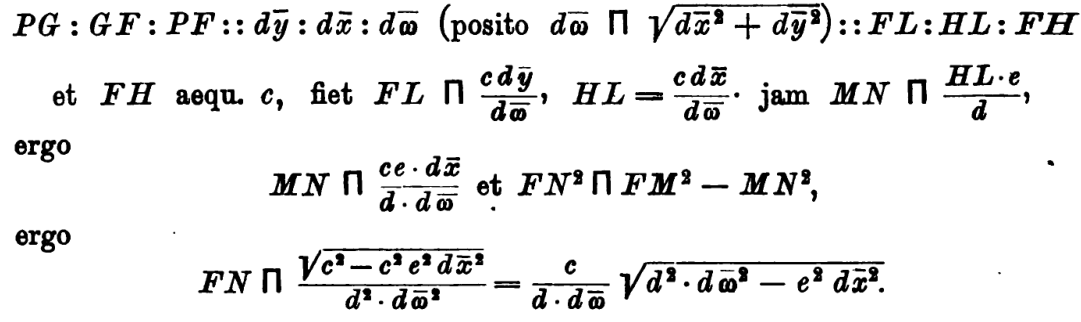
3Jam radius DF ipsi BG parallelus non perget versùs H in linea recta, sed intrans in vitrum refringetur in FM versus perpendicularem FP, ita ut, si centro F radio FH aequ. C, describatur circulus secans FM in M et ex punctis H, M in FP ducantur perpendiculares HL, MN, data sit ratio HL : MN :: d : e secundum quantitatem refractionis vitri. Quia FH parallela GP, erit triang. FLH simile triangulo PGF et
The ray DF, parallel to BG, will now no longer continue straight towards H. On entering the glass it will be refracted along FM towards the normal FP. With centre F and radius FH equal to C, draw a circle cutting FM at M. From H and M draw the perpendiculars HL and MN to FP. Then HL is to MN in the given ratio d to e, according to the amount of the refraction of the glass. Since FH is parallel to GP, triangle FLH will be similar to triangle PGF, and we have the following proportions.
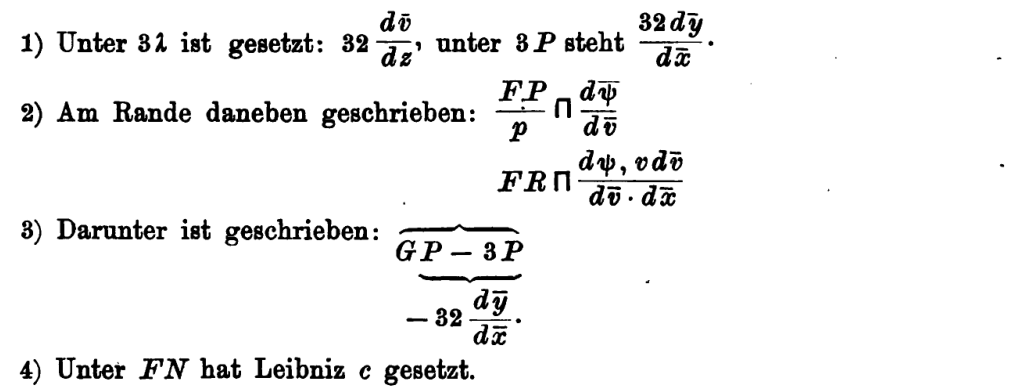
4PG, GF and PF are as dy, dx and the element of arc dω, with dω equal to √(dx² + dy²). They are also as FL, HL and FH. Putting FH equal to c gives FL and HL as the indicated fractions of c. Since MN = HL·e/d, substitution gives the expression for MN. From FN² = FM² − MN² he then obtains the two printed expressions for FN.
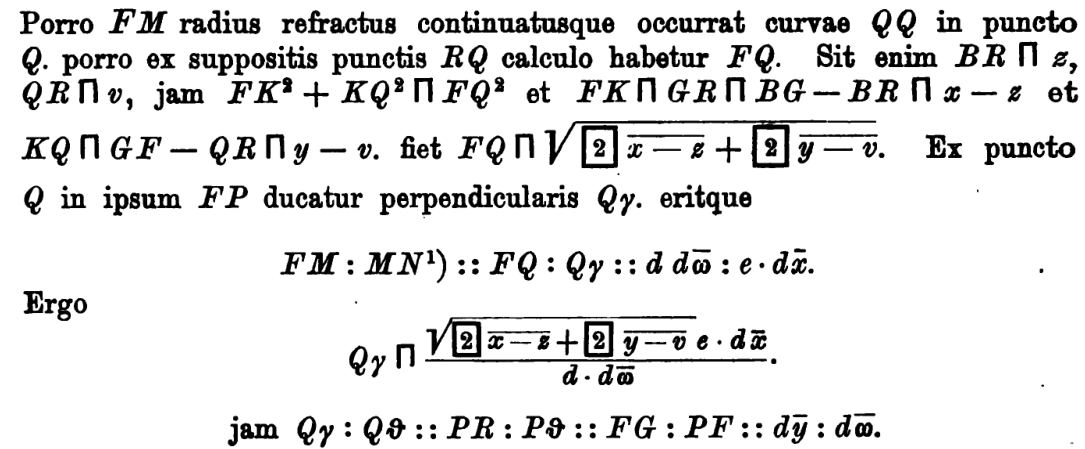
5Porro FM radius refractus continuatusque occurrat curvae QQ in puncto Q. porro ex suppositis punctis RQ calculo habetur FQ. Sit enim BR ⊓ z, QR ⊓ v, jam FK² + KQ² ⊓ FQ² et FK ⊓ GR ⊓ BG − BR ⊓ x − z et KQ ⊓ GF − QR ⊓ y − v. fiet FQ [formula]. Ex puncto Q in ipsum FP ducatur perpendicularis Qγ. eritque [formula]. Ergo [formula]. jam Qγ : Qϑ :: PR : Pϑ :: FG : PF :: dȳ : dω̄.
Let FM, the refracted ray produced, meet the curve QQ at Q. From the assumed points R and Q the length FQ is obtained by calculation. Put BR = z and QR = v. Now FK² + KQ² = FQ², where FK = GR = BG − BR = x − z, and KQ = GF − QR = y − v. This gives FQ. From Q let Qγ be drawn perpendicular to FP. The proportion FM : MN :: FQ : Qγ gives Qγ as in the display. The next proportion is Qγ : Qϑ :: PR : Pϑ :: FG : PF :: dy : dω.
6In present-day grouping the distance in each of these lines is √((x − z)² + (y − v)²). The two little boxes containing 2 in the displayed distance apply to the two individual differences.
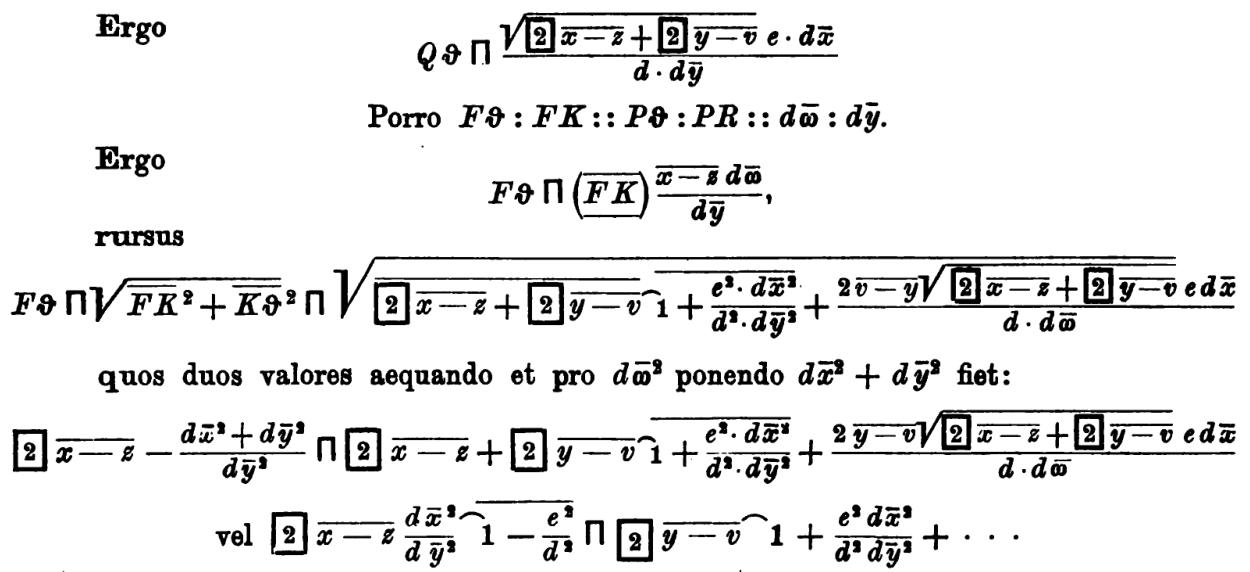
7[S. 75] Ergo [Qϑ]. Porro Fϑ : FK :: Pϑ : PR :: dω̄ : dȳ. Ergo [Fϑ]. rursus [Fϑ]. quos duos valores aequando et pro dω̄² ponendo dx̄² + dȳ² fiet [aequatio], vel [aequatio].
Hence we get Qϑ. Next, Fϑ is to FK as Pϑ is to PR and as dω is to dy, giving the first expression for Fϑ. Again, taking the square root of FK² + Kϑ² gives the second expression. Equating those two values and putting dx² + dy² for dω² gives the last two lines. The dots are in the print.
8The long vincula, the boxes denoting squares, and the dots following the last term are reproduced to show their scope.
9Haec aequatio nihil difficile involvit. Quod si jam aequatio accedat, quae relationem exprimit inter x et y, item inter dȳ et dx̄, ea tolli possunt dx̄, dȳ, item alterutra harum duarum x et y. igitur una adhuc aequatione opus est, qua tollatur et altera, ut scilicet tantùm restent z et v. Hanc novam ita porrò inveniemus:
This equation involves nothing difficult. If we now add the equation expressing the relation between x and y, and likewise between dy and dx, we can use it to eliminate dx and dy, and also one of x and y. One more equation is therefore needed to eliminate the other as well, so that only z and v remain. We shall find this new equation as follows.
10Radius FQ ipsi curvae occurrens inde non pergit in QS recta linea, sed ibi ex vitro in aërem egreditur adeoque refringitur à perpendiculari λQω in QB occurrens tandem puncto dato B. sumatur QS aeq. QB et ex punctis S, B in ipsam perpendicularem curvae QQ, nempe λQωT, ducantur perpendiculares Bω, ST. Et quidem Bω bis inveniri potest, primum ex eo, quod semper in curva supposita, ut data perpendicularis ex puncto dato ad curvae perpendicula (seu tangenti curvae parallela) duci potest. Sed eadem Bω etiam ex eo habetur, quod ratio ejus ad ST data est. Primum itaque Bω quaeramus communi methodo ex curvâ.
The ray FQ on meeting the curve does not continue straight along QS. It leaves the glass there for the air and is therefore refracted away from the normal λQω along QB, finally reaching the given point B. Take QS equal to QB. From S and B draw ST and Bω perpendicular to the normal to QQ, namely λQωT. Now Bω can be found in two ways. First, once the curve is supposed given, one can always draw from a given point a perpendicular to its normal, that is, a parallel to its tangent. The same Bω is also found from its given ratio to ST. Let us first seek Bω from the curve by the ordinary method.
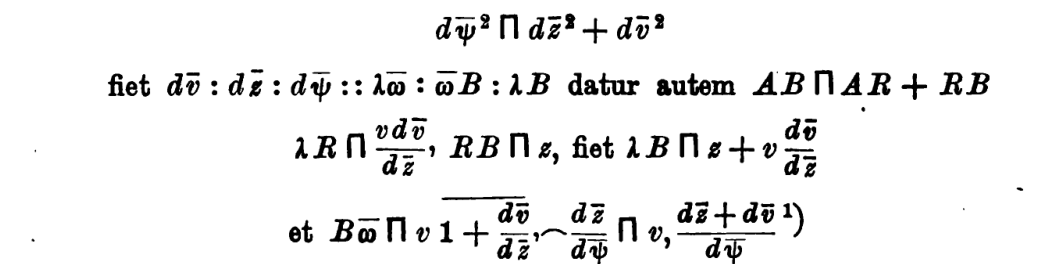
11[dψ̄²]. fiet [proportio]. datur autem AB ⊓ AR + RB. λR [formula], RB ⊓ z, fiet λB [formula] et Bω [formula].
Introduce the differential of the second arc, with dψ² = dz² + dv². The proportion between the differential triangle and the triangle at B is set down below. The text gives AB = AR + RB, then uses λR and RB = z to obtain λB. Substitution gives a value for Bω. The change between A and λ in this line has been left as printed.
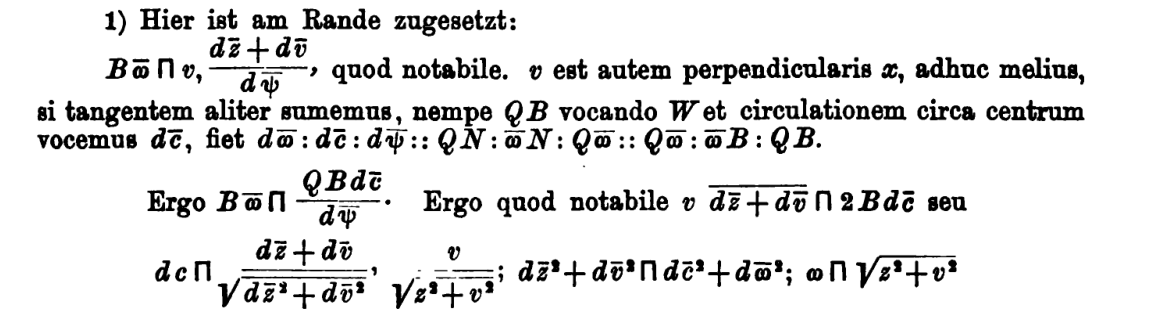
12In the last form Bω is v multiplied by (dz + dv)/dψ.
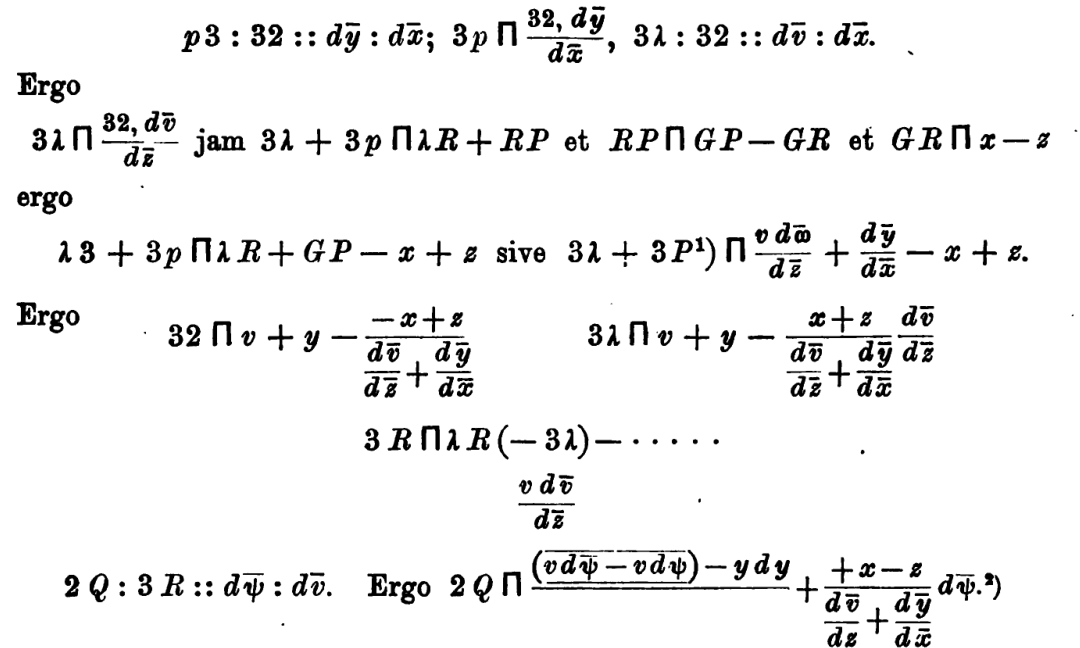
13[S. 76] Ut autem Bω adhuc semel nanciscimur, quaerenda est ST. Quod ita fiet: Ex puncto 2, ubi se secant FP, Qλ (productae, si opus, ducantur) in axem BG perpendicularis 23 [calculus].
To obtain Bω a second time, we must seek ST. This is done as follows. From the point labelled 2, where FP and Qλ intersect (let them be produced if necessary), draw the perpendicular 23 to the axis BG. The calculation follows.
14The first two differential proportions give relations for 3p and 3λ. Combine 3λ and 3p by way of λR and RP, substitute GP − GR for RP and x − z for GR, and compare the resulting expressions. The last line uses 2Q : 3R :: dψ : dv and gives 2Q. The dotted expression for 3R in the preceding line is reproduced as printed.
15Ex puncto 2 ducatur ad FD perpend. 24. jam 2F : Fp :: 3G : Gp fiet [2F].
From point 2 draw 24 perpendicular to FD. Now 2F is to Fp as 3G is to Gp. This gives 2F.
16The numerator groups and the two fractions in the final denominator belong to the same displayed calculation of 2F.
1724 : 2F :: MN : FN. ita habetur 24. Habita 24 et 2Q habetur et ratio QS (⊓ QB) ad ST, adeoque et ST, ergo et Bω adhuc semel. Calculus talis erit [24].
Now 24 is to 2F as MN is to FN. Thus 24 is obtained. With 24 and 2Q we have the ratio of QS (equal to QB) to ST, and hence ST itself, and so a second value for Bω. The calculation of 24 is as follows.
18Here 24 denotes the segment from point 2 to point 4.
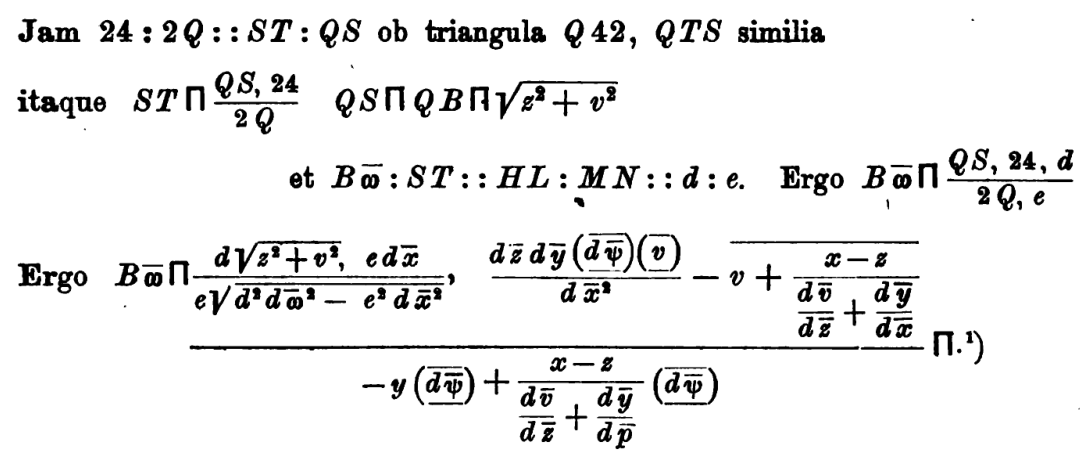
19[S. 77] Jam 24 : 2Q :: ST : QS ob triangula Q42, QTS similia. itaque [ST], QS ⊓ QB [formula]. et Bω : ST :: HL : MN :: d : e. Ergo [Bω]. Ergo [formula].
Now 24 is to 2Q as ST is to QS because triangles Q42 and QTS are similar. This yields ST, with QS = QB = √(z² + v²). Also Bω is to ST as HL is to MN, that is, as d is to e. Thus Bω is obtained in terms of QS, 24, 2Q and the refraction ratio. The full substitution follows it in the print.
20The long final expression ends with an equality sign and a stop. The edition supplies no right-hand member there.
21Melius rem ita instituemus, si curva FF existente data et sumta QQ qualicunque sumtoque in axe AG puncto fixo A positoque radium axi occurrere in B, quaeratur calculo AB, ex datis x, y, v, z. expliceturque relatio inter v et z. ita ut evanescant omnes indeterminatae, fiet recta AB constans; et solutum erit problema.
We shall do better to set up the matter as follows. Let the curve FF be given, take any curve QQ and fix a point A on the axis AG. Suppose the ray to meet the axis at B. Seek AB by calculation from the given x, y, v and z, and determine the relation between v and z in such a way that all the indeterminates disappear. The straight length AB will be constant, and the problem will be solved.
Text. Ernst Gerland, Leibnizens nachgelassene Schriften physikalischen, mechanischen und technischen Inhalts (Leipzig 1906), “Optische Arbeiten,” no. 31, pp. 74–77. Internet Archive leibnizensnachg00gerlgoog, PDF pages 87–90. Gerland describes one and a half folio pages. He says the first contains an unfinished draft calculation and introduces what he prints as coming from the second. No date is attached. The following no. 32 has its own title and date. The Potsdam Gerland concordance gives no Akademie parallel for pp. 74–77.
Formulas (ours). Point 2 is a label in Fig. 49, so 2Q, 23 and 24 are lengths from that point. The small boxed 2 in the expressions for FQ and the other distances is an exponent attached to a grouped difference. The letter d serves both as one of the refraction parameters d : e and as part of the differential notation. In the English prose the differentials are linearized as dx, dy, dz, dv, dω and dψ. The formulas themselves are reproduced from the page, including crossed groupings, superposed bars, unfinished equalities and dots. The prose has been checked against the four printed pages. The two long expressions for Bω have not been proved algebraically equivalent.
Existing English. No earlier English version identified in this lane.
Licence. Gerland 1906 is in the public domain. This translation is CC BY-NC 4.0.