Editor’s note
December 1681. For a ray passing between two media, Leibniz asks where it must cross their common boundary so that its two lengths, weighted by the densities of the media, have the least possible sum. He applies his method of tangents and reads the sines from a circle centred at the point of refraction. Two steps in the printed algebra disagree with the construction. The readings are preserved and checked below. The heading in brackets is supplied from the opening words.
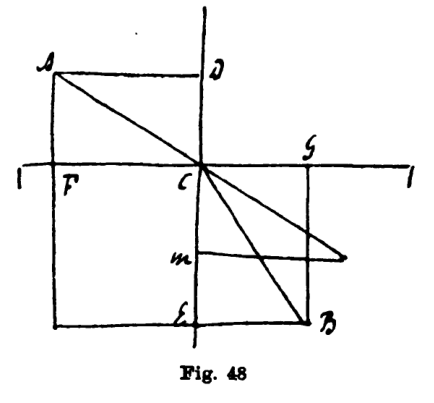
Text. Ernst Gerland, Leibnizens nachgelassene Schriften physikalischen, mechanischen und technischen Inhalts (Leipzig 1906), “Optische Arbeiten,” no. 30, printed p. 73, Internet Archive leibnizensnachg00gerlgoog, PDF page 86. Gerland describes one folio leaf. The whole item, including the dating line, Fig. 48 and the conclusion, is on this page. No. 31 begins on p. 74. The Potsdam Gerland concordance gives no Akademie parallel for p. 73.
Formulas (ours). In the first row a short joining stroke is rendered as a multiplication dot. The letter l is an ell. The sign before AC and BC in the two denominators is represented here by ⊓. It identifies the length meant in each case. In this paper dx is the product of the density d and the distance x. It is not a differential.
- Second radical. The squared length CB is first given as m² + ff + xx − 2fx. In the following displayed formula Gerland prints + 2fx under the radical. From the figure, CB² = m² + (f − x)², which agrees with the first occurrence.
- Ratio. Gerland prints dx/(ef − x). Differentiating the weighted length with l, m, f, d and e fixed gives d·x/AC = e·(f − x)/BC. Thus AC/BC = d·x/[e·(f − x)]. The printed denominator lacks the factor e on the x term. Leibniz's next statement, (f − x) : x = d : e when the two radii are equal, agrees with the corrected expression.
- Sines. AD and BE are the transverse lengths for equal radii. Their common radius cancels in the ratio. The translation keeps Leibniz's own term “density” for d and e.
Existing English. No earlier English version identified in this lane.
Licence. Gerland 1906 is in the public domain. This translation is CC BY-NC 4.0.