210₁. PLAGULAE PRIMA ET SECUNDA
10₁. FIRST AND SECOND SHEETS
3Ex Dettonvillaeo seu Pascalii Geometricis excerpta: Cum additamentis.²
Excerpts from Dettonville, that is, from Pascal's geometrical writings, with additions.²
41 2 3 4 / A B C D / B C D / C D / D
1 2 3 4 / A B C D / B C D / C D / D
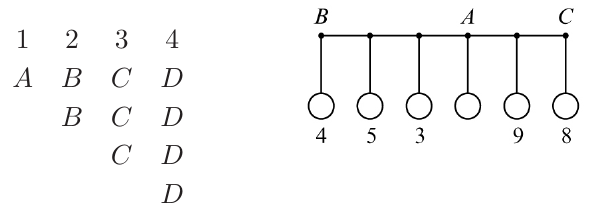
5[Fig. 1. The balance BC with the point A between B and C, and weights marked 4, 5, 3 on the arm towards B and 9, 8 on the arm towards C.]
7Si quantitates sint A. B. C. D. summa eorum triangularis incipiendo ab A. est 1A. 2B. 3C. 4D.
If the quantities are A, B, C, D, their triangular sum, beginning from A, is 1A, 2B, 3C, 4D.
8Recta quacunque BC. in partes aequales divisa quotcunque et ponderibus quibuscunque ex punctis divisionis suspensis, aequalibus vel inaequalibus, sumtoque eorum puncto aequilibrii A. necesse est summam triangularem ponderum unius brachii AB. aequari summae triangulari ponderum alterius brachii AC. incipiendo summam triangularem utrobique a puncto interiore, seu a latere A. Et ratio est, quia pondera gravant in composita ratione ex ratione ponderum, et distantiarum a centro. Distantiae autem, ob divisionem rectae seu iugi in partes aequales, crescunt ut 1. 2. 3. etc.
If any straight line BC is divided into any number of equal parts, and any weights, equal or unequal, are hung from the points of division, and their point of equilibrium A is taken, the triangular sum of the weights of one arm AB must equal the triangular sum of the weights of the other arm AC, the triangular sum beginning on both sides from the inner point, that is, from the side of A. The reason is that weights press in the ratio compounded of the ratio of the weights and that of their distances from the centre. And because the line or beam is divided into equal parts, the distances increase as 1, 2, 3, etc.
9Haec Pascalius quibus ego adicio: etsi summae triangulares ab utroque puncti latere non sint eaedem, seu etsi duo brachia non sint in aequilibrio, fore tamen semper momenta ad se invicem ut summas triangulares. Semper enim momenta sunt summis triangularibus aequalia.
So far Pascal. To this I add: even if the triangular sums on the two sides of the point are not the same, that is, even if the two arms are not in equilibrium, the moments will still always be to each other as the triangular sums. For the moments are always equal to the triangular sums.
10Hinc regulam longe generaliorem, si sit recta BC. quaecunque in partes aequales divisa, ponderibus onerata quibuscunque ex punctis divisionis suspensis, puncto quolibet divisionis assumto, A, erunt momenta ponderum brachii BA. unius ad momenta ponderum brachii alterius CA, ut summae triangulares incipiendo a pondere ipsi A. proximo. Et cum figura qualibet, id est linea, superficie vel solido ita locata, ut recta aliqua in ea assumta sit horizonti parallela ista recta haberi potest pro libra, et omnia puncta aut rectae aut plana, punctis in recta assumtis horizontaliter supposita, seu in plana eorum punctorum horizonti perpendicularia, incidentia, possunt haberi pro ponderibus.
Hence a far more general rule: if any straight line BC is divided into equal parts and loaded with any weights hung from the points of division, then, taking any point of division A, the moments of the weights of the one arm BA will be to the moments of the weights of the other arm CA as the triangular sums beginning from the weight nearest to A. And when any figure, that is, a line, surface or solid, is so placed that some straight line taken in it is parallel to the horizon, that straight line can be taken for a balance, and all the points, or straight lines, or planes lying horizontally under the points taken in the line, that is, falling in the planes through those points perpendicular to the horizon, can be taken for weights.
11Hinc si constet nobis de horum ponderum quantitate seu progressione, et per consequens de eorum summa triangulari, hinc potest inveniri centrum aequilibrii non quidem in figura, attamen in recta figurae assumta. Centrum aequilibrii in ipsa figura eius est naturae, ut recta per id transiens secet figuram in duas partes ita ut utrinque summae triangulares punctorum, rectarum, solidorum horizontalium fiant aequales. Hinc centro gravitatis figurae totius reperto, centra gravitatis eiusmodi brachiorum extra figuram assumibilium haberi possunt.
Hence, if we know the quantity or progression of these weights, and consequently their triangular sum, the centre of equilibrium can be found, not indeed in the figure, but in the straight line taken in the figure. The centre of equilibrium in the figure itself is of such a nature that a straight line passing through it cuts the figure into two parts so that the triangular sums of the horizontal points, lines or solids become equal on both sides. Hence, once the centre of gravity of the whole figure has been found, the centres of gravity of such arms, which can be taken outside the figure, can be obtained.
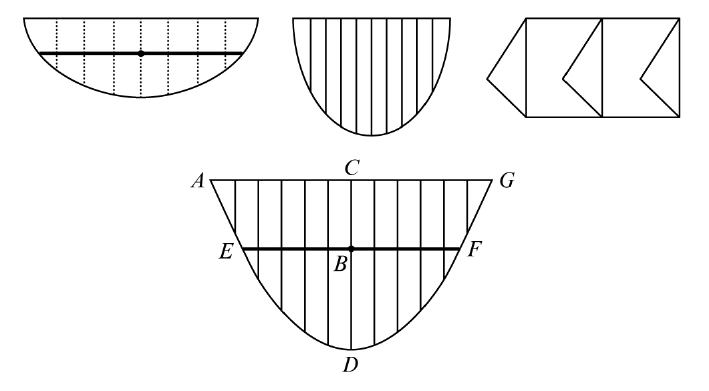
13[Fig. 2. Above, three figures divided by parallel lines; below, a curved figure with the horizontal AG through C, the vertical CD, and the line EF through B. A names both a point and the whole figure.]
14Ponatur enim figura esse A. in qua centrum gravitatis B. ponatur horizonti parallela et centrum gravitatis eius super stylo horizontali locatum, vel ex filo suspensum intelligatur, manifestum est figuram foret in aequilibrio. At si in aequilibrio est, ergo recta CD. facta per centrum gravitatis eam figuram ita secabit ut summae utrinque triangulares sint aequales; si scilicet alia recta EF. priori CD. perpendicularis secta intelligatur in partes aequales infinitas per rectas infinitas ipsi CD. parallelas, summa triangularis rectangulorum infinitorum utrinque erit aequalis, quia ex praesuppositis ipsa EF. velut libra[,] rectangula velut pondera ex punctis divisionis suspensa iudicari possunt (unde patet pondera suspensa non necessario horizonti perpendicularia intelligi debere posse et esse parallela).²
Let the figure be A, with its centre of gravity B. Let it be placed parallel to the horizon, and let its centre of gravity be understood to rest on a horizontal pin, or to hang from a thread: plainly the figure would be in equilibrium. But if it is in equilibrium, then the straight line CD drawn through the centre of gravity will cut the figure so that the triangular sums on both sides are equal. That is, if another straight line EF, perpendicular to CD, is understood to be cut into infinitely many equal parts by infinitely many straight lines parallel to CD, the triangular sum of the infinitely many rectangles will be equal on both sides, because by our assumptions EF can be regarded as a balance and the rectangles as weights hung from the points of division. (Hence it is clear that the hanging weights need not be understood as perpendicular to the horizon; it is enough that they are parallel.)²
15His positis mutetur situs figurae ex horizontali in perpendicularem, fiatque libra AG. manifestum est punctum aequilibrii cadere in C. cum summae triangulares rectangulorum ab utroque latere sint ex hypothesi aequales. Ergo dato centro gravitatis figurae cuiusque librae, extra vel intra figuram assumtae, cui figura rigide affixa intelligitur, punctum aequilibrii haberi potest si modo perpendicularis ex centro gravitatis ad libram ducatur, ea libram in puncto aequilibrii secabit.
With this laid down, let the position of the figure be changed from horizontal to vertical, and let AG become the balance. Plainly the point of equilibrium falls at C, since by hypothesis the triangular sums of the rectangles on both sides are equal. Therefore, given the centre of gravity of a figure, the point of equilibrium of any balance, taken outside or inside the figure, to which the figure is understood to be rigidly fixed, can be found: one need only draw the perpendicular from the centre of gravity to the balance, and it will cut the balance at the point of equilibrium.
16Contra si duarum librarum eiusdem figurae puncta aequilibrii dentur, inventum erit centrum gravitatis figurae (sive id sit extra sive intra figuram, cadit enim aliquando
Conversely, if the points of equilibrium of two balances of the same figure are given, the centre of gravity of the figure will have been found (whether it lies outside or inside the figure, for it sometimes falls
18centrum gravitatis intra figuram aliquando [extra] ut in annularibus, figuris, lineis curvis, aliisve incompletis) in puncto scilicet concursus duarum perpendicularium ex duabus illis libris ad easdem partes ductarum, in eodem plano, si figura sit plana, aut si duae illae librae sint in eodem plano, quod si vero duae librae non sint in eodem plano, opus est tribus. Hoc examinandum.
inside the figure and sometimes [outside], as in ring-shaped figures, curved lines, or other incomplete ones): namely at the point where two perpendiculars meet, drawn from those two balances towards the same side in the same plane, if the figure is plane, or if the two balances lie in the same plane. But if the two balances are not in the same plane, three are needed. This is to be examined.
19Imo sic potius: affigatur figura primum uni librae, et planum librae et horizonti perpendicularem ex puncto aequilibrii demissum figuram secet, postea affigatur alteri librae, et rursus aliud planum demissum figuram secet, illorum duorum planorum intersectio dabit rectam, quae continebit centrum aequilibrii, quod si iam accedat tertia libra, seu tertium planum, punctum intersectionis omnium planorum, seu punctum quo tertium planum lineam inventam secat, erit centrum aequilibrii. Quod si autem figurae sunt planae, tunc sufficiunt duae librae, duaeque perpendiculares, ergo etiam si sint lineae curvae in eodem plano manentes.
Or rather, better thus: let the figure first be fixed to one balance, and let a plane let down from the point of equilibrium, perpendicular to the balance and to the horizon, cut the figure. Then let it be fixed to another balance, and again let another plane let down cut the figure. The intersection of those two planes will give a straight line containing the centre of equilibrium. If a third balance, or a third plane, is now added, the point of intersection of all the planes, that is, the point where the third plane cuts the line found, will be the centre of equilibrium. But if the figures are plane, two balances and two perpendiculars suffice, and therefore also for curved lines that stay in one plane.
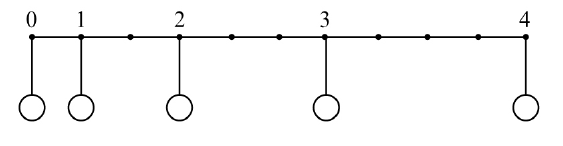
20Iam operae pretium est quaedam annotare de iis casibus, in quibus libra non est secta in partes aequales, fieri enim potest ut habeamus certo quodam modo summas ponderum earumque progressiones, sed ita ut ea librae applicata, eam dividant in partes inaequales; tunc investiganda progressio partium in quas dividitur libra, ut si in partes continue crescentes ut quadrata, aliterve, dividatur. Ut ponamus pondera aequalia esse, libram autem dividi in partes crescentes ut 1. 2. 3. 4. etc.
It is now worth noting something about the cases in which the balance is not cut into equal parts. For it can happen that we have the sums of the weights and their progressions in some definite way, but such that, applied to the balance, they divide it into unequal parts. Then one must find the progression of the parts into which the balance is divided, for instance if it is divided into parts continually increasing as the squares, or otherwise. Let us suppose, for example, that the weights are equal but the balance is divided into parts increasing as 1, 2, 3, 4, etc.
21[Fig. 3. A balance with points 0, 1, 2, 3, 4 at intervals of 1, 2, 3 and 4 units, and an equal weight hung at each.]
22Sed ut rem regula complectamur ita procedendum est, ponatur punctum illud aequilibrii iam inventum, et esse per exemplum 2.
But to bring the matter under a rule, we must proceed as follows. Let the point of equilibrium be supposed already found, and let it be, for example, 2.
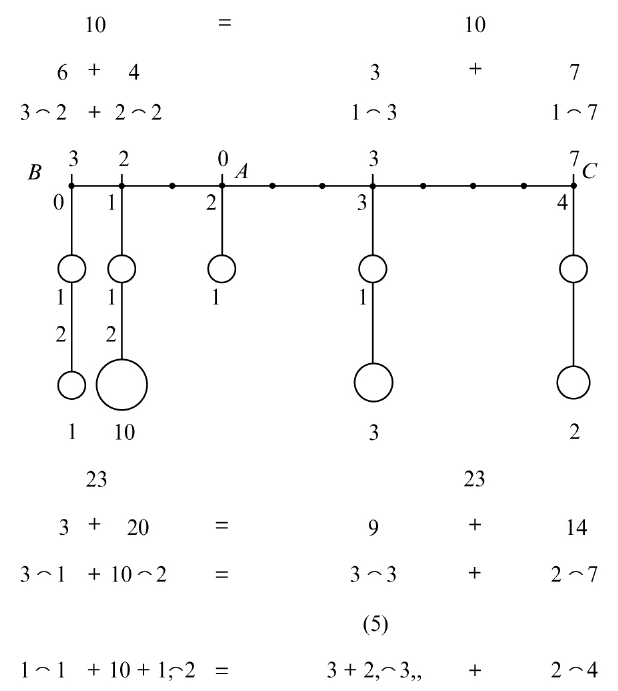
24[Fig. 4. The balance BC with A at point 2. Above the beam: 10 = 10; 6 + 4 = 3 + 7; 3⌢2 + 2⌢2 = 1⌢3 + 1⌢7. On the beam, the arm numbers 3, 2, 0 on the side of B and 3, 7 on the side of C; below it, the point numbers 0, 1, 2, 3, 4. Each point carries a small weight and, at points 0, 1, 3 and 4, a larger one below it on a longer cord; the numbers under the weights are 1 (point 0), 10 (point 1), 1 (point 2), 3 (point 3) and 2 (point 4), and the cords at points 0 and 1 are marked 1, 2. Below: 23 = 23; 3 + 20 = 9 + 14; 3⌢1 + 10⌢2 = 3⌢3 + 2⌢7; and, with (5) above, 1⌢1 + 10 + 1⌢2 = 3 + 2⌢3 + 2⌢4.]³
25Manifestum est a puncto illo 2. assumto velut centro, brachia fore numeris notanda et punctum 1. notandum numero 2. punctum 0. numero 3. ab altero latere punctum 3. numero 3. punctum 4. numero 7. Et iam ponderibus suppositis in suorum punctorum seu brachiorum numeros ductis necesse est productum fieri aequale, quod si non sit, aliud quaerendum est punctum (aut ponderibus aliquid addendum demendumve ut hoc loco si pondera 2. 3. ponantur duplicata seu loco 1. 1. ipsis subscriptum 2. 2. utrobique esset aequilibrium 10).
Plainly, taking that point 2 as centre, the arms are to be marked with numbers: point 1 with the number 2, point 0 with the number 3; on the other side, point 3 with the number 3 and point 4 with the number 7. Now, when the weights hung below are multiplied by the numbers of their points, or arms, the products must come out equal. If they do not, another point must be sought (or something must be added to or taken from the weights: here, for instance, if the weights at 2 and 3 were doubled, that is, if 2, 2 were written under them instead of 1, 1, there would be equilibrium on both sides at 10).
26Sed ne opus sit ire per omnia puncta compendium quaerendum esset; quod si nullam certam progressionem servent partes librae, et pondera, compendium erit impossibile, at ubi certa quaedam progressio haberi potest, tunc compendium inveniri potest, quatenus progressio illa patitur. Sed magna pars difficultatis cessat quando omnia pondera appensa intelliguntur aequalia.
But so as not to have to go through all the points, a short cut ought to be sought. If the parts of the balance and the weights keep no definite progression, a short cut will be impossible. But where some definite progression can be had, a short cut can be found, as far as that progression allows. And a great part of the difficulty ceases when all the hanging weights are understood to be equal.
28Imo inventa est regula generalis simplex Pascalianae reciproca[,]² nimirum punctum tale assumendum est, ut summa triangularis numerorum utriusque lateris, semper incipiendo ab extremo usque ad medium sit aequalis,
Indeed, a simple general rule has been found, the converse of Pascal's.² Namely, the point must be taken such that the triangular sum of the numbers on each side, always beginning from the end and going to the middle, is equal,
29ut summa triangularis 4 3 (7) deberet esse = 2 1 (3). / 3 (3) 1 (1) / (4) (6) (2) (2)
as the triangular sum 4, 3 (7) ought to be = 2, 1 (3): / under them 3 (3) and 1 (1); / giving (4) (6) and (2) (2).
30Quod si iam tam librae partes quam pondera ipsa sint inaequalia, rursus regula generalis haec est: Debere punctum librae eligi, ut summa rectangulorum factorum ex quolibet pondere in summam partium librae (ab extremo sumtarum) sibi superpositam seu inter punctum suum et assumtum interceptam, ducto, sit utrobique aequalis[,] ut
Now if both the parts of the balance and the weights themselves are unequal, the general rule is again this: the point of the balance must be chosen so that the sum of the rectangles made by multiplying each weight into the sum of the parts of the balance (taken from the end) lying above it, that is, intercepted between its own point and the point taken, is equal on both sides, as
312⌢7 + 3⌢3 = 10⌢2 + 1⌢3 / 14 + 9 20 + 3
2 × 7 + 3 × 3 = 10 × 2 + 1 × 3 / 14 + 9 = 20 + 3
32Vel aliter, ut si summa ponderum omnium suppositi et sequentium versus librae extremitatem multiplicetur per numerum partis librae punctum suspensionis antecedentis versus librae medium; summa productorum utrobique sit aequalis.
Or otherwise: if the sum of all the weights, the one hung below and those following towards the end of the balance, is multiplied by the number of the part of the balance that precedes its point of suspension towards the middle of the balance, the sum of the products must be equal on both sides.
33Ita si punctum aequilibrii sit dictum 2. vel A. momentum ponderum brachii AC. ita inibimus quoque, hac methodo:
Thus, if the point of equilibrium is the said 2, or A, we shall also obtain the moment of the weights of the arm AC by this method:
343 + 2. summa ponderum sequentium multiplicetur per 3. numerum partium aequalium partis librae inaequalis A3. habemus 15. Iam 2. summa ponderum sequentium (restat nullum hoc loco) multiplicetur per 4. numerum punctorum partis 3C. antecedentis versus A. medium, habemus 8.
let 3 + 2, the sum of the following weights, be multiplied by 3, the number of equal parts in the unequal part A3 of the balance: we have 15. Now let 2, the sum of the following weights (here none remains beyond it), be multiplied by 4, the number of points in the part 3C preceding it towards A, the middle: we have 8.
35Iam summa / 3 + 2 2 / 5 4 / 15 + 8 = 23 / ‖
Now the sum: / 3 + 2, 2 / × 5, 4 / 15 + 8 = 23 / ‖ (equal to the line below)
36Eodem modo ab altero latere 10 + 1. multiplicetur per 2. punctorum partis antecedentis, punctum ex quo suspensum pondus 10. habemus 22. et pondus 1. per 1. numerum punctorum partis antecedentis punctum ex quo suspensum pondus 1. nempe 1.
In the same way, on the other side, let 10 + 1 be multiplied by 2, the number of points of the part preceding the point from which the weight 10 hangs: we have 22. And the weight 1 by 1, the number of points of the part preceding the point from which the weight 1 hangs: namely 1.
3710 + 1 1 / 2 1 / 22 + 1 = 23
10 + 1, 1 / × 2, 1 / 22 + 1 = 23
38Ex his intelligi potest, etsi punctum aliquod tale sit, ut non fiat aequilibrium, tamen eam esse rationem momentorum utrinque quae est horum productorum, et ita theorema generaliter concipiendum est.
From this it can be understood that, even if a point is such that there is no equilibrium, the ratio of the moments on the two sides is still that of these products; and so the theorem is to be conceived generally.
40Porro theorema Pascalii non est nisi casus huius simplicissimus, patet enim ex nostro summas ponderum duci in numeros partium librae, summam productorum dare momentum. At si numeri partium librae sint 1. summa productorum, erit summa summarum ponderum, seu summa ponderum triangularis.
Pascal's theorem, moreover, is only the simplest case of this. For it is clear from ours that, when the sums of the weights are multiplied into the numbers of the parts of the balance, the sum of the products gives the moment. But if the numbers of the parts of the balance are 1, the sum of the products will be the sum of the sums of the weights, that is, the triangular sum of the weights.
41Patet autem ex nostro theoremate summam productorum ex quolibet pondere in summam partium librae antecedentium versus centrum aequari summae productorum ex summis ponderum, in numerum partis antecedentis versus centrum, imo, etsi aliud punctum assumatur loco centri, et utrobique eatur versus illud punctum. Id ergo necesse est pendere ex theoremate aliquo generali, quod tale est,
It is also clear from our theorem that the sum of the products of each weight into the sum of the parts of the balance preceding it towards the centre equals the sum of the products of the sums of the weights into the number of the preceding part towards the centre; and indeed even if another point is taken in place of the centre, and on both sides one goes towards that point. This must therefore depend on some general theorem, which is this:
42si sint duae series quaecunque, ut 3. 4. item 3. 2. sibi suppositae 3. 4. 0. / 3. 2. 0.
if there are any two series, such as 3, 4 and 3, 2, placed one under the other: 3, 4, 0 / 3, 2, 0,
43et summae partium ineantur, unius ab una parte 0 + 4 + 3 = 7 alterius ab altera parte 3 2 0 = 5 / 4 + 3 = 7 2 0 = 2 / 3 = 3 0 = 0
and the sums of the terms are taken, of the one from one end: 0 + 4 + 3 = 7, 4 + 3 = 7, 3 = 3; of the other from the other end: 3 + 2 + 0 = 5, 2 + 0 = 2, 0 = 0;
44quae sibi ita subscribantur:
and these are written one under another thus:
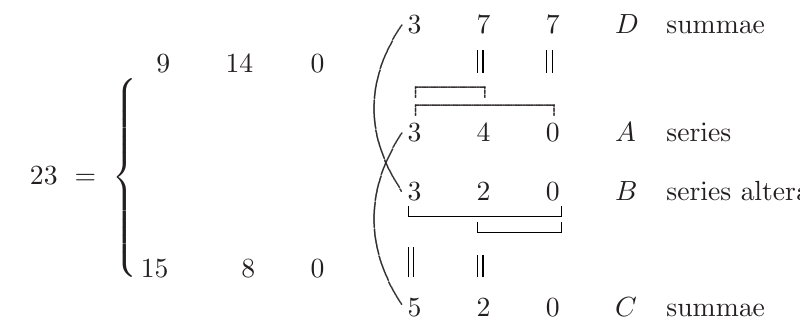
45[Scheme. D, sums: 3, 7, 7. A, series: 3, 4, 0. B, the other series: 3, 2, 0. C, sums: 5, 2, 0. Lines join A to C and B to D. The products of A into C are 15, 8, 0, and of B into D are 9, 14, 0; each set totals 23.]³
46atque eo situ servato, termini seriei unius A. in summas [C.] seriei alterius. B. et vicissim termini seriei posterioris B. in summas D. seriei prioris A. ducantur, productorum summae sunt aequales.
and, keeping this arrangement, if the terms of the one series A are multiplied into the sums [C] of the other series B, and conversely the terms of the latter series B into the sums D of the former series A, the sums of the products are equal.
48Id literis exprimamus, sunto duae series quantitatum a. b. c. d. F / et alia u. x. y. z. G
Let us express this in letters. Let there be two series of quantities, a, b, c, d (F), and another, u, x, y, z (G),
49ita ut numerus terminorum sit aequalis (quod fieri semper potest quando inaequalis, locis vacuis per zero vel cyphram suppletis), eaeque series sibi, ut libuerit, subscribantur (modo is subscriptionis ordo in iis quae mox dicemus servetur)² vel coordinentur — aio si quantitates posterioris seriei G. v.g. u. x. y. z. ducantur in summas respondentes quantitatum prioris seriei [F.] continue diminutas[,] inde ab uno aliquo latere v.g. ab ‹a›.¹ ita ut primus posterioris ducatur in omnes terminos prioris, secundus posterioris in omnes prioris demto termino primo, tertius posterioris in omnes prioris demto primo et secundo etc.
so that the number of terms is equal (which can always be arranged when it is unequal, by filling the empty places with zero, or the cipher), and let these series be written one under the other, or coordinated, in any way one likes (provided that this order of writing is kept in what we shall say next).² I say: if the quantities of the latter series G, e.g. u, x, y, z, are multiplied into the corresponding sums of the quantities of the former series [F], continually diminished from some one side, e.g. from ‹a›,¹ so that the first of the latter is multiplied into all the terms of the former, the second of the latter into all of the former except the first term, the third of the latter into all of the former except the first and second, etc.,
50[Scheme. a. b. c. d. into u; b. c. d. into x; c. d. into y; d. into z. Products: au. bu. cu. du. / bx. cx. dx. / cy. dy. / dz. = H.]
51seu si posterioris seriei G. primus ducatur in prioris seriei F. primum et omnes sequentes, secundus posterioris in secundum prioris et omnes sequentes, tertius posterioris in tertium prioris et omnes sequentes: et summa productorum appelletur H.
that is, if the first of the latter series G is multiplied into the first of the former series F and all that follow, the second of the latter into the second of the former and all that follow, the third of the latter into the third of the former and all that follow; and let the sum of the products be called H.
52Iamque vicissim quantitates prioris seriei F. nempe a. b. c. d. ducantur in summas respondentes quantitatum seriei posterioris G. opposito modo, v.g. inde a latere z; diminutas, ita ut primus prioris seriei F. ducatur in primum terminum posterioris seriei G. secundus
And now, conversely, let the quantities of the former series F, namely a, b, c, d, be multiplied into the corresponding sums of the quantities of the latter series G, diminished in the opposite way, e.g. from the side of z, so that the first of the former series F is multiplied into the first term of the latter series G, the second
54prioris in primum et secundum posterioris, tertius prioris in primum secundum et tertium posterioris, quartus prioris in primos quatuor posterioris, et ita porro; et summa horum productorum appelletur I. aio duas istas productorum summas esse inter se aequales seu H = I. Nam:²
of the former into the first and second of the latter, the third of the former into the first, second and third of the latter, the fourth of the former into the first four of the latter, and so on; and let the sum of these products be called I. I say that these two sums of products are equal to each other, that is, H = I. For:²
55[Scheme. au. bu. cu. du. / bx. cx. dx. / cy. dy. / dz. = ua. / ub. xb. / uc. xc. yc. / ud. xd. yd. zd. = I, with u over a, u.x. over b, u.x.y. over c and u.x.y.z. over d. Each product of H is struck through as it is found in I.]
56Demonstratio manifesta est, quia prima series summae factorum H. coincidit primis terminis serierum, summae factorum I. secunda series terminis primis serierum residuarum, post praecedentes abiectos, tertia series rursus primis serierum residuarum, quarta rursus primis residuarum, donec nihil restet, qualibet autem subductione unius seriei magnae H. ex seriebus in I. una series in I. evanescit, et idem est numerus serierum utrobique.
The proof is plain: the first row of the sum of products H coincides with the first terms of the rows of the sum of products I; the second row with the first terms of the remaining rows, after the preceding have been discarded; the third row again with the first terms of the remaining rows; the fourth again with the first terms of those remaining, until nothing is left. And with each subtraction of one long row of H from the rows in I, one row in I vanishes, and the number of rows is the same on both sides.
57Breviter: si series duae eundem numerum terminorum habentes sibi ut libuerit coordinentur, ac termini unius seriei ducantur in summas terminorum alterius seriei, unusquisque prioris in summam ex termino posterioris sibi respondente[,] omnibusque, eum sequentibus conflatam; vicissim vero termini posterioris seriei ducantur in summas terminorum prioris seriei, opposito modo assumtas, unusquisque scilicet posterioris seriei in summam ex termino prioris sibi respondente, omnibusque eum antecedentibus conflatam; summae productorum multiplicationis unius, sunt summis productorum multiplicationis alterius aequales.
Briefly: if two series having the same number of terms are coordinated in any way one likes, and the terms of one series are multiplied into sums of the terms of the other, each term of the former into the sum made up of the corresponding term of the latter and all that follow it; and conversely the terms of the latter series are multiplied into sums of the terms of the former, taken in the opposite way, namely each term of the latter into the sum made up of the corresponding term of the former and all that precede it: then the sums of the products of the one multiplication are equal to the sums of the products of the other.
58Tentari posset quomodo theorema tale constitui debeat assumtis pluribus seriebus. Tentari potest etiam quid futurum sit si iidem utrobique sint termini, sed perturbato modo ordinati. Occurrere casus potest, ubi ista aequatio magnum usum praestet in geometria.
One could try how such a theorem should be set up when more series are taken. One can also try what will happen if the terms are the same on both sides but arranged in a disturbed order. A case may occur where this equation is of great use in geometry.
59Porro variis seriebus inter se iunctis punctum eiusmodi medium aequilibrii invenire ex calculi principiis res futura est pulcherrimae inquisitionis summique usus in geometria ad invenienda centra gravitatis. Vicissim ubi iam habentur centra gravitatis vel etiam saltem puncta librarum possunt infinitae inveniri aequationes, libris variis assumtis; et variae illae aequationes inter se collatae magnam afferre lucem possunt et aliquando nova theoremata seu figurarum incognitarum dimensiones aperire.²
Further, to find from the principles of calculation such a middle point of equilibrium when various series are joined together will be a matter of the most beautiful inquiry and of the greatest use in geometry for finding centres of gravity. Conversely, where centres of gravity, or at least the points of the balances, are already had, infinitely many equations can be found by taking various balances; and those various equations, compared with one another, can throw great light and sometimes reveal new theorems, that is, the dimensions of unknown figures.²
61Porro Pascalius ex eo lemmate, quod libra in aequales partes divisa summae triangulares ponderum ab utroque latere suspensorum, incipiendo ubique ab extremo, brachii, sint aequales, deducit tres propositiones,² quarum fundamentalis haec est:
From the lemma that, when the balance is divided into equal parts, the triangular sums of the weights hung on each side, beginning everywhere from the end of the arm, are equal, Pascal further deduces three propositions,² of which the fundamental one is this:
62Summa triangularis omnium ponderum aequatur summae simplici omnium [ponderum multiplicatae] in numerum punctorum brachii, a cuius latere summa triangularis iniri coepta est[,] unde sequitur summam omnium ponderum ductam in numerum omnium punctorum librae, esse ad summam triangularem omnium ponderum ut numerus punctorum librae integrae ad numerum punctorum unius brachii, a quo coepta est summa triangularis, et si sint duae summae triangulares eorundem ponderum, a diversis lateribus coepta, ea fore inter se ut numeros punctorum brachiorum, a quibus sunt coepta. Sed propositionis fundamentalis non demonstrationem affert sed potius exemplum.
The triangular sum of all the weights equals the simple sum of all [the weights multiplied] into the number of points of the arm from whose side the triangular sum was begun. Hence it follows that the sum of all the weights multiplied into the number of all the points of the balance is to the triangular sum of all the weights as the number of points of the whole balance to the number of points of the one arm from which the triangular sum was begun; and if there are two triangular sums of the same weights, begun from different sides, they will be to each other as the numbers of points of the arms from which they were begun. But for the fundamental proposition he gives not a proof but rather an example.
63Hinc facile apparet, data libra dataque una summa triangulari, et area, dari alteram quoque, seu potius data saltem ratione summae triangularis ad aream, dari brachium unum librae. Ergo datur et alterum, quo in aream ducto, fit summa triangularis altera, seu brachium a quo incipit summa triangularis scilicet summa triangulari divisa per aream figurae.²
Hence it is easily seen that, given the balance, one triangular sum and the area, the other is also given; or rather that, given merely the ratio of the triangular sum to the area, one arm of the balance is given. Therefore the other is given too, and when it is multiplied into the area the other triangular sum results; that is, the arm from which the triangular sum begins is the triangular sum divided by the area of the figure.²
64Interim hanc inde consequentiam duco: sint ordinatae quaecunque ad aliquam rectam (sinus sunt ordinatae ad curvam in rectam extensam, aliaeque lineae aut plana orta in figura curvilinea cuius curva in partes aequales secta est), unde fiet quoddam trilineum, aio si in isto trilineo considerentur haec: axis (cui applicantur ordinatae), basis, area figurae, summa triangularis ordinatarum ad axem (vel huius loco punctum aequilibrii in axe), summa triangularis ordinatarum ad basin (vel huius loco punctum aequilibrii in basi), centrum gravitatis figurae, aio eam esse relationem harum rerum, ut unumquodque eorum detur, caeteris omnibus datis.²
Meanwhile I draw this consequence from it. Let there be any ordinates to some straight line (sines are ordinates to a curve stretched out into a straight line, and so are other lines or planes arising in a curvilinear figure whose curve is cut into equal parts), so that a kind of trilinear figure results. I say that if in this trilinear figure the following are considered: the axis (to which the ordinates are applied), the base, the area of the figure, the triangular sum of the ordinates to the axis (or in its place the point of equilibrium on the axis), the triangular sum of the ordinates to the base (or in its place the point of equilibrium on the base), and the centre of gravity of the figure, then these things are so related that each of them is given when all the others are given.²
65Quod ita facile patet: data area figurae seu summa ordinatarum ad basin axemque (velut ponderum ad libram totam), dataque summa triangulari applicatarum ad axem, datur punctum aequilibrii in ipso axe, velut
This is easily seen as follows: given the area of the figure, that is, the sum of the ordinates to the base and to the axis (as of the weights to the whole balance), and given the triangular sum of the ordinates applied to the axis, the point of equilibrium on the axis itself is given, as
67libra, datur enim ratio brachii a quo coepto summa triangularis ad libram totam seu axem totum. Idem in basi: vicissim si dentur iam puncta aequilibrii dantur summae triangulares. Hinc uno dato centro gravitatis dataque area figurae, dantur omnes summae triangulares tam super axem quam super basin; vicissim data una summa triangulari, datoque centro gravitatis, datur area figurae. Quod manifestum est, quia semper datis duobus illis aequilibrii punctis datur centrum gravitatis, eorum intersectione.
on a balance, for the ratio is given of the arm, from which the triangular sum was begun, to the whole balance, that is, to the whole axis. The same on the base. Conversely, if the points of equilibrium are already given, the triangular sums are given. Hence, given just the centre of gravity and the area of the figure, all the triangular sums are given, both on the axis and on the base; and conversely, given one triangular sum and the centre of gravity, the area of the figure is given. This is plain, because when those two points of equilibrium are given, the centre of gravity is always given by their intersection.
68Intellige haec de trilineo plano, nam si sit superficies curva, aut si sit solidum, opus est tribus punctis aequilibrii, vel tribus summis triangularibus ad habendum centrum gravitatis. In omnibus superficiebus quae bisecari semel possunt in duas partes similes et aequales non opus est nisi uno puncto aequilibrii ad habendum centrum gravitatis; et in omnibus figuris in uno plano non manentibus quae bisecari possunt, non opus est nisi duobus.¹ ²
Understand this of a plane trilinear figure. For if it is a curved surface, or a solid, three points of equilibrium, or three triangular sums, are needed to obtain the centre of gravity. In all surfaces that can once be bisected into two similar and equal parts, only one point of equilibrium is needed to obtain the centre of gravity; and in all figures not remaining in one plane that can be so bisected, only two.¹ ²
69Quod attinet demonstrationem propositionis fundamentalis, eam affert talem:
As for the proof of the fundamental proposition, he gives it thus:
70[Fig. 5a. The balance B F E A D C with the weights 7, 0, 4, 5, 9, 8 at B, F, E, A, D, C, and the letter ט above D. Fig. 5b. The same balance with the weights 7, 0, 4 on the side of B and 9, 8 on the side of C, and none at A.]²
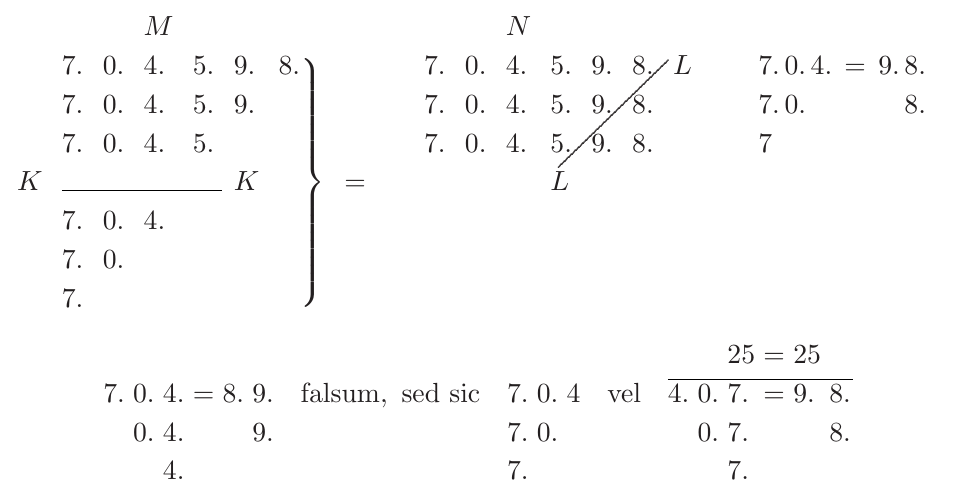
72[Scheme. M: the rows 7. 0. 4. 5. 9. 8. / 7. 0. 4. 5. 9. / 7. 0. 4. 5. / then the line K, and below it 7. 0. 4. / 7. 0. / 7. This is set equal to N: 7. 0. 4. 5. 9. 8. / 7. 0. 4. 5. 9. 8. / 7. 0. 4. 5. 9. 8., in which the oblique line L cuts off 8; 9. 8.; and 9. 8. at the right end. Beside it: 7. 0. 4. = 9. 8. / 7. 0. 8. / 7.]
737. 0. 4. = 8. 9. falsum, sed sic 7. 0. 4 vel 4. 0. 7. = 9. 8. / 0. 4. 9. 7. 0. 0. 7. 8. / 4. 7. 7. / 25 = 25
7. 0. 4. = 8. 9. is false; it should be thus: 7. 0. 4, or 4. 0. 7., = 9. 8.; / under them 0. 4. and 9.; 7. 0.; 0. 7. and 8.; / 4.; 7.; 7. / 25 = 25³
74Summa triangularis horum ponderum e libra BC. aequaliter secta cuius punctum aequilibrii A. suspensorum incipiendo a C. seu omittendo primum 8. postea 9. 8. postea 9. 8. 5. etc. aequatur summae eorundem ponderum simplici in brachium CA. ducto seu per numerum punctorum brachii A.D.C. seu 3. multiplicatae. (Medium punctum A. simul computandum in finitis. Nam in infinitis nil refert an simul computetur, an non.)
The triangular sum of these weights hung from the equally divided balance BC, whose point of equilibrium is A, beginning from C, that is, leaving out first 8, then 9, 8, then 9, 8, 5, etc., equals the simple sum of the same weights multiplied into the arm CA, that is, multiplied by the number of points of the arm A, D, C, namely 3. (The middle point A must be counted in with finite quantities; with infinitely many it makes no difference whether it is counted in or not.)
75Nam summa triangularis ponderum brachii BA. seu 7. 0. 4. / 0. 4. / 4. aequatur alteri 9. 8. / 8 per theorema praecedens.
For the triangular sum of the weights of the arm BA, that is, 7. 0. 4. / 0. 4. / 4., equals the other, 9. 8. / 8, by the preceding theorem.
76Abscindatur hoc commune, utrobique per lineam K. et per lineam L. restat ut monstretur residua M. et N. post L. et K. abscissa esse aequalia, hoc Pascalius non demonstrat, quia scilicet id in schemate apparet, sed ostendendum ita semper eventurum in quolibet exemplo.
Let this common part be cut off on both sides, by the line K and by the line L. It remains to show that the remainders M and N, after L and K have been cut off, are equal. Pascal does not prove this, because it is evident in the scheme; but it must be shown that it will always happen so in any example.
77Et ratio haec est, quia in ineunda omni summa triangulari primum aufertur ultimum, deinde ultimum et penultimum, continuando aufertur summa triangularis[,] semper summa triangularis ab eodem latere incipiens brachii cuiusdam a C. assumti, et ea quidem semper aequalis summae triangulari oppositi brachii si quidem id brachium sit brachium aequilibrii, seu quando punctum ad quod in generanda summa triangulari totius perventum est, est punctum aequilibrii. Porro si ultra pergetur in ea totius summa triangulari facienda non adicie-
And the reason is this. In forming any triangular sum, first the last term is taken away, then the last and the next to last; going on, a triangular sum is taken away, always a triangular sum beginning from the same side, of some arm taken from C; and this is always equal to the triangular sum of the opposite arm, if that arm is an arm of equilibrium, that is, when the point reached in generating the triangular sum of the whole is the point of equilibrium.² If one goes further in making that triangular sum of the whole, nothing will be added
79tur nisi summa triangularis oppositi brachii incipiendo ab eodem puncto aequilibrii, ea ergo aeque ac quod adiectum est omittatur, et quia non generatur id quod in summa triangulari totius restat, abiecta summa triangulari brachii oppositi nisi toties assumta summa simplici, quoties aliquis terminus oppositi brachii abici potest, tot autem abici possunt quot sunt, et quando ad punctum aequilibrii perventum est, nihil amplius brachii illius a quo inceptum, abicitur.
but the triangular sum of the opposite arm, beginning from the same point of equilibrium. Let it therefore be left out, just as what was added. And what remains in the triangular sum of the whole, once the triangular sum of the opposite arm is discarded, is generated only by taking the simple sum as many times as some term of the opposite arm can be discarded; and as many can be discarded as there are terms; and when the point of equilibrium is reached, nothing more of the arm from which one began is discarded.
80Ideo id quod in summa triangulari totius restat abiecta summa triangulari brachii oppositi (seu potius nondum eum attingendo), id est toties sumta summa simplex quot sunt factae abiectiones, seu quod sunt termini abicibiles, id est quot sunt, et adhuc semel (nam prima vice nihil abicitur). Ergo sic concipiendum erat theorema Pascalium, ut monstrat demonstratio scilicet toties multiplicandam summam simplicem in numerum punctorum brachii a quo inceptum, addito uno, quod ut dissimulavit Pascalius centrum brachio illi computando, quod tamen computari debet neutri. Argumento id est claram eius rei demonstrationem tunc ei ob oculos non fuisse.
Therefore what remains in the triangular sum of the whole, once the triangular sum of the opposite arm is discarded (or rather, before reaching it), is the simple sum taken as many times as discards have been made, that is, as there are discardable terms, that is, as many as there are, and once more (for the first time nothing is discarded). So Pascal's theorem should have been conceived as the proof shows: the simple sum must be multiplied by the number of points of the arm from which one began, with one added. Pascal concealed this by counting the centre with that arm, whereas it ought to be counted with neither. This is a sign that he did not then have a clear proof of the matter before his eyes.³
81Sed operae pretium videtur nostrum quoque construere theorema, si libra divisa sit in partes inaequales, sint autem pondera aequalia. Eo casu manifestum est libram esse bisecandam; sed videtur tamen et aliud theorema construi posse. Bisecari [posse] quidem patet, si nullum intercedat 0. seu zero, at si hoc intercedat in effectu ibi pondera desinunt esse simplicia.²
But it seems worth while to construct our own theorem too, for when the balance is divided into unequal parts but the weights are equal. In that case it is plain that the balance must be bisected; but it seems that yet another theorem can be constructed. That it [can] be bisected is indeed clear if no 0, or zero, comes between; but if one does, the weights there in effect cease to be simple.²
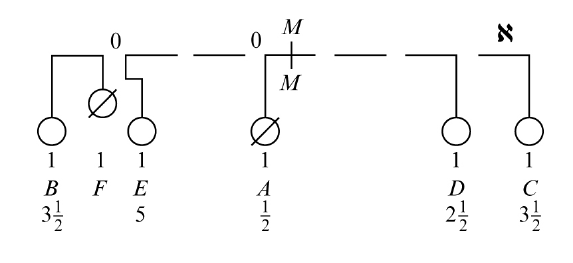
82[Fig. 6, marked ℵ. A balance with gaps marked 0, the support M, and unit weights at B, F, E, A, D, C; those at F and A are struck through. Below the letters: 3½ under B, 5 under E, ½ under A, 2½ under D, 3½ under C.]²
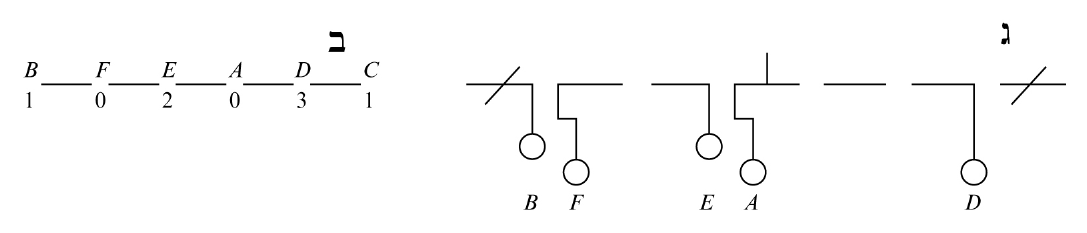
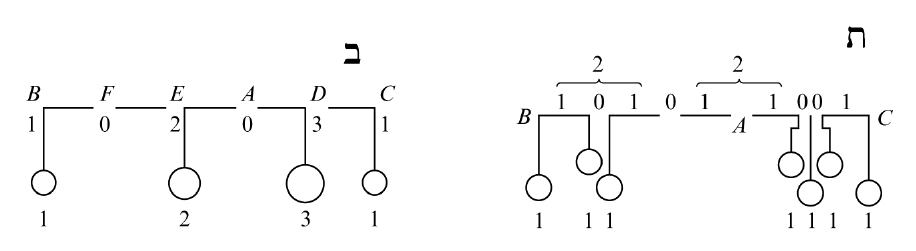
84[Fig. 7, marked ב. The balance B F E A D C, equally divided, with the weights 1, 0, 2, 0, 3, 1. Fig. 8, marked ג. The inversion: equal weights at B, F, E, A, D hung from a balance in unequal parts, with the extreme parts struck.]¹ ²
85Quod elegantissimae est considerationis, nimirum cum antea ut in fig. ב libra BC. fuerit aequalium partium, pondera vero inaequalia 1. 0. 2. 0. 3. 1., rem nunc invertamus ut in ℵ, ibique libram dividamus in partes inaequales 1. 0. 2. 0. 3. 1., pondera sunto aequalia; utque inversio procedat rectius uti semper pondus pertinebat ad partem librae sequentem in ב versus centrum ab utroque latere, ita nunc in ג faciamus librae partem pertinere ad pondus sequens versus centrum utrinque quo facto fiet, nulla alia mutatione, ut quemadmodum antea numerus ponderum superabat unitate numerum partium librae, ita nunc numerus partium librae superet numerum ponderum; sed quia inde duae extremae partes sunt vacuae omitti possunt calculo non variato, et ita rursus per consequentiam salvis inversionis legibus fit ut tamen numerus ponderum excedat numerum partium unitate.
This is of the most elegant consideration. Before, as in figure ב, the balance BC had equal parts but the weights were unequal, 1, 0, 2, 0, 3, 1. Let us now invert the matter, as in ℵ, and there divide the balance into the unequal parts 1, 0, 2, 0, 3, 1, and let the weights be equal. And so that the inversion proceeds more correctly: just as in ב each weight always belonged to the following part of the balance towards the centre, from either side, so now in ג let us make each part of the balance belong to the following weight towards the centre on either side.² When this is done, with no other change, it comes about that, as before the number of weights exceeded the number of parts of the balance by one, so now the number of parts of the balance exceeds the number of weights. But since the two extreme parts are then empty, they can be left out without changing the calculation; and so again, as a consequence and keeping the laws of the inversion, the number of weights still exceeds the number of parts by one.
86Iam notabile est, ut 0. repraesententur in partibus librae, in effectu idem esse ac si duo pondera quorum unum ex parte aliqua vera librae, alterum ex imaginaria seu zero suspenditur, reapse intelligi debeant suspensa ex puncto librae eodem, unde reapse eo casu falsum est librae pondera omnia esse aequalia, ideo eo casu non procedit bisectio, ut in exemplis ℵ et ג apparet, me initio admirante, ante intellectam causam.
Now it is remarkable that, when 0 is represented in the parts of the balance, it is in effect the same as if two weights, one hung from some real part of the balance and the other from an imaginary part, or zero, must really be understood as hung from the same point of the balance. Hence in that case it is really false that all the weights on the balance are equal, and so in that case bisection does not work, as appears in the examples ℵ and ג, which surprised me at first, before I understood the cause.
87Hinc observatio est mirabilis: casum ponderum inaequalium reduci posse ad casum ponderum aequalium, modo partes librae reddantur inaequales, id est ipsis interponi intelligantur zero, tot quoties pondus
Hence a wonderful observation: the case of unequal weights can be reduced to the case of equal weights, provided the parts of the balance are made unequal, that is, zeros are understood to be put between them, as many times as the weight
89in pondere continetur, imo et dimidia zero, etc.; si sint fractiones, id est zero. Vicissim casum partium librae inaequalium reduci posse ad partium librae aequalium, eadem arte, si scilicet ubi partes librae sunt inaequales, redactis illis ad aequalitatem ubi partes librae iusto maiores sunt, pondera, quae zero sint, interponi intelligantur, seu aliquando cum fractiones sunt, ne opus sit quaerere minimas partes commensurabiles, sufficit pondera esse quasdam ipsius zero fractiones, aut rationes cum partes sunt incommensurabiles.
is contained in the weight; indeed even half a zero, etc., if there are fractions, that is, of zero.³ Conversely, the case of unequal parts of the balance can be reduced to that of equal parts by the same device: namely, where the parts of the balance are unequal, they are brought to equality, and where the parts are larger than they should be, weights that are zero are understood to be put between; or sometimes, when there are fractions, so as not to have to look for the smallest commensurable parts, it is enough for the weights to be certain fractions of the zero itself, or ratios when the parts are incommensurable.
90Tandem cum utraeque sunt inaequales, reduci possunt, ad casum, in quo alterutrae sunt aequales, non, quo utraque. Quaerendus ergo est modus, quo resolvatur casus quando pondera quidem sunt aequalia, et partes librae inaequales, seu iis interponuntur zero.
Finally, when both are unequal, they can be reduced to the case in which one or the other is equal, but not to the case in which both are. A way must therefore be sought to solve the case in which the weights are equal and the parts of the balance unequal, that is, with zeros put between them.
91Hoc fieri duobus modis potest, partim hunc casum mutando in alium, quo partes librae fiunt aequales, pondera inaequalia, quo casu res reducitur ad puncti inventionem, cuius ab utroque latere summae triangulares sunt aequales, in quibus ineundis zero negligenda non sunt, zero autem hoc efficiunt in summa triangulari, ut quot sint zero, toties sequens summa sumenda sit, quodsi sit fractio de zero, vel ratio de zero, etiam fractio eiusmodi de summa sequente assumenda est, cuius demonstratio patet, si ad evitandas fractiones, in partes minores, ut omnia fiant commensurabilia (quando id fieri potest) partes divisae intelligantur.
This can be done in two ways. First, by changing this case into the other, in which the parts of the balance become equal and the weights unequal. In that case the matter is reduced to finding the point on each side of which the triangular sums are equal; in forming these the zeros must not be neglected. The effect of the zeros in a triangular sum is that the following sum must be taken as many times as there are zeros; and if there is a fraction of a zero, or a ratio of a zero, a like fraction of the following sum must be taken. The proof is clear if, to avoid fractions, the parts are understood to be divided into smaller parts so that everything becomes commensurable (when that can be done).
92[Fig. 9, marked ד, and Fig. 10, marked ה. The balance in parts 1 0, 2 0, 3, 1, with equal weights hung at the beginning or the end of each part.]²
93Quaestio est an initio an fini partis pondus appendendum, vide ex ד et ה quam ista varient, ego malim ut ה suspendendo simul ab utroque latere, semper ad terminos partis a medio remotos ita ut habebamus ante in ב pondera 6. nempe 1. 0. 2. 0. 3. 1. ita nunc habemus tales quoque partes librae totidem, sed malum est quod pro 5. partibus librae aequalibus habemus 7. pondera aequalia — sed hoc evitari non poterat abiectis enim duobus ponderibus extremis abicientur eo ipso seu inutiles vel reicibiles fient (cum calculum non varient) partes librae extremae.
The question is whether the weight should be hung at the beginning or at the end of a part. See from ד and ה how much these differ. I would prefer, as in ה, to hang them on both sides at once, always at the ends of the parts away from the middle, so that, as we had before in ב six weights, namely 1, 0, 2, 0, 3, 1, so now we have just as many such parts of the balance. But the trouble is that for 5 equal parts of the balance we have 7 equal weights. This could not be avoided, for if the two extreme weights are discarded, the extreme parts of the balance are thereby discarded too, that is, they become useless or rejectable (since they do not change the calculation).
94Certum enim est in summis triangularibus ineundis zero initio et fine positum nihil variare, bene tamen in medio. Imo corrigo me non variat positum fine, variat positum initio, hinc interest a quo latere incipere velis. Sed cum ab utroque debeat incipi posse ne calculus varietur, hinc patet nullam esse rationem
For it is certain that, in forming triangular sums, a zero placed at the beginning or the end changes nothing, though one in the middle does. No, I correct myself: placed at the end it does not change anything, placed at the beginning it does; hence it matters from which side you choose to begin. But since one must be able to begin from either side without changing the calculation, it is clear that there is no reason
96cur ut in ד ab altero tantum latere vacua librae portio relinquatur. Imo certum est in libra ista portiones quotcunque sub fine adiectas nil ad rem pertinere. Sed ut dubitatione ista solide exeamus, veram rigorosamque instituamus conversionem methodo paulo ante demonstrata.
why, as in ד, an empty portion of the balance should be left on one side only. Indeed it is certain that in this balance any number of portions added at the end have nothing to do with the matter. But to get out of this doubt on solid ground, let us make a true and rigorous conversion by the method shown a little earlier.
97[Fig. 11, marked ב. The balance B F E A D C in equal parts, marked 1, 0, 2, 0, 3, 1, with the weights 1, 2, 3, 1 below. Fig. 12, marked ת. The converted balance from B to C, with the parts marked 1 0 1 (bracketed as 2), 0, 1 1 (bracketed as 2) about A, then 0 0 1, and seven unit weights.]¹ ²
98Casus datus est ב, hunc casum transformemus in casum ponderum aequalium, partium librae inaequalium. Habemus 1. 2. 3. 1. fient unitates 7. abiectis zero ponderum et ex ב fiet ת, seu ex 1. 1. 1. 1. 1. partibus librae aequalia et 1. 0. 2. 0. 3. 1. ponderibus fient 2. 0. 2. 0. 0. 1. partes librae et 1. 1. 1. 1. 1. 1. 1. pondera aequalia.
The given case is ב. Let us transform it into the case of equal weights and unequal parts of the balance. We have 1, 2, 3, 1; these become 7 units, with the zero weights discarded. And from ב comes ת: that is, from the equal parts of the balance 1, 1, 1, 1, 1 and the weights 1, 0, 2, 0, 3, 1 come the parts of the balance 2, 0, 2, 0, 0, 1 and the equal weights 1, 1, 1, 1, 1, 1, 1.
99Aequilibrium quidem semper erit in A, sed quomodo id ostendemus non reducendo in casum partium librae aequalium, sumamus summam triangularem ipsarum partium librae, incipiendo unde libet v.g. a 2. fiet
The equilibrium will indeed always be at A. But how shall we show this without reducing it to the case of equal parts of the balance? Let us take the triangular sum of the parts of the balance themselves, beginning wherever we like, e.g. from 2. It will be:
1002. 0. 2. 0. 0. 1. / 0. 2. 0. 0. 1 / 2. 0. 0. 1 / 0. 0. 1 / 0. 1 / 1 / 2. 0. 6. 0. 0. 6. = 14
2. 0. 2. 0. 0. 1. / 0. 2. 0. 0. 1 / 2. 0. 0. 1 / 0. 0. 1 / 0. 1 / 1 / total 2. 0. 6. 0. 0. 6. = 14
102Sed hanc summam summa simplex non metitur, quare non video [quomodo] eam producere possit, in aliud datum (nulla enim fractio data est[)], ducta. An ergo sic inquiremus: summa quaeratur triangularis numerorum partium cuiusque brachii, incipiendo ab extremo versus medium (contra quam in ponderum inquisitione).²
But the simple sum does not measure this sum, so I do not see [how] it could produce it when multiplied into some other given number (for no fraction is given). Shall we then inquire thus: let the triangular sum be sought of the numbers of the parts of each arm, beginning from the end towards the middle (the opposite of what we did in inquiring into the weights).²
103Numeri unius brachii BA (fig. ת) sunt 2. 0. 1. quorum summa triangularis 2. 0. 1. = 5 / 0. 1. / 1.
The numbers of the one arm BA (fig. ת) are 2, 0, 1, whose triangular sum is 2. 0. 1. / 0. 1. / 1. = 5.
104alterius brachii AC numeri 1. 0. 0. 1 horum summa triangularis 1. 0. 0. 1. = 5 / 0. 0. 1. / 0. 1. / 1.
The numbers of the other arm AC are 1, 0, 0, 1; their triangular sum is 1. 0. 0. 1. / 0. 0. 1. / 0. 1. / 1. = 5.
1051. 0. 0. 1. = 2. 0. 1. / 0. 0. 1. 0. 1. / 0. 1. 1. / 1.
1. 0. 0. 1. / 0. 0. 1. / 0. 1. / 1. = 2. 0. 1. / 0. 1. / 1.
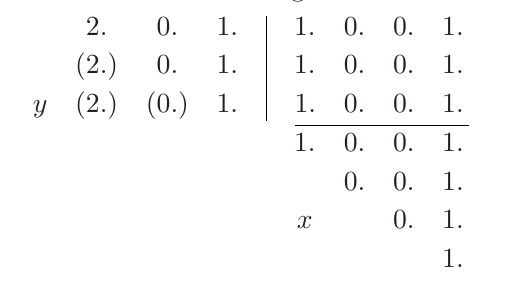
106Ut rectius iam fiat comparatio secundum 2. in 2. 0. 2. 0. 0. 1. resolvatur in duas unitates fiet 2. 0. 1. 1. 0. 0. 1. habebimus summam triangularem
For a more correct comparison, let the second 2 in 2. 0. 2. 0. 0. 1. be resolved into two units: it becomes 2. 0. 1. 1. 0. 0. 1., and we shall have the triangular sum
107[Scheme. Left of a vertical line: 2. 0. 1. / (2.) 0. 1. / y (2.) (0.) 1. Right of it: 1. 0. 0. 1. three times, a rule, then 1. 0. 0. 1. / 0. 0. 1. / x 0. 1. / 1.]
108Hinc facile patet non produci summam totius triangularem aliqua summae simplicis multiplicatione, si enim infra x abiciatur[,] y supplendum eius loco ei non est aequale.
Hence it is easily seen that the triangular sum of the whole is not produced by any multiplication of the simple sum; for if what lies below x is discarded, y, which must be supplied in its place, is not equal to it.³
109Hinc discimus duo alia notatu digna[:] primum aliam fieri summam triangularem, si terminus aliquis resolvatur in suas partes, alterum vero longe memorabilius nempe: Si ineatur summa triangularis seriei totius ab aliquo latere, et ineantur quoque series triangulares duarum partium totum complentium, ab interioribus, seu eodem puncto omittendo in-
From this we learn two other things worth noting. First, that the triangular sum becomes different if some term is resolved into its parts. Second, and far more memorable: if the triangular sum of the whole series is taken from some side, and the triangular series of the two parts that make up the whole are also taken, from the inner ends, that is, beginning by leaving out the same point,
111cipientes, tunc eae duae summae triangulares partium inter se aequales a tota summa triangulari detractae relinquunt rectangulum factum ex numero punctorum terminorum eius partis unde coeptum est, et summa terminorum partis alterius 1. 0. 0. 1.⌢3. quod applicari potest geometriae hoc modo.
then these two triangular sums of the parts, equal to each other, when taken from the whole triangular sum, leave the rectangle made from the number of points, that is, of terms, of the part from which one began, and the sum of the terms of the other part: 1. 0. 0. 1. × 3. This can be applied to geometry as follows.³
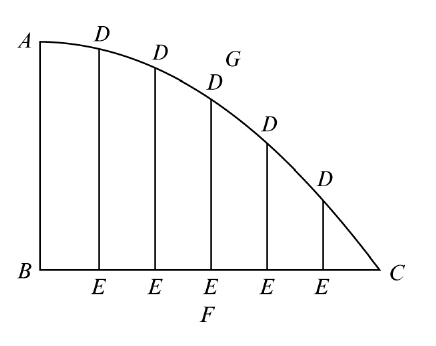
112[Fig. 13. A trilinear figure with the straight sides AB and BC and the curve ADC; ordinates DE stand on BC at the points E; F is one of the points E, and G is the point of the curve above it.]
113¹ Esto spatium quodcunque divisum in partes quotcunque per ordinatas quasdam vel sinus, rectas scilicet (vel si solidum plana), applicabiles alicui in partes aequales diviso, sive rectae sive curvae, horum partium summae sunt figurae DEC. et omnium partium summa totum spatium, si rectae DE. sunt ordinatae seu si recta BC. punctis E. divisa est in partes aequales; sin minus et si curva ADC. punctis D. aequidivisa est, summa erit spatium curvae applicatum, ut constat.
¹ Let any space be divided into any number of parts by certain ordinates or sines, that is, straight lines (or planes, if it is a solid), which can be applied to something divided into equal parts, whether a straight line or a curve. The sums of these parts are the figures DEC, and the sum of all the parts is the whole space, if the straight lines DE are ordinates, that is, if the straight line BC is divided by the points E into equal parts. If not, and the curve ADC is divided equally by the points D, the sum will be the space applied to the curve, as is known.
114Iam considerandae sunt summae summarum, seu summae ipsarum figurarum DEC. mensurae applicatarum, seu summae ipsarum rectarum DE. triangulares. Ponatur summam triangularem omnium DE. esse inventam, ponatur et punctum aequilibrii notum esse F. ita ut ipsis DE. fulcro FD. impositis (si prius mensurae sint applicatae) fiat aequilibrium (futurum scilicet tunc punctum aequilibrii est revera in F. si DE. sint ordinatae, sin sint sinus verum punctum aequilibrii erit punctum curvae cuius sinus est FD. nempe G. sive curva in rectam extensa applicentur ipsae DE. sive ea curva manente ei impositae forment superficiem cylindricam
Now the sums of the sums must be considered, that is, the sums of the figures DEC applied to the measure, that is, the triangular sums of the straight lines DE. Let the triangular sum of all the DE be supposed found, and let the point of equilibrium F be supposed known, so that when the DE are placed on the fulcrum FD (if they have first been applied to the measure) there is equilibrium (namely, the point of equilibrium will then really be at F if the DE are ordinates; but if they are sines, the true point of equilibrium will be the point of the curve whose sine is FD, namely G, whether the DE are applied to the curve stretched out into a straight line or, the curve remaining, are set upon it and form a truncated cylindrical surface).²
116truncatam), notae ergo sunt summae triangulares ipsarum FG. DE. etc. incipiendo a C. similiter nota summa triangularis ipsarum FD. DE. AB. incipiendo a AB.
Therefore the triangular sums of FG, DE, etc., beginning from C, are known; likewise the triangular sum of FD, DE, AB, beginning from AB.²
117Ratio est, quia data summa triangulari totius et centro gravitatis datur et partium, imo sine centro, data quoque summa simplici ( ). Ergo et summae triangulares earundem partium retro sumtae seu inde ab F. At si a summa triangulari omnium inde ab AB. detrahantur summae triangulares partiales inde ab F. residuum erit factum ex parte regulae, applicanda ad ABF, in summam simplicem alterius partis FDC.
The reason is that, given the triangular sum of the whole and the centre of gravity, that of the parts is also given; indeed even without the centre, if the simple sum is also given ( ).² Therefore the triangular sums of the same parts taken backwards, that is, from F, are also given. But if from the triangular sum of all, from AB, the partial triangular sums from F are taken away, the remainder will be the product of the part of the rule to be applied to ABF into the simple sum of the other part FDC.
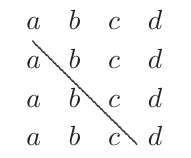
118Summa triangularis differt a summa rectangulari, summa opposita triangulari, ablato quodam in finito praecise in infinito.
The triangular sum differs from the rectangular sum by the opposite triangular sum: in the finite case with something taken away, in the infinite case exactly.
119[Scheme. a b c d written in four rows, with a diagonal line separating the triangle above and to the right from the triangle below and to the left.]
120Nam in finito assumenda summa triangularis inversa seriei termino ultimo differentis a data, at illa differentia in infinito nullius momenti.
For in the finite case one must take the inverted triangular sum of a series that differs from the given one by its last term; but in the infinite case that difference is of no moment.³
121Si summae istae triangulares FAD. fig. praeced. vel FGC. assumantur ab extremis, tunc duae triangulares istae partium sunt aequales, et una earum addita toti dabit summam simplicem multiplicatam in numerum partium brachii (seu partem regulae illis partibus applicandam) a quo coeptum, ut supra ostensum vid. fig. ב.¹ ²
If these triangular sums FAD of the preceding figure, or FGC, are taken from the ends, then these two triangular sums of the parts are equal, and one of them added to the whole will give the simple sum multiplied into the number of parts of the arm (that is, the part of the rule to be applied to those parts) from which one began, as shown above: see fig. ב.¹ ²
122Nunc cum Pascalio pergamus, ille ergo methodum ex his deducit universalem puncta aequilibrii (ipse vocat ‹centra gravitatis›, cum sint tantum puncta aequilibrii certa quadam libra sumta) definiendi quae talis est, secetur figura infinitis planis inter
Now let us go on with Pascal.² From this he derives a universal method of determining points of equilibrium (he calls them ‹centres of gravity›, though they are only points of equilibrium when some definite balance is taken), which is this: let the figure be cut by infinitely many planes
124se parallelis (perpendicularibus ad libram figurae datam[,] hoc enim addendum est, sin data non est, assumi potest quaelibet maxima, seu inter duo plana parallela extrema figuram secantia intercepta, planis secantibus perpendicularis)[,] ut est summa triangularis omnium partium figurae inter plana interceptarum, incipiendo ab uno latere librae ad summam triangularem omnium illarum partium incipiendo ab altero latere librae, ita est brachium illud ad hoc, seu distantia unius plani a centro, ut distantia alterius ab eodem.
parallel to one another (perpendicular to the given balance of the figure; this must be added; if none is given, one may take any greatest one, that is, the line intercepted between the two outermost parallel planes cutting the figure and perpendicular to the cutting planes). Then as the triangular sum of all the parts of the figure intercepted between the planes, beginning from one side of the balance, is to the triangular sum of all those parts beginning from the other side of the balance, so is that arm to this one, that is, the distance of one plane from the centre to the distance of the other from it.
125Idem aliter: summa triangularis sumta ab aliquo librae latere est ad summam simplicem toties quot sunt puncta in libra, seu summae in summam summarum seu triangularem ingredientes, sumtam, seu in libram ductam; uti brachium a quo coeptum est ad libram integram.
The same otherwise: the triangular sum taken from some side of the balance is to the simple sum taken as many times as there are points in the balance, that is, as there are sums entering into the sum of sums or triangular sum, that is, multiplied into the balance, as the arm from which one began is to the whole balance.
126(Non annotavit Pascalius ad verum centrum gravitatis figurae inveniendum opus esse pluribus eiusmodi punctis aequilibrii, et minimum duobus in figuris planis.) Hinc data summa simplici, triangulari, libraque, dantur duo brachia, seu centrum aequilibrii.¹ Hac methodo etiam arcuum summa triangularis inveniri potest non minus ac trilineorum, dato puncto aequilibrii, et data magnitudine simplici arcus etc.
(Pascal did not note that to find the true centre of gravity of a figure several such points of equilibrium are needed, at least two in plane figures.) Hence, given the simple sum, the triangular sum and the balance, the two arms are given, that is, the centre of equilibrium.¹ By this method the triangular sum of arcs too can be found, no less than that of trilinear figures, given the point of equilibrium and the simple magnitude of the arc, etc.
127Rationem cur summae istae vel numeri vocentur triangulares, pyramidales etc. hanc intelligo, quia si partes sint aequales, qui simplicissimus est casus formant triangulum, pyramidem etc. et semper crescunt eorum dimensiones, si figuris applicentur, ut in potestatibus.
The reason why these sums or numbers are called triangular, pyramidal, etc., I understand to be this: if the parts are equal, which is the simplest case, they form a triangle, a pyramid, etc.; and their dimensions always increase, if they are applied to figures, as in powers.
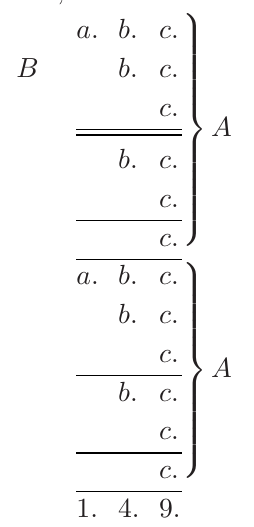
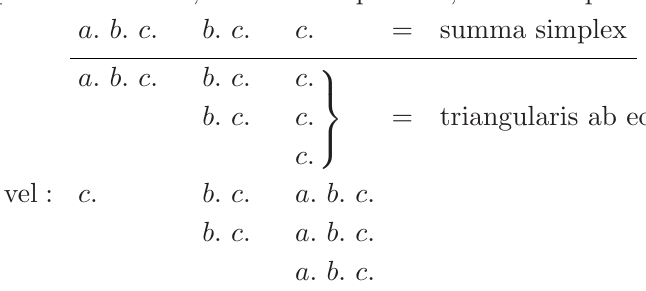
129Iam ad summas pyramidales: Sint quantitates [a. b. c.] earum summa triangularis a. b. c. / b. c. / c.
Now to pyramidal sums.² Let there be quantities [a, b, c]; their triangular sum is a. b. c. / b. c. / c.
130summa pyramidalis A. sumatur bis, et ab ea abscindatur semel summa triangularis B.
Let the pyramidal sum A be taken twice, and let the triangular sum B be cut off from it once.
131[Scheme. Twice the pyramidal sum A: each time a. b. c. / b. c. / c. / b. c. / c. / c., the first copy with the triangular sum B (a. b. c. / b. c. / c.) marked off by a double rule; below, the counts 1. 4. 9.]
132summa residui aequabitur termino primo semel, 2do quater, tertio novies, etc. ordine scilicet numerorum quadratorum deinceps ab unitate. Nam in omni summa pyramidali primus terminus assumitur semel, 2dus 3. tertius 6. vicibus etc. per numeros quos vocant triangulares. NB.¹ (Ergo numeri naturales deberent appellari triangulares, numeri triangulares deberent appellari pyramidales, etc.).
The sum of the remainder will equal the first term once, the second four times, the third nine times, etc., namely in the order of the square numbers from unity onwards. For in every pyramidal sum the first term is taken once, the second 3 times, the third 6 times, etc., according to the numbers they call triangular. NB.¹ (So the natural numbers ought to be called triangular, the triangular numbers pyramidal, etc.)
133At numeri isti triangulares, hoc habent ut duplicati diminutique exponente relinquant quadratum exponentis, hoc loco autem omnes triangulares, minuuntur suis exponentibus, quia a summa pyramidali seu triangularibus
But these triangular numbers have this property: doubled and diminished by their index, they leave the square of the index.³ And here all the triangular numbers are diminished by their indices, because from the pyramidal sum, that is, from all the triangular
135numeris omnibus, abicitur summa exponentium, seu numeri naturales (summa nimirum triangularis B.).
numbers, the sum of the indices is discarded, that is, the natural numbers (namely the triangular sum B).
136Nota bene. Numeri naturales ipsi non faciunt triangula, sed eorum summa facit triangulum, ita summa triangularium facit pyramidem. Et puto rem a summa non a numeris ipsis aestimandam, non enim 6. facit triangulum. Imo facit NB.¹ Et ideo recte appellati sunt hi numeri communi more.
Note well. The natural numbers themselves do not make triangles, but their sum makes a triangle; so the sum of the triangular numbers makes a pyramid. And I think the matter should be judged by the sum, not by the numbers themselves, for 6 does not make a triangle. No, it does, NB.¹ And so these numbers are rightly named in the common way.
137Nota quemadmodum in aequationibus Geometriae quando comparantur lineae cum superficiebus, vel superficies cum solidis, vel lineae cum solidis, necesse est dari unitatem (unde in numeris aequationes inter dimensiones diversorum graduum libere admittuntur), ita in Geometria indivisibilium, cum dicitur summam linearum aequari cuidam superficiei, vel summam superficierum cuidam solido, necesse est dari unitatem, dari scilicet lineam quandam cui applicatae intelligantur, seu in cuius partium infinitarum aequalium, unam, quae ‹unitatem› exhibet, ducantur, ut infinitae inde fiant superficies, etsi qualibet data minores.¹
Note: just as in the equations of geometry, when lines are compared with surfaces, or surfaces with solids, or lines with solids, a unit must be given (which is why in numbers equations between dimensions of different degrees are freely admitted), so in the geometry of indivisibles, when the sum of lines is said to equal some surface, or the sum of surfaces some solid, a unit must be given: that is, some line must be given to which they are understood to be applied, or into one of whose infinitely many equal parts, the one that represents the ‹unit›, they are multiplied, so that infinitely many surfaces result, though each smaller than any given.¹
138Ex infinitis autem superficiebus qualibet data minus latis, unam finitam fieri necesse est, ut ex lineis fiat solidum, infinities infinitis opus est lineis, quarum quaelibet in quadratum unitatis ducatur. Et ad quadrato-quadratum opus est lineis infinities⌢infinities infinitis in cubum unitatis ductis et ita porro, vel superficiebus infinities infinitis ductis in quadratum unitatis. Res est consideratu digna infinities infinitum, tam in Arithmetica quam [in Geometria].²
And from infinitely many surfaces, each narrower than any given, one finite surface must result. For a solid to be made from lines, infinitely-infinitely many lines are needed, each multiplied into the square of the unit. And for a square-square, lines infinitely × infinitely-infinitely many, multiplied into the cube of the unit, are needed, and so on; or surfaces infinitely-infinitely many, multiplied into the square of the unit. The infinitely infinite is a thing worth considering, in arithmetic as much as [in geometry].²
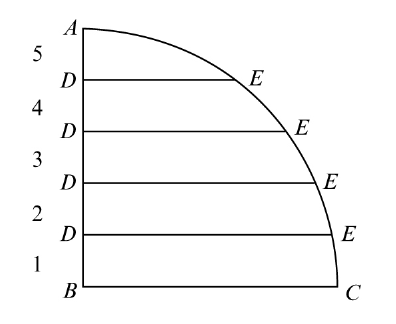
140[Fig. 14. A right trilinear figure: the axis AB divided at the points D into equal parts, numbered 1 to 5 from B, with ordinates DE parallel to the base BC meeting the curve AEC.]
141¹ In trilineo rectangulo ABC. axe AB. divisa in partes aequales indefinitas ductisque ex punctis divisionis, ordinatis AE. seu basi parallelis, summa ordinatarum est figura, summa summarum seu spatiorum BCA. DEA. etc. est summa ordinatarum triangularis.
¹ In the right trilinear figure ABC, with the axis AB divided into indefinitely many equal parts and ordinates drawn from the points of division parallel to AE, that is, to the base, the sum of the ordinates is the figure; the sum of the sums, that is, of the spaces BCA, DEA, etc., is the triangular sum of the ordinates.
142Ea sic inibitur, si quaelibet DE. per suam DB. seu distantiam a puncto unde incipitur multiplicetur summa omnium rectangulorum erit summa triangularis ordinatarum,¹ quia ita prima per 1. altera per 2. tertia per 3. quarta per 4. etc. multiplicatur, at hoc modo producitur summa triangularis. Ergo summa omnium istorum rectangulorum est aequalis triangulari.
It will be obtained thus: if each DE is multiplied by its DB, that is, by its distance from the point from which one begins, the sum of all the rectangles will be the triangular sum of the ordinates,¹ because in this way the first is multiplied by 1, the second by 2, the third by 3, the fourth by 4, etc.; and in this way the triangular sum is produced. Therefore the sum of all these rectangles equals the triangular sum.
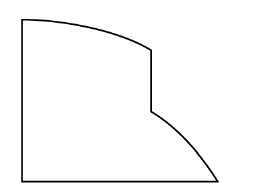
143[Leibniz's marginal figure to “trilineo rectangulo”: two straight sides at a right angle, closed by a curve with a step in it.]¹
144Summa solidorum ex rectis DE. in quadrata suorum cuiusque DB. ductis est
The sum of the solids made by multiplying the straight lines DE into the squares of their respective DB is
146aequalis summae pyramidali incipientis a B. dimidiatae. Nam summa pyramidalis duplicata aequatur terminis multiplicatis primo per 1. secundo per 4. tertio per 9. addita tantum semel summa triangulari, ut ostensum, at ea in infinito negligi potest, cum faciat planum, hic autem de solido quaestio sit, ergo absolute summa pyramidalis fit ex terminis multiplicatis ordine per numeros quadratos ordine.²
equal to half the pyramidal sum beginning from B. For the doubled pyramidal sum equals the terms multiplied, the first by 1, the second by 4, the third by 9, with the triangular sum added just once, as was shown; but in the infinite case that can be neglected, since it makes a plane, whereas the question here is of a solid. So, absolutely, the pyramidal sum is made from the terms multiplied in order by the square numbers in order.² ³
147At 1. hoc loco est ipsa DB. minima vel ipsa AD. ergo quadrata horum DB. sunt 1. 4. 9. etc. per haec ergo multiplicandae ordinatae. Summa omnium horum solidorum facit plano-planum.
But 1 here is the least DB, or AD. So the squares of these DB are 1, 4, 9, etc., and by these the ordinates must be multiplied. The sum of all these solids makes a plano-plane.
148¹ Utilis est annotatio Pascaliana neminem turbari debere plano-planis istis seu quartis dimensionibus, et altioribus, quia sumi possunt plana vel etiam rectae loco solidorum, quae sint inter se, ut ea solida, ita assumtis rectis quae sint invicem ut summae triangulares formantes summam pyramidalem, summa earum ‹repraesentabit› summam pyramidalem.¹ ²
¹ Useful is Pascal's remark that nobody should be troubled by these plano-planes, that is, fourth dimensions, and higher, because planes or even straight lines can be taken in place of solids, provided they are to one another as those solids; so if straight lines are taken that are to one another as the triangular sums forming the pyramidal sum, their sum will ‹represent› the pyramidal sum.¹ ²
149His ita suppositis venit Pascalius ad problemata de cycloeide: ea erant, si ADE. ponatur esse cycloeidis ABC. pars ordinata quadam DE. abscissa, invenire eius spatii dimensionem et centrum gravitatis; dimensionem et centrum gravitatis semisolidi circumductione per axem AD. geniti item circa basin DE. Item alia tria in Historia cycloeidis proposita: centrum gravitatis curvae AE. (potius eius punctum aequilibrii in AD. hoc enim puto intelligit, fortasse verum intelligit, scilicet punctum aequilibrii tam in AD.
With this laid down, Pascal comes to the problems of the cycloid.² They were: if ADE is supposed to be a part of the cycloid ABC cut off by some ordinate DE, to find the dimension and the centre of gravity of that space; and the dimension and centre of gravity of the half-solid generated by rotation about the axis AD, and likewise about the base DE. Also three others proposed in the History of the cycloid: the centre of gravity of the curve AE (or rather its point of equilibrium on AD; for I think this is what he means; perhaps he means the true centre, namely the point of equilibrium both on AD
151quam in DE.) quantitas, item centrum gravitatis superficiei semisolidi tam rotatione super axem, quam supra basin, generati.
and on DE), its quantity, and the centre of gravity of the surface of the half-solid generated by rotation both about the axis and about the base.
152Haec problemata ut solveret, accedit ad ungulas suas. Proponitque eiusmodi definitiones quas cum sint confusae ita distinguo. Trilineum rectangulum (malim dicere ‹figura rectangula›) est figura plana cuius duo sunt latera angulum rectum facientia.²
To solve these problems he comes to his hooves (ungulae). And he proposes definitions of this kind, which, since they are confused, I distinguish thus.² A right trilinear figure (I would rather say ‹right-angled figure›) is a plane figure two of whose sides make a right angle.²
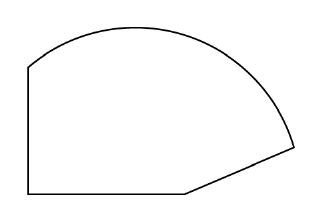
153(Adde, quod ab eo non observatum, eius magnitudinis, ut figura cadat in rectangulum sub ipsis, seu ut rectangulum sub ipsis sit figurae circumscriptum, alioquin enim si figura esset talis
(Add, what he did not observe, that they must be of such a size that the figure falls within the rectangle under them, that is, that the rectangle under them is circumscribed about the figure; for otherwise, if the figure were such as this,
154[Fig. 15. A figure with a vertical and a horizontal straight side at a right angle, closed by an arc that bulges beyond the rectangle formed on those sides and by a short oblique straight line.]
155non foret rectangula, an malumus figuram talem appellare ‹orthogoniam›, ne latina rectanguli vox nos confundat. — Idem ad solida transferri potest, quod factum a Pascalio non est [nisi fallor, videbo tamen in progressu], ut scilicet sit solidum trilineum constans duobus planis eiusmodi quorum parallelepipedo figura inscribitur. Nota idem intelligi potest, si istae rectae sint arcus circuli angulum rectum facientes, ut in sphaericis omnia enim quodammodo proportionaliter eodem modo produci possent. Nec sunt ista penitus negligenda.)
it would not be right-angled; or would we rather call such a figure ‹orthogonal›, so that the Latin word “rectangulum” does not confuse us? The same can be transferred to solids, which Pascal has not done [unless I am mistaken; but I shall see as we go on]:² namely, there can be a trilinear solid consisting of two such planes, in whose parallelepiped the figure is inscribed. Note that the same can be understood if these straight lines are arcs of a circle making a right angle, as in spherics; for everything could in a way be produced proportionally in the same manner. Nor are these things to be wholly neglected.)
156² Ut resumamus ergo. Figura orthogonia est planum (vel solidum) cuius duo sunt latera (hedrae) angulum rectum facientia (quorum rectangulo inscripta est figura), et recta quaecunque ex uno latere ducta, alteri lateri parallela seu lateri ex quo ducitur perpendicularis, reliquam figurae circumferentiam non nisi in uno puncto attingit (ita tamen ut nullum sit punctum circumferentiae reliquae quod non a duabus rectis intra figuram
² To resume, then. An orthogonal figure is a plane (or solid) two of whose sides (faces) make a right angle (and in the rectangle of which the figure is inscribed), and any straight line drawn from one side parallel to the other side, that is, perpendicular to the side from which it is drawn, meets the rest of the boundary of the figure in only one point (yet so that there is no point of the rest of the boundary that is not reached by two straight lines falling within the figure,
158cadentibus, una ab uno altera ab altero latere perpendiculariter eductis, attingatur. Hac postrema conditione, seu quod huic ultimae parenthesi inscriptum est, adiecta, potest negligi altera de circumscriptione intra rectangulum et vicissim. Pro solido rectae substitue planum.) Hoc modo accurata habetur figurae huius definitio. Nam circumscriptio rem non bene exprimit, nam si reliqua circumferentia constet multis lateribus, videri posset quodlibet tangi debere a circumscripto, potest ergo dici includi potius rectangulo, possum tamen et dicere inscribi, sed ipsa definitio inscriptionis ultra resolvatur, res huc denique redit.
drawn perpendicularly, one from the one side and the other from the other. When this last condition, that is, what is written in this last parenthesis, is added, the other condition about circumscription within the rectangle can be neglected, and conversely. For a solid, put a plane in place of the straight line.) In this way an accurate definition of this figure is had. For circumscription does not express the matter well: if the rest of the boundary consists of many sides, it might seem that each of them ought to be touched by the circumscribed figure. So it can rather be said to be enclosed in the rectangle; I may still say “inscribed”, but if the definition of inscription itself is resolved further, the matter finally comes back to this.
159Unam horum laterum rectilineorum vocat Pascalius axem, alterum basin, non satis congruum nomen axis, quia ad solidum, ubi plano opus est applicari non potest, planum enim non potest dici axis. Malim ergo altitudinem dicere, sed hoc quoque videtur exprimere lineam tantum. Posset ergo dici latus ‹erectum› vel ‹erecta›, altera ‹basis›.²
One of these rectilinear sides Pascal calls the axis, the other the base.² The name axis is not very suitable, because it cannot be applied to a solid, where a plane is needed, for a plane cannot be called an axis. I would rather say height, but this too seems to express only a line. So one could say the ‹erect› side, or the ‹erect›, and the other the ‹base›.
160Nota discrimen in eo quoque est solidorum a planis, quod latus in planis ubique est aequalis latitudinis, est enim nullius, at in solidis fieri potest ut planum aliquod sit v.g. semicirculus, aut alia quaelibet curvilinea figura plana, cuius aliqua est basis rectilinea, qua alteri plano scilicet iungitur.
Note that solids also differ from planes in this: in plane figures a side is everywhere of equal breadth, namely of none; but in solids it can happen that some plane face is, e.g., a semicircle, or any other curvilinear plane figure, which has some rectilinear base by which it is joined to the other plane.
161Nunc autem intelligendum est orthogonium solidum comprehendi debere non tantum parallelepipedo, quod dixi, sed potius portioni communi duorum prismatum se secantium, quorum alterius basis est latus erectum, alterius, latus horizontale seu basis orthogoniae datae. Hinc v.g. potest esse trilineum solidum, cuius latus erectum est semicirculus, vel segmentum circuli, aut semisegmentum, latus horizontale hyperbola, basi utriusque lateris existente eadem. Tales autem figuras credo a nemine hactenus consideratas, ne a Pascalio quidem, qui solida tantum ea consideravit (si ungulas demas), quae ex circumgyratione trilineorum planorum nascuntur.
But now it must be understood that an orthogonal solid must be contained not only in a parallelepiped, as I said, but rather in the common part of two intersecting prisms, the base of one of which is the erect side, and of the other the horizontal side, that is, the base of the given orthogonal figure. Hence there can be, e.g., a trilinear solid whose erect side is a semicircle, or a segment of a circle, or a half-segment, and whose horizontal side is a hyperbola, the base of both sides being the same. Such figures, I believe, have been considered by no one so far, not even by Pascal, who considered only those solids (if you leave out the hooves) that arise from the rotation of plane trilinear figures.
162Quod si iam ad figuras quoque orthogonias solidas extendatur contemplatio, absolutum est quicquid pene de dimetiendis figuris dici potest,¹ si modo iis quae hactenus dicta sunt, de perpendicularibus ad latera, accedat tractatio de perpendicularibus ad tangentes reliquae circumferentiae productas, iisque vel ex uno puncto, vel una recta, etc. prodeuntibus. Id sic scilicet intelligendum est, considerationi sinuum, axium, basium,
And if the study is now extended to orthogonal solid figures as well, almost everything that can be said about measuring figures is complete,¹ provided that to what has been said so far about perpendiculars to the sides is added a treatment of perpendiculars to the tangents of the rest of the boundary, produced, and of those issuing from one point, or from one straight line, etc. This is to be understood thus: to the consideration of sines, axes, bases,
164ordinatarum, applicatarum, addendam etiam sinuum versorum, nam ii habent aliquid affinitatis cum intervallis tangentium productarum.
ordinates and applied lines must be added the consideration of versed sines as well, for these have some affinity with the distances of the tangents produced.
165Nota in omni figura quaerendum est per analysin, an assignari possit punctum, vel linea, vel alius locus, ex quo ductae rectae ad intervalla tangentium, aliarum atque aliarum, aliis atque aliis continue quoque in loco, punctis assumtis, sint aequales, hoc facto enim spatium compositum ex omnibus rectis ex loco ad curvam ductis erit aequale curvae in intervallum tangentium ductae, producto dimidiato in plano, tertia producti parte sumta in solido. Talis locus aliquando ut dixi est punctum, ut in circulo centrum. Puto autem analysi perfectiore determinari posse, quando in aliqua curva possibile sit locum esse punctum, vel lineam, etc.
Note: in every figure one must inquire by analysis whether a point, or a line, or some other locus can be assigned such that the straight lines drawn from it to the distances of the tangents, of one tangent after another, with one point after another taken continually in the locus as well, are equal. For when this is done, the space composed of all the straight lines drawn from the locus to the curve will equal the curve multiplied into the distance of the tangents, the product being halved in the plane, and a third of the product taken in the solid. Such a locus is sometimes, as I said, a point, as the centre in the circle. I think a more perfect analysis can determine when, in some curve, it is possible for the locus to be a point, or a line, etc.³
166Nota aliter nonnihil eloquendum, dicendum potius chordas esse producendas, et ex puncto illo a quo intervallum chordae productae quaeritur duas esse rectas ducendas ad chordae extremitatem, quae faciunt triangulum, horum triangulorum summa hoc pacto invenietur. Porro quando chordae figurae sunt assumtae inaequales, tunc necesse est intervalla chordarum productarum a loco, esse aequalia (nisi paucis casibus, quando chordarum illarum scilicet progressio quodammodo nota est, et progressio intervallorum quoque et potest ex Arithmetica infinitorum iniri summa rectangulorum, nequicquam obstante inaequalitate[)].
Note that this should be put somewhat differently: rather, the chords should be produced, and from the point from which the distance of the produced chord is sought, two straight lines should be drawn to the ends of the chord, which make a triangle; the sum of these triangles will be found in this way. Further, when the chords of the figure are taken unequal, the distances of the produced chords from the locus must be equal (except in a few cases, namely when the progression of those chords is known in some way, and the progression of the distances too, and the sum of the rectangles can be obtained from the arithmetic of infinites, the inequality being no obstacle at all).
167Sed quando chordae (seu arcus) assumtae sunt aequales, tunc omnia sunt faciliora, ibi enim nihil opus est, nisi curvae toti, seu summae chordarum in rectum extensae, applicari omnia illa intervalla[,] figura producta erit aequalis illi figurae, quae rectis inter extrema loci et arcus iungentibus comprehenditur.
But when the chords (or arcs) are taken equal, everything is easier. For then nothing is needed but to apply all those distances to the whole curve, that is, to the sum of the chords stretched out into a straight line; the figure produced will equal the figure enclosed by the straight lines joining the ends of the locus and of the arc.
168Quod si iam istae figurae sint geometricae, seu per aequationes invenibiles, tunc ingentem ex ista inquisitione fructum capiemus, habebimus enim semper figuram quandam mixtilineam scilicet loco intervallorum, et curva data comprehensam, aequalem alteri cuidam figurae, ex recta (arcui figurae datae aequali), et applicatis ei intervallis, constanti.
And if these figures are geometrical, that is, can be found by equations, we shall reap an enormous fruit from this inquiry. For we shall always have some mixtilinear figure, namely one enclosed by the locus of the distances and the given curve, equal to some other figure consisting of a straight line (equal to the arc of the given figure) and the distances applied to it.
169Hinc patebit quid Algebra iuncta Geometriae indivisibilium et Arithmeticae infinitorum possit. Cum habituri simus aequationes infinitarum figurarum geometricarum, heterogenearum inter se invicem, et ita simul, ut semper curvarum quantitas in aequationem ingrediatur. Unde saepe per alias accedentes aequationes poterit ipsarum curvarum comparatio reperiri vicissim inverso modo argumentandum.
Hence it will be clear what algebra can do when joined to the geometry of indivisibles and the arithmetic of infinites, since we shall have equations of infinitely many geometrical figures, heterogeneous to one another, and at the same time such that the quantity of the curves always enters the equation. From this, often, by means of other equations coming in, the comparison of the curves themselves can be found. Conversely, one should argue in the inverse way:
170Exempli causa dato loco quodam intervallorum, v.g. puncto, recta, curva, etc. invenire locum chordarum, seu lineam, superficiem, etc. ubi intervallis positis aequalibus, vel talis naturae aut aequationis, chordae quoque sint talis naturae aut aequationis vel progressionis qualis postulatur. V.g. posito
for example, given some locus of the distances, e.g. a point, a straight line, a curve, etc., to find the locus of the chords, that is, a line, surface, etc., in which, the distances being put equal, or of such a nature or equation, the chords too are of the nature, equation or progression required. E.g., supposing
172locum datum esse punctum, intervalla esse aequalia, erit ecce sector circuli summa intervallorum loco ascriptorum.
the given locus is a point and the distances are equal, then the sum of the distances ascribed to the locus will be, behold, a sector of a circle.
173Iam quaeritur locus, cuius chordae scilicet productae, perpendiculariter incidant in sectorem datum seu ut rectae eaedem sint tangentes loci utriusque, sive eae chordae assumantur aequales, sive inaequaliter decrescere certo modo an fortasse nihil refert, imo certe. Tunc ex puncto illo sectoris ductae rectae ad arcus extrema dabunt figuram aequalem sectori ad arcum illum applicato duplicato.
Now a locus is sought whose chords, produced, fall perpendicularly on the given sector, that is, so that the same straight lines are tangents of both loci, whether those chords are taken equal or decreasing unequally in a certain way; or perhaps it makes no difference? Indeed it certainly does. Then the straight lines drawn from that point of the sector to the ends of the arc will give a figure equal to the sector applied to that arc, doubled.
174¹ Doctrina de evolutionibus qua curvis quibusdam geometricis inventae aequales rectae, in eo imperfecta est, quod non potest id fieri in figuris quibusdam datis, sed in inventis tantum. Et ideo illae figurae pleraeque sunt artificiales, seu quae non nisi per puncta describi possunt, ac proinde vix reperiuntur utiles in natura rerum.¹
The doctrine of evolutes,¹ by which straight lines equal to certain geometrical curves have been found, is imperfect in this: it cannot be done for certain given figures, but only for figures that have been found. And so most of those figures are artificial, that is, they can be described only by points, and consequently are hardly found useful in nature.¹
175Illud ergo restabat quaerere, an data curva geometrica dari possit alia geometrica, quae datae evolutione describatur, seu, quae ita comparata sit, ut curvae datae tangentes sint quaesitae perpendiculares[,] ut si evoluta circuli describi posset geometrice per aequationes licet altioris gradus haberemus quadraturam; licet ea problema altioris gradus futura sit, ut in mesolabo.
So it remained to inquire whether, given a geometrical curve, another geometrical curve can be given that is described by the evolution of the given one, that is, so constituted that the tangents of the given curve are perpendiculars of the curve sought. For example, if the evolute of the circle could be described geometrically by equations, even of a higher degree, we should have the quadrature, even if it were to be a problem of a higher degree, as in the mesolabe.
176An forte malum in eo est, quod in quolibet puncto opus foret aequatione nova, ut patet in circulo. Nam si haberetur figura cuius puncta geometrice determinarentur aequatione quadam, quae evolutione circuli describeretur, haberetur cuilibet arcui circuli aequalis recta, quae describeretur scilicet illa evolutione, et cum illa recta data futura sit, daretur et ratio eius ad aliam rectam toti circumferentiae aequalem, ergo et arcus in quo circulum tangit, ita haberetur sectio angulorum universalis. At ea haberi non potest, nisi per aequationes alias atque alias continuo altioris gradus. Ergo pro initio aequationis opus foret aequatione graduum infinitorum, et ita semper regrediendo. Quod est impossibile. Res tum accuratius consideranda.
Or perhaps the trouble is that at each point a new equation would be needed, as is clear in the circle. For if a figure were had whose points were determined geometrically by some equation, and which was described by the evolution of the circle, then for any arc of the circle a straight line equal to it would be had, namely the one described by that evolution. And since that straight line would be given, its ratio to another straight line equal to the whole circumference would also be given, and therefore also the arc in which it touches the circle; so the universal section of angles would be had. But that cannot be had except by equations of ever higher degree, one after another. So for the beginning of the equation an equation of infinitely many degrees would be needed, and so on, always going back. Which is impossible. The matter must then be considered more accurately.³
178[Zu S. 134 Z. 22:] NB. ipsa summa summarum, seu summa triangularis, assumatur pro simplici et videamus, quid sit futurum.
[To A p. 134 l. 22:] NB. Let the sum of sums itself, that is, the triangular sum, be taken as simple, and let us see what will happen.
180a. b. c. est summa simplex, a. b. c. / b. c. / c. est triangularis, scripta in textu pyramidalis, nunc ipsam triangularem sumamus pro simplici, sumendo a. b. c. pro termino uno, b. c. iterum pro uno, c. iterum pro uno, fiet:
a. b. c. is the simple sum; a. b. c. / b. c. / c. is the triangular sum; the pyramidal sum is written in the text. Now let us take the triangular sum itself as simple, taking a. b. c. as one term, b. c. again as one, c. again as one. It will be:
181[Scheme. a. b. c. / b. c. / c. = simple sum. Below a rule: a. b. c., b. c., c. / b. c., c. / c. = triangular from the same side as the simple sum. Or: c., b. c., a. b. c. / b. c., a. b. c. / a. b. c.]
182Manifestum est priorem quippe eodem modo assumtam, quo assumta summa triangularis simplex coincidere summae pyramidali. At si triangularis simplex inversa sit replicatae, separatam res inquisitionem meretur. Scilicet cum cuiuslibet summae simplicis dentur duae triangulares simplices, dabuntur quatuor triangulares, ex quibus duae sunt directae duabus pyramidalibus respondentibus aequales, inquirendum restaret, cuinam inversae quae scilicet contra naturam suae triangularis simplicis assumtae sunt aequentur. Sed non opus ei rei insistere, sufficit monstrasse.
It is plain that the former, being taken in the same way as the simple triangular sum was taken, coincides with the pyramidal sum. But if the simple triangular sum is the inverse of the repeated one, the matter deserves a separate inquiry. Namely, since for any simple sum there are two simple triangular sums, there will be four triangular sums of these, of which two are direct and equal to the two corresponding pyramidal sums; it would remain to inquire to what the inverse ones are equal, namely those taken contrary to the nature of their simple triangular sum. But there is no need to dwell on this; it is enough to have pointed it out.³
183[Zu S. 137 Z. 8:] Notat Pascalius si summa ordinatarum alicuius semicirculi intelligatur applicata non diametro sed duplo diametri fieri inde semiellipsin duplicatam semicirculi. Videndum an hoc lucem aliquam afferre possit comparationi curvae ellipticae et circularis.²
[To A p. 137 l. 8:] Pascal notes that if the sum of the ordinates of some semicircle is understood to be applied not to the diameter but to twice the diameter, a half-ellipse results which is double the semicircle.² It should be seen whether this can throw any light on the comparison of the elliptical curve with the circular.
184[Fig. 16. Left, a semicircle with rectangles standing on equal parts of its diameter; right, the half-ellipse on twice the diameter, with the same ordinates on parts twice as wide.]
186Manifestum est si retenta altitudine, et duplicata basi semper et chordae constanti ratione multiplicarentur datae iniri rationem circularis curvae ad curvam ellipticam maxime cum eadem semper hic sit basis, et eaedam altitudines utrobique.
It is plain that if, the height being kept and the base always doubled, the chords too were multiplied in a constant ratio, the ratio of the circular curve to the elliptical curve could be obtained, especially since here the base is always the same, and the heights are the same on both sides.
187Sit basis semper eadem a. altitudines continue decrescentes b. c. d. etc. erunt chordae Rq a² + b². Rq a² + c². Rq a² + d². etc.
Let the base always be the same, a, and the heights continually decreasing, b, c, d, etc. The chords will be √(a² + b²), √(a² + c²), √(a² + d²), etc.
188Duplicetur basis caeteris retentis, fient chordae: Rq 4a² + b². Rq 4a² + c². Rq 4a² + d².
Let the base be doubled, the rest kept: the chords will be √(4a² + b²), √(4a² + c²), √(4a² + d²).
189Regula ergo haec fieri potest: divisa diametro semicirculi et maxima diametro ellipsis earundem ordinatarum in partes infinitas aequales, quadratum arcus cuiuslibet circuli, differt a quadrato arcus cuiuslibet ellipsis (seu quadrato chordae) tribus quadratis, unius ex partibus aequalibus diametri circuli. Ergo differentia totorum, seu summarum omnium quadratorum est quadratum partis triplicatum, toties sumtum quot sunt partes totius diametri circuli seu quod idem est rectangulum sub diametro circuli et minima partium triplicata.
So this rule can be made: when the diameter of the semicircle and the greatest diameter of the ellipse with the same ordinates are divided into infinitely many equal parts, the square of any arc of the circle differs from the square of any arc of the ellipse (that is, from the square of the chord) by three squares of one of the equal parts of the diameter of the circle. Therefore the difference of the wholes, that is, of the sums of all the squares, is the square of the part tripled, taken as many times as there are parts in the whole diameter of the circle; or, what is the same, the rectangle under the diameter of the circle and the least of the parts, tripled.
190Et haec quidem semper comparatio summae chordarum haberi potest utilis ad ambitus ellipsium dimetiendos. Si chordae sint licet finitae multae tamen, est approximatio satis utilis. Videndum quae sit comparatio sinuum, si utrobique arcus in partes aequales divisus.
And this comparison of the sum of the chords can always be had, useful for measuring the perimeters of ellipses. If the chords are finite in number but many, it is a fairly useful approximation. It should be seen what the comparison of the sines is if on both sides the arc is divided into equal parts.² ³
191[Zu S. 141 Z. 8] Materia est elegantis adhuc et intactae speculationis, considerare figuras, quae figurarum datarum evolutionibus describuntur, eae enim figurae sunt in rerum natura, et saepe occurrere possunt, et habent quoddam affine cum cycloeidibus, ut evoluta parabolae, circuli, etc.
[To A p. 141 l. 8] It is a matter of elegant and still untouched speculation to consider the figures described by the evolutions of given figures. For these figures are found in nature and can often occur, and they have some affinity with cycloids, such as the evolute of the parabola, of the circle, etc.
192Pro evoluta circuli sumatur semiquadratum basis cycloeidis, seu arcus circuli, eiusque applicatae omnes ascribantur circulo ad tangentes, arcui scilicet illi cui aequales sunt, seu qui id cycloeidis punctum ‹attingit›,¹ figura quam describent, curvaque consideratione digna est.
For the evolute of the circle, let the half-square of the base of the cycloid, that is, the arc of the circle, be taken, and let all its applied lines be ascribed to the circle along the tangents, namely to the arc to which they are equal, that is, which ‹reaches› that point of the cycloid:¹ the figure they will describe, and its curve, is worth considering.
193Hae figurae sunt inversae trochoeidum, ut enim in trochoeide curva applicatur plano immobili, ita contra in evoluta curvae immobili applicatur planum. Utroque modo extremum moti considerandum est, extremum circumferentiae motae, assumtum ubivis, seu punctum contactus cum circulo, cum incipit volvi, describit cycloeidem; punctum extremum plani cum incipit applicari, seu a quo aperiri seu evolvi incipit, describit evolutam.
These figures are the inverses of trochoids. For as in the trochoid the curve is applied to a fixed plane, so conversely in the evolute the plane is applied to a fixed curve. In both ways the end of what moves must be considered: the end of the moving circumference, taken anywhere, that is, the point of contact with the circle when it begins to roll, describes the cycloid; the end point of the plane when it begins to be applied, that is, from which it begins to be opened out or unrolled, describes the evolute.
195Nota, nomen cycloeidis debet esse species trochoeidis, nam potest et dari trochoeis parabolica, etc. continua eiusmodi applicatione, ad planum, et ita in aliis omnibus. Investiganda relatio inter trochoeides et evolutas. Omnes figurae curvae demto circulo possunt intelligi evolutae. Malim aliter appellare, nec invenio vocem significantiorem, quam ‹evolutionales›, id est evolutione descriptae.
Note: the name cycloid ought to be a species of trochoid, for there can also be a parabolic trochoid, etc., by continual application of this kind to a plane, and so in all others. The relation between trochoids and evolutes must be investigated. All curved figures except the circle can be understood as evolutes. I would rather name them differently, and I find no more expressive word than ‹evolutional›, that is, described by evolution.
196Quod alibi dixi in curvis quibusdam assumendas semper tangentes inaequales, falsum, possunt assumi variis modis pro ratione descriptionis, aut resolutionis. Omnes curvae evolutione descriptae constant ex arcubus circularibus infinitis, continue variantibus. Operae pretium est considerare eandem curvam evolutam, eandem producere evolutionalem, quomodocunque dividatur, in partes aequales an inaequales, eius rei ratio quaerenda ex Arithmetica infinitorum.
What I said elsewhere,² that in certain curves unequal tangents must always be taken, is false: they can be taken in various ways, according to the manner of description or of resolution. All curves described by evolution consist of infinitely many circular arcs, continually varying. It is worth considering that the same evolved curve produces the same evolutional curve however it is divided, into equal or unequal parts; the reason for this should be sought from the arithmetic of infinites.
19710₂. PLAGULA TERTIA
10₂. THIRD SHEET
198Definivi paulo ante ‹orthogoniam figuram›, eius latera duo, quorum rectangula figuram comprehendunt, erectum ‹axis› (in plano), horizontale ‹basis›.²
I defined a little earlier the ‹orthogonal figure›;² its two sides, whose rectangles contain the figure, are the erect one, the ‹axis› (in the plane), and the horizontal one, the ‹base›.²
199Applicatae sunt rectae intra figuram ab uno extremo ad alterum productae, ‹lateri orthogonio› (sic enim generali nomine tam basin quam axin appellare lubet) parallelae alteri perpendiculares. ‹Applicatae› ei lateri orthogonio ducuntur ad quod sunt perpendiculares. ‹Ordinatae› sunt quae latus orthogonium cui applicatae sunt in partes aequales dividunt. Hypotenusa orthogonii, vel ‹inclinata› est residuum peripheriae orthogonii demto latere erecto et iacente.
Applied lines are straight lines drawn within the figure from one end to the other, parallel to an ‹orthogonal side› (for so I like to call both the base and the axis by a general name) and perpendicular to the other. ‹Applied lines› are drawn to that orthogonal side to which they are perpendicular. ‹Ordinates› are those that divide into equal parts the orthogonal side to which they are applied. The hypotenuse of the orthogonal figure, or the ‹inclined line›, is the rest of the perimeter of the orthogonal figure after the erect and the lying sides are taken away.
200‹Sinus recti› sunt applicatae lateri cuidam orthogonio, inclinatam dividentes in partes aequales, suntque vel sinus ad axem vel sinus ad basin. ‹Sinus versi› sunt rectae inde a vertice aliquo sumtae per rectas a latere orthogonio ad quod applicatae sunt abscissae. Sinus versi ad latus orthogonium unum, sunt semper sinuum rectorum ad alterum complementum ad applicatam rectanguli circumscripti, seu rectam lateri orthogonio a quo abscissi sunt sinus versi, parallelam et aequalem. Seu ‹sinus versus constituit suum latus orthogonium,›
‹Right sines› are lines applied to some orthogonal side that divide the inclined line into equal parts; they are either sines to the axis or sines to the base. ‹Versed sines› are straight lines taken from some vertex, cut off from the orthogonal side to which they are applied by straight lines. The versed sines to one orthogonal side are always the complements of the right sines to the other, up to the applied line of the circumscribed rectangle, that is, up to the straight line parallel and equal to the orthogonal side from which the versed sines are cut off. That is, ‹the versed sine makes up its orthogonal side›
202‹si sinui recto ad alterum latus orthogonium, sibi ordine respondenti, addatur.›
‹if it is added to the right sine to the other orthogonal side that corresponds to it in order.›
203Iam perpendiculares ex quolibet plani orthogonii puncto eleventur indefinite prisma inde ortum secari intelligatur plano quodam ad planum orthogonii inclinato per latus aliquod orthogonium transeunte,² pars inter sectionem et basin, prismatis seu planum orthogonium datum intercepta, appelletur ‹ungula›,¹ ² et si idem inferius fieri intelligatur, erit ungula duplex quod scilicet inter duas sectiones interceptum est.
Now let perpendiculars be raised indefinitely from every point of the orthogonal plane,¹ and let the prism so formed be understood to be cut by some plane inclined to the plane of the orthogonal figure and passing through one of its orthogonal sides.² The part of the prism intercepted between the section and the base, that is, the given orthogonal plane, is to be called the ‹hoof› (ungula);¹ ² and if the same is understood to be done below as well, there will be a double hoof, namely what is intercepted between the two sections.
204[Leibniz's marginal figure beside l. 3: an upright prism on a triangular base, with an inclined section drawn in the base.]¹
205Huius ungulae superficies curva, est quasi cylindracea, si inclinatae sit curvae, cuius basis scilicet curva dicta, sed supra truncata. Est autem ungula aut ungula basis, aut ungula axis.
The curved surface of this hoof is quasi-cylindrical, if the inclined line is a curve, namely with that curve as its base, but truncated above. And a hoof is either a hoof of the base or a hoof of the axis.
206Nota Hugenius in tract. de Horologio oscillationis, ubi de centro oscillationis, eadem ungula utitur post Pascalium, sed alio vocat nomine. Cuneum scilicet super figuram abscissum, et perfectiorem nonnihil reddit seu generaliorem Pascalii demonstrationem. Assumit enim etiam quae trilinea non sunt, modo planum transeat per eorum tangentem.
Note: Huygens, in his treatise on the Horologium oscillatorium, where he deals with the centre of oscillation,² uses the same hoof after Pascal, but calls it by another name, namely the wedge cut off above the figure; and he makes Pascal's proof somewhat more perfect, that is, more general. For he also takes figures that are not trilinear, provided the plane passes through their tangent.
207Pascalius ait requirere se ut planum secans angulum faciat 45 graduum ad planum figurae, idem requirit Hugenius: aequari abscissum eiusmodi cuneum basi, in distantiam centri gravitatis a puncto contactus ductae. Demonstratio est facilis tangens in eodem cum figura plano haberi potest pro ‹fulcro›, quaelibet puncta figurae seu exigua rectangula pro ponderibus. Iam idem est productum, sive summa omnium ponderum, ducatur in dis-
Pascal says he requires the cutting plane to make an angle of 45 degrees with the plane of the figure. Huygens requires the same: that such a wedge cut off equals the base multiplied into the distance of the centre of gravity from the point of contact. The proof is easy. The tangent in the same plane as the figure can be taken as the ‹fulcrum›, and any points of the figure, or tiny rectangles, as weights. Now the product is the same whether the sum of all the weights is multiplied into the dis-
209tantiam centri gravitatis a fulcro, sive singula pondera in suas distantias, summaque omnium colligatur. At iam singula puncta ducta intelligantur in distantias suas, erigentur prismata super illis, altitudine distantiarum. Haec prismata omnia simul praecise complebunt cuneum istum, quia enim angulus inclinationis plani secantis est 45 graduum. Ideo punctum unumquodlibet aequidistat a plano secante per horizontalem, et per perpendicularem, horizontales autem sunt rectae, quae erectae constituunt prismata illa infinita haec autem cuneum, ergo omnes illae horizontales seu distantiae a fulcro constituunt cuneum.
tance of the centre of gravity from the fulcrum, or each weight into its own distance and the sum of all collected. Now let each point be understood to be multiplied into its distance: prisms will be raised on them with the heights of the distances. All these prisms together will exactly fill that wedge, because the angle of inclination of the cutting plane is 45 degrees. So every point is equally distant from the cutting plane horizontally and vertically; and the horizontals are the straight lines which, erected, make up those infinitely many prisms, and these make up the wedge; so all those horizontals, that is, the distances from the fulcrum, make up the wedge.
210Caeterum Pascalius ungula sua ita utitur: fiat ungula ad axem, semirotetur et planum orthogonium circa axem, secari intelligatur planum orthogonium datum tam quod duplae ungulae basis est quam quod semisolidi planis per axis ordinatas transeuntibus ad planum figurae perpendicularibus. Sectiones in ungula erunt triangula, nempe semiquadrata ordinatae. Ratio, quia duo plana duplae ungulae faciunt angulum rectum cum quodlibet faciat 45 grad. ad planum orthogonii datum intermedium, et rectae utrinque aequales, hinc ista semiquadrata.²
Pascal, moreover, uses his hoof thus. Let a hoof be made on the axis, and let the orthogonal plane also be rotated half-way round the axis. Let the given orthogonal plane, both as the base of the ‹double hoof› and as that of the half-solid, be understood to be cut by planes passing through the ordinates of the axis, perpendicular to the plane of the figure. The sections in the hoof will be triangles, namely half-squares of the ordinate. The reason: the two planes of the double hoof make a right angle, since each makes 45 degrees with the given orthogonal plane lying between them, and the straight lines on both sides are equal; hence these half-squares.²
211Semisolidi sectiones erunt semicirculi ordinatae, at semicirculus ad semiquadratum radii est ut arcus quadrantis ad radium. Semper ergo omnium sectionum semisolidi geniti, ad quamlibet sectionem ungulae erit ratio eadem, ergo eadem ratio totorum, nempe quae radii ad arcum quadrantis, eadem et superficierum curvarum, et distantiarum centrorum gravitatis utriusque solidi.²
The sections of the half-solid will be semicircles on the ordinate; and the semicircle is to the half-square of the radius as the quadrant arc to the radius. So the ratio of every section of the generated half-solid to the corresponding section of the hoof will always be the same; therefore the ratio of the wholes is the same, namely that of the radius to the quadrant arc; and the same holds of the curved surfaces and of the distances of the centres of gravity of the two solids.² ³
212Ostendit autem quod notabile est, inverso modo haec esse, nimirum dimensiones solidorum et superficierum ungulae ad geniti, esse ut radium ad arcum quadrantis; at vero distantiam centri gravitatis ungulae item superficiei ungulae ab axe esse ad distantiam centri gravitatis geniti item superficiei geniti, ab eodem axe, ut arcus quadrantis est ad radium, ergo sunt in inversa ratione figurarum. Hoc ipse non annotat, nec reflexione aliqua signat, cum mereatur. Eadem autem centra gravitatis ostendit esse in ipso plano trilinei, et aequidistare a basi, ita uno habito alterum habetur.
But he shows, what is remarkable,² that these are in the inverse way: namely, that the dimensions of the solid and surfaces of the hoof are to those of the generated figure as the radius to the quadrant arc, whereas the distance of the centre of gravity of the hoof, and likewise of the surface of the hoof, from the axis is to the distance of the centre of gravity of the generated solid, and likewise of its surface, from the same axis, as the quadrant arc is to the radius; so they are in the inverse ratio of the figures. He himself does not note this, nor mark it with any reflection, though it deserves it. He also shows that these centres of gravity lie in the plane of the trilinear figure itself and are equidistant from the base, so that when one is had, the other is had.
213Methodus unica quae restat, perficiendi supplendique Arithmeticam infinitorum, mihi videtur haec esse, ut quando radices surdae intercurrunt, quo solo casu cessat calculus, eius loco numeri quadrati eiusdem naturae substituantur; v.g. quaeritur summa
The only method that remains for completing and supplementing the arithmetic of infinites seems to me to be this: when surd roots come in, which is the only case in which the calculation stops, square numbers of the same nature should be substituted in their place. For example, the sum is sought
215linearum ita crescentium, ut radices numerorum arithmeticae progressionis, si hoc quaerendum sit per Arithmeticam infinitorum, sine consideratione ipsius figurae inde ortae, fieri posset hoc modo: Quaerendi essent numeri quadrati aliquot, tres quatuor pluresque progressionis arithmeticae, quorum radices in numeris habentur, hae radices summari possunt, idque fieri potest pluribus exemplis, unde apparebit an aliqua summae ineundae ratio possit haberi; qua inventa per haec experimenta facilius invenietur demonstratio. Ecce quomodo experimenta usui possint esse in Geometria, cum enim sint in omni Arithmetica, erunt et in doctrina serierum, ergo et in Arithmetica infinitorum, ergo et in Geometria.²
of lines increasing as the roots of numbers in arithmetical progression. If this is to be sought by the arithmetic of infinites, without considering the figure that arises from it, it could be done thus: one would look for some square numbers, three, four or more, in arithmetical progression, whose roots are had in numbers; these roots can be summed, and this can be done with several examples, from which it will appear whether some way of obtaining the sum can be had; and once it is found by these experiments, the proof will be found more easily. See how experiments can be of use in geometry: since they occur in all arithmetic, they will also occur in the doctrine of series, therefore also in the arithmetic of infinites, therefore also in geometry.²
216[Fig. 1a, a blind drawing (scored without ink): a circle with vertical diameter AC, ordinates DE meeting the circle at E, F, B, G, chords from A, and the points H, I, K, L, M. Fig. 1b: a semicircle with three ordinates and the chords from the upper end of the diameter to their ends.]
217Si in semicirculo diameter ductis ordinatis dividatur in partes aequales quotcunque,² et ex una aliqua diametri extremitate ad quodlibet punctum, quo ordinata aliqua circumferentiam attingit, rectae seu chordae, ducantur quas appellabimus ‹chordas ad ordinatas›, sic enim appellare licet, aio differentias inter duarum quarumque chordarum proximarum (aut quomodocunque distantium) quadrata esse aequales differentiis inter quadrata quarumcunque aliarum proximarum (aut eodem in serie numero distantium), seu seriem ex quadratis chordarum ad ordinatas, eo ordine quo sunt in figura, esse arithmeticae progressionis.
If in a semicircle the diameter is divided by ordinates into any number of equal parts,² and from one end of the diameter straight lines, or chords, are drawn to every point where an ordinate meets the circumference, which we shall call ‹chords to the ordinates› (for we may call them so), I say that the differences between the squares of any two neighbouring chords (or chords at any distance apart) are equal to the differences between the squares of any other neighbouring chords (or chords the same number of places apart in the series); that is, the series of the squares of the chords to the ordinates, in the order in which they lie in the figure, is an arithmetical progression.³
218Hinc sequitur: Summam omnium chordarum ad ordina-
Hence it follows that the sum of all the chords to the ordinates,²
220tas, aequari semiparabolae, cuius basis chorda maxima, altitudo ordinatae ad chordam maximam, sinus versus seu ad verticem a diametro abscissa. At omnes chordae sunt duplae applicatarum, videndum ergo an ex summa chordarum ad ordinatas inveniri possit summa ipsarum ordinatarum.
equals the half-parabola whose base is the greatest chord, and whose height is that of the ordinate to the greatest chord, the versed sine, that is, the part of the diameter cut off from the vertex.³ But all chords are double of applied lines; so it should be seen whether from the sum of the chords to the ordinates the sum of the ordinates themselves can be found.
221Sed hoc fieri non posse, facile demonstratur fig. 1. ubi semicirculus AB. diameter divisa in punctis D. ordinatae DE. chordae AE. Quaestio est an hae chordae possint esse ordinatae. Arcus AF. AB. AG. AC. bisecentur in punctis, et arcus transponi intelligantur, ita ut puncta eorum media cadant in summitatem A. seu ipsi HE. sumatur aequalis AL. et ipsi IB. aequalis IM. Sed ipsi KE. aequalis potest sumi nulla, cum sit maior semicirculo. Ergo non ultra procedendum ad chordam ⟨— ...⟩
But that this cannot be done is easily shown by fig. 1, where AB is the semicircle, the diameter divided at the points D, the ordinates DE, and the chords AE. The question is whether these chords can be ordinates. Let the arcs AF, AB, AG, AC be bisected at points, and let the arcs be understood to be moved so that their midpoints fall on the summit A; that is, let AL be taken equal to HE, and IM equal to IB. But no line equal to KE can be taken, since it is greater than a semicircle. So one must not go further, to the chord ⟨— ...⟩²
222[Fig. 2, Pascal's Fig. 16: the quadrant of the circle with centre A and radius AB, in its square; points D on the arc, with verticals through X above and I, O below; horizontals to S on AB; lines from A to the points D; and the points Q, P, T, Z, V, Y.]²
223Fig. 16. Pascal. (2a) diameter. (a) radius AB. (4a²) quadratum diametri. (2a²) quad. inscriptum. (Rq 2,⌢a) radix quadrati inscr. eius dimidium QT. vel AZ. (Rq 2,⌢a)/2 = Rq ½,⌢a. ZB. = a − Rq ½,⌢a.
Fig. 16 of Pascal. (2a) the diameter. (a) the radius AB. (4a²) the square of the diameter. (2a²) the inscribed square. (√2 × a) the root of the inscribed square; its half QT, or AZ, is (√2 × a)/2 = √½ × a. ZB = a − √½ × a.
224Ducatur ZB. in arcum QB. peripheriae octantem. Erit portio superficiei cylindricae, cuius basis circulus AB. altitudo ipsa ZB. Ponatur ZB. duci in totam peripheriam, manifestum est cylindrum, cuius est ea superficies fieri ex ductu circuli baseos in altitudinem cylindri.
Let ZB be multiplied into the arc QB, an eighth of the circumference. The result will be a portion of the cylindrical surface whose base is the circle AB and whose height is ZB. Suppose ZB is multiplied into the whole circumference: plainly the cylinder whose surface this is results from multiplying the base circle into the height of the cylinder.
226The radius is a. Let the circumference be x; the circle will be ax/2, and the cylinder will be (ax/2) × (a − √½ × a) = a²x/2 − (a²x/2) × √½ = a²x/2 − √(a⁴x²/8) = a²x/2 − a²x/√8.³
227[Volumen cylindri divisum] per radium baseos AB = a. producto duplicato dabit superficiem cylindri, totam, cuius octava pars est portio quaesita[,] ergo dividatur per radium, productique sumatur pars quarta ax/8 − ax/Rq 128.¹ Ab hac si auferatur summa sinuum versorum XQ. XD. seu segmentum QB. duplicatum, restabit summa sinuum rectorum [QT. DI.].²
[The volume of the cylinder divided] by the radius of the base, AB = a, with the product doubled, will give the whole surface of the cylinder, of which the eighth part is the portion sought. So let it be divided by the radius, and let a quarter of the product be taken: ax/8 − ax/√128.¹ If from this the sum of the versed sines XQ, XD, that is, the segment QB doubled, is taken away, the sum of the right sines [QT, DI] will remain.²
228Iam quia segmentum circuli maioris non potest commode auferri a minori, auferatur a maiori, et a residuo auferatur differentia inter maiorem et minorem. Nam si auferre debeam b. ab a. idem est ac si auferam b. a c. quod esse suppono maius quam a. et a residuo auferam differentiam inter c. et a.
Now, since the segment of the larger circle cannot conveniently be taken from the smaller quantity, let it be taken from a larger one, and from the remainder let the difference between the larger and the smaller be taken. For if I have to take b from a, it is the same as if I take b from c, which I suppose to be greater than a, and take from the remainder the difference between c and a.
230a − b = c − b − c + a. Further, when the doubled segment PB is taken from the circle AB, there remains the semicircle ax/4 plus two triangles of the octant of the circle AB on the fulcrum. From this remainder must be taken the difference between ax/2 and ax/8 − ax/√128, that is, ax/2 + ax/√128 − ax/8, that is, 3ax/8 + ax/√128. Let this be taken from ax/4 + 2 triangles of the octant AB. Now ax/4 = 2ax/8. There remains: 2 triangles of the octant AB − ax/8 − ax/√128.
231To investigate the triangle of the octant, we have the straight line QZ, or QT, = √½ × a. To its square, ½a², let the square of ZB be added: a² + ½a² − 2a² × √½. We have 2a² − 2a² × √½, and its root is the straight line (QB). The square of √(2a² − 2a² × √½)/2 will be (2a² − 2a² × √½)/4. Let it be taken from the square of the radius, a². There remains the square of the fulcrum, which will be a² − (2a² − 2a² × √½)/4 = (2a² + 2a² × √½)/4. And the fulcrum will be √(2a² + 2a² × √½)/2. Let it be multiplied into QB, the product being halved:² the product will be √(4a⁴ − 4a⁴/2)/(4 × 2), or √((4a⁴ − 4a⁴/2)/64) = √((a⁴ − a⁴/2)/16) = √(a⁴/32) = (a²/√32): ‹the triangle of the octant›.¹ ³ Now all the sines DI equal the radius a multiplied into DT, or QZ = √½ × a; this gives (√½ × a²), the sum of the sines, from which let the straight line ZA (or QZ) be taken, multiplied into the arc QB,
233or x/8: this gives √½ × (ax/8). There remains √½ × a² − √½ × ax/8 = 2a²/√32 − ax/8 − ax/√128. Therefore (since √½ × ax/8 = ax/√128) a²/√2 = 2a²/√32 − ax/8. There must be an error in the calculation, because a²/√2 > 2a²/√32.¹ ³
234Fortasse datur methodus in Arithmetica infinitorum, summandi aliquam surdorum progressionem, quoniam etsi praecise integris exprimi non possint, aliquando tamen id quod deest, erit minus quolibet dato. V.g. quoties res reduci potest ad eum statum, ut radices quadratae differentiarum, aut aliquid ab illis pendens desit supersitque, id enim tuto negligi potest.
Perhaps there is a method in the arithmetic of infinites of summing some progression of surds. For although they cannot be expressed exactly by whole numbers, sometimes what is lacking will be less than any given quantity: e.g., whenever the matter can be brought to the state where the square roots of the differences, or something depending on them, are lacking or left over; for that can safely be neglected.
235√a² + √b² = √(a² + b² + 2ab). / √ab + √bc = √(ab + bc + 2√(ab²c)). / √(a² + bc) + √(d² + bc) = √(a² + bc + d² + bc + 2√(b²c² + bca² + d²bc + d²a²)).³
236Quoties multiplicatione duarum surdarum in se invicem aliquis terminus produci potest, ex quo possit extrahi radix, sive quadrata sive cubica etc. toties ex duabus surdis fieri potest una.
Whenever, by multiplying two surds into each other, a term can be produced from which a root, square or cube, etc., can be extracted, so often can one surd be made from two.
237Nota si velis inire summam duarum radicum, sic procedendum est, ineatur summa quadratorum, eaque duplicetur, a producto auferatur quadratum differentiarum inter radices, residui radix erit summa radicum. Iam si tres radices summare velis,²
Note: if you want to obtain the sum of two roots, proceed thus: take the sum of the squares and double it; from the product take the square of the difference between the roots; the root of the remainder will be the sum of the roots. Now if you want to sum three roots,²
239√a² + √b² + √c²: the first two give √(2a² + 2b² − (√a² − √b²)²), + √c² = √(4a² + 4b² − 2(√a² − √b²)² + 2c² ... [the calculation breaks off].¹ ²
240xa − 2y² = A²; xa − y² = A + y²; B = A + y; B − A = y. / B − x = A; B − A − x = 0; B − A = x.
241[Fig. 3. A rectangle from which a curved segment is cut at the top, marked “= A”; a triangle closed above by a convex arc; and a triangle closed above by a concave arc.]
242Quadrata sinuum versorum quadrantis sunt differentia inter quadrata sinuum rectorum quadrantis, et quadrata chordarum quadrantis ad sinus.
The squares of the versed sines of the quadrant are the difference between the squares of the right sines of the quadrant and the squares of the chords of the quadrant to the sines.
243Iam quadrata sinuum rectorum quadrantis, aequantur cylindro, cuius basis quadrans, altitudo radius. Quadrata chordarum, ita investigabimus: chordae ad sinus quadrantis, sunt dupli sinus octantis, seu semichordae ad sinus quadrantis, sunt sinus octantis, QB, nempe DZ. DS.
Now the squares of the right sines of the quadrant equal the cylinder whose base is the quadrant and whose height is the radius. The squares of the chords we shall investigate thus: the chords to the sines of the quadrant are double the sines of the octant; that is, the half-chords to the sines of the quadrant are the sines of the octant QB, namely DZ, DS.
244Eorum summa sic facile initur, si a sinubus quadrantis, nempe quadrato radii, auferatur summa sinuum alterius octantis CQ. (in radio terminati, ubi scilicet sinuum maximus est), nempe radius in semilatus quadrati inscripti ductus a⌢Rq 2a²/2 = Rq 2a⁴/2. fiet summa sinuum octantis sinu maximo ad radii extremitatem non terminati a² − Rq 2a⁴/2.
Their sum is easily obtained thus: if from the sines of the quadrant, namely the square of the radius, the sum of the sines of the other octant CQ is taken (the octant ending at the radius, that is, where the greatest of the sines is), namely the radius multiplied into half the side of the inscribed square, a × √(2a²)/2 = √(2a⁴)/2, the sum of the sines of the octant whose greatest sine does not end at the extremity of the radius will be a² − √(2a⁴)/2.³
245Iam et quadrata horum sinuum quaeremus. Dantur quadrata omnium quadrantis sinuum CA. PV. DS. B. nempe cylinder quadrantis basi, altitudine radio, ab his auferemus cylindrum ipsius CQZA. restabit utique cylinder basi QBZ. seu semisegmento octantis altitudine
Now let us also seek the squares of these sines. The squares of all the sines of the quadrant CA, PV, DS, B are given, namely the cylinder with the quadrant as base and the radius as height. From these we shall take away the cylinder of CQZA. There will certainly remain the cylinder on the base QBZ, that is, on the half-segment of the octant,² with height
247radio. Huius quadruplum est summa quatuor cylindrorum, quorum basis semisegmentum octantis, altitudo radius, vel cylinder cuius basis semisegmentum octantis, altitudo diametri duplum. Atque hanc necesse est esse summam quadratorum omnium chordarum ad sinus, quadrantis.²
equal to the radius. Four times this is the sum of four cylinders whose base is the half-segment of the octant and whose height is the radius, or the cylinder whose base is the half-segment of the octant and whose height is twice the diameter. And this must be the sum of the squares of all the chords to the sines of the quadrant.²
248Ab hoc auferatur summa omnium quadratorum sinuum quadrantis, seu quadrantis cylinder. Ac primum auferatur portio cylindri quadrantis cuius basis QBZ. seu reiciatur unus ex cylindris QBZ⌢a restabunt tres eiusmodi cylindri. Similis portio CQT. rursus auferatur, restabunt duo cylindri QBZ⌢a. a quibus auferri debet parallelepipedum basi quadrato quartam partem faciente quadrati inscripti, altitudine ratio. Addendi scilicet adhuc quatuor cylindri QBZ⌢a. quia chordarum summa ut habeatur duci debebat in arcum [BC.]² at in octante ducta est in eius dimidium, ideo duplicanda. Igitur a sex istis cylindris parallelepipedum quod dixi auferendum est.
From this let the sum of all the squares of the sines of the quadrant, that is, the cylinder of the quadrant, be taken away. First let the portion of the cylinder of the quadrant whose base is QBZ be taken away, that is, let one of the cylinders QBZ × a be rejected: three such cylinders remain. Let the similar portion CQT again be taken away: two cylinders QBZ × a remain, from which must be taken a parallelepiped whose base is the square making a quarter of the inscribed square, with the radius as height. Four more cylinders QBZ × a must be added, of course, because, to have the sum of the chords, it ought to have been multiplied into the arc [BC],² but in the octant it was multiplied into half of it, and so it must be doubled. So the parallelepiped I mentioned must be taken from these six cylinders.
249Let us see how the rectangle DZB stands to the square of DZ. The square of DZ is a²/2. The rectangle DZ.ZB is (√(2a²)/2) × (a − √(2a²)/2): it becomes √(2a⁴)/2 − a²/2. Multiplied by six, this is 3√(2a⁴) − 3a². Let a²/2 be taken away: it becomes 3√(2a⁴) − 7a²/2. The cylinder of this base multiplied into the radius, that is, 3√(2a⁶) − 7a³/2,
250additis sex segmentis QBZ. in radium ductis, seu sexies sectorem octantis, demto sexies eius fulcro, residuo in radium ducto, dabit summam quadratorum sinuum versorum quadrantis.²
with six segments QBZ multiplied into the radius added, that is, six times the sector of the octant less six times its fulcrum, the remainder multiplied into the radius, will give the sum of the squares of the versed sines of the quadrant.²
251Eadem quadrata sinuum versorum aliter, et sic quidem inveniri possunt: cum sinus versus sit quadratum chordae per diametrum divisum: quad. chord./diameter. quadratum sinus versi erit quad. quad. chord./quad. diam. Est autem summa chordarum: summa sinuum rectorum arcus dimidii quadruplicata, seu quaelibet semichorda arcus dati ut CB. arcus quadrantis in partes aliquotas ut DQ. divisi, est sinus arcus dimidi QB. in aliquotas dimidio minores divisi. At sinuum QZ. DS. segmenti QBZ. quadrato-quadratorum summa ae-
The same squares of the versed sines can be found otherwise, and indeed thus: since the versed sine is the square of the chord divided by the diameter, (square of chord)/diameter, the square of the versed sine will be (square-square of chord)/(square of diameter). The sum of the chords is the sum of the right sines of the half-arc multiplied by four; that is, any half-chord of the given arc, such as CB, the arc of the quadrant divided into aliquot parts such as DQ, is the sine of the half-arc QB divided into aliquot parts half as large. And the sum of the square-squares of the sines QZ, DS of the segment QBZ e-²
253quatur cuborum ordinatarum ad BZ. applicatarum, per radium multiplicatorum. Porro haec summa quadrato-quadratorum dividenda est per quadratum diametri. Quoniam autem dupli sinuum horum sunt chordae, ideo hoc multipl. per 16. et adhuc per 2. ob aliquotam arcus prioris dimidiam, ergo habebimus²
quals the sum of the cubes of the ordinates applied to BZ, multiplied by the radius. Further, this sum of square-squares must be divided by the square of the diameter. And since the chords are double these sines, it is therefore to be multiplied by 16, and again by 2 because of the half aliquot part of the former arc. So we shall have²
254(cubes of the ordinates of the half-segment of the octant × [radius struck] × 16 × 2)/(square of the diameter) = 3(√(2a⁴) − 7a²/2) [marked A] + 6 segm. QBZ, × [radius struck].¹ ²
255Quadrari possunt quadrata ordinatarum in unam summam collecta at non cubi, hactenus, utile foret saltem earum cuborum summae relationem ad circulum vel segmentum etc. inveniri.
The squares of the ordinates collected into one sum can be squared, but so far not the cubes. It would be useful at least to find the relation of the sum of their cubes to the circle, or the segment, etc.
256Tertia methodus qua quadrata sinuum versorum quaeri possunt, haec est: Sinum totum nominemus a. rectum b. erit versus a − b. cuius quadratum a² + b² − 2ab. Habemus autem quadrata sinuum totorum applicata arcui quadrantis, seu quadratum sinus totius in arcum quadrantis ductum xa²/4. seu cylinder cuius basis est semicirculus, altitudo radius (circulus enim est xa/2). Summa quadratorum sinuum rectorum quadrantis est xa²/8. seu
A third method by which the squares of the versed sines can be sought is this.² Let us call the whole sine a and the right sine b; the versed sine will be a − b, whose square is a² + b² − 2ab. We have the squares of the whole sines applied to the arc of the quadrant, that is, the square of the whole sine multiplied into the arc of the quadrant, xa²/4, that is, the cylinder whose base is the semicircle and whose height is the radius (for the circle is xa/2). The sum of the squares of the right sines of the quadrant is xa²/8, that is,
258cylinder cuius basis quadrans, altitudo radius. (Unde obiter apparet hanc summam prioris esse dimidiam.) Horum summa est 3xa²/8. Ab hac summa auferatur summa duplicata rectangulorum sub sinubus versis et rectis [sinum totum]² complentibus ut BS⌢SA.
the cylinder whose base is the quadrant and whose height is the radius. (Whence it appears in passing that this sum is half the former.) The sum of these is 3xa²/8. From this sum let the doubled sum of the rectangles under the versed and right sines that make up [the whole sine],² such as BS × SA, be taken away.
259Hanc summam sic inveniemus[:] Ipsa DS. semper est media proportionalis inter BS. et SA + AB. Ergo DS⌢DS = BS⌢SA. + BS⌢AB. Ergo DS⌢DS. summa quadratorum sinuum rectorum quadrantis, seu quadrantis cylinder sub radio; −BS⌢AB. radius in summam sinuum versorum, seu cylinder cuius basis segmentum quadrantis duplicatum, altitudo radius, aequabitur rectangulis sinuum rectorum et versorum sinum totum complentium.
We shall find this sum thus. DS is always the mean proportional between BS and SA + AB. Therefore DS × DS = BS × SA + BS × AB. Therefore DS × DS, the sum of the squares of the right sines of the quadrant, that is, the cylinder of the quadrant under the radius, less BS × AB, the radius into the sum of the versed sines, that is, the cylinder whose base is the segment of the quadrant doubled and whose height is the radius, will equal the rectangles of the right and versed sines that make up the whole sine.
260Hoc auferatur bis a priore 3xa²/8, restabit xa²/8 + bis, cylinder cuius basis segmentum quadrantis, altitudo radius, seu 3xa²/8 − a³. ‹summa quadratorum sinuum versorum.›²
Let this be taken twice from the former, 3xa²/8: there remains xa²/8 + twice the cylinder whose base is the segment of the quadrant and whose height is the radius, that is, 3xa²/8 − a³: ‹the sum of the squares of the versed sines.›² ³
261Ostendimus hoc loco summam rectangulorum sub sinubus rectis et versis sinum totum complentibus,² aequari cylindro quadrantis, demto bis cylindro segmenti quadrantis; posito radio utriusque cylindri altitudine communi.
We have shown here that the sum of the rectangles under the right and versed sines that make up the whole sine² equals the cylinder of the quadrant less twice the cylinder of the segment of the quadrant, the radius being taken as the common height of both cylinders.
262Nunc eadem aliter inveniemus: Ducatur radius BA = (SA vel ID + SB) in sinum rectum ID. vel [SA.]² summa est cubus radii. A cubo radii subtrahatur ID⌢ID. seu quadratum sinus recti, quorum summa, cylinder quadrantis, residuum erit SB⌢ID. vel SB⌢AS. Ergo:
Now we shall find the same otherwise. Let the radius BA = (SA, or ID, + SB) be multiplied into the right sine ID, or [SA]:² the sum is the cube of the radius. From the cube of the radius let ID × ID, that is, the square of the right sine, be subtracted, the sum of which is the cylinder of the quadrant; the remainder will be SB × ID, or SB × AS. Therefore:
263cylind. quadrant. −2 cylind. segm. quadrant. = cub. rad. − cylind. quadrant. / 2 cyl. quadrant. −2 cyl. segm. quadrant. = cub. rad.
cyl. of quadrant − 2 cyl. of segment of quadrant = cube of radius − cyl. of quadrant. / 2 cyl. of quadrant − 2 cyl. of segment of quadrant = cube of radius.
264Si subtrahatur utrobique, seu subtrahenti addatur utrobique bis cylinder cuius basis fulcrum quadrantis, id est simul cubus radii, fiet: 2 cyl. quadrant. −2 cyl. quadrant. = cub. rad. − cub. rad.²
If on both sides there is subtracted, that is, if to the subtrahend there is added on both sides, twice the cylinder whose base is the fulcrum of the quadrant, that is, together, the cube of the radius, it becomes: 2 cyl. of quadrant − 2 cyl. of quadrant = cube of radius − cube of radius.² ³
265Restat ut summam cuborum ordinatarum semisegmenti quadrantis ad axem² inveniamus ad 2dam methodum absolvendam. Summa cuborum ordinatarum ad axem, aequatur
It remains to find the sum of the cubes of the ordinates of the half-segment of the quadrant to the axis,² in order to complete the second method. The sum of the cubes of the ordinates to the axis² equals
267sexies summae pyramidali ordinatarum ad basin, incipiendo ab axe.² Summa pyramidalis ordinatarum ad basin incipiendo ab axe aequatur summae solidorum, factorum ex qualibet ordinata, in quadratum suae distantiae ab axe ducta, seu maxima ordinata ducta in 1. 2da in 4. 3tia in 9. quarta in 16. quod ita investigari potest.
six times the pyramidal sum of the ordinates to the base, beginning from the axis.² The pyramidal sum of the ordinates to the base, beginning from the axis, equals the sum of the solids made by multiplying each ordinate into the square of its distance from the axis, that is, the greatest ordinate into 1, the second into 4, the third into 9, the fourth into 16; and this can be investigated thus.
268Ponatur in quamlibet ordinatam, ducta eius distantia a basi perpendiculariter erecta; distantia centri gravitatis ab axe omnium horum rectangulorum, ducta in omnia ista rectangula, aequatur omnibus istis rectangulis cuilibet in suam a basi distantiam ductis. Cum vero hoc invenire difficile, inveniemus si iam aliter prima aut tertia methodo summa quadratorum sinuum versorum inventa intelligatur.
Suppose that into each ordinate its distance from the base, erected perpendicularly, is multiplied. The distance from the axis of the centre of gravity of all these rectangles, multiplied into all these rectangles, equals all these rectangles each multiplied into its own distance from the base. But since this is difficult to find, we shall find it if the sum of the squares of the versed sines is understood to have already been found otherwise, by the first or the third method.
269[Fig. 4. A parabola with vertex a; the axis runs down through b and e to the base; the tangent at the point c (also marked L) meets the axis produced above the vertex at d; af is drawn from the vertex to the tangent; ce is drawn from c to the axis; a small triangle G, W, L sits at c, with W on the ordinate bc.]²
270[Erste Betrachtung, gestrichen]
[First consideration, struck through]²
271De intervallis tangentium parabolae, a puncto verticis inveniendis.
On finding the distances of the tangents of a parabola from the vertex.
272Esto altitudo parabolae AB. a. applicata BC = b. BD = 2a. CD = Rq 4a² + b². Patet ▽lum DEC. esse simile ▽lo DBC. habent enim duos angulos (ergo et tres) aequales, habent enim angulum D. communem, et praeterea unum quodlibet, unum rectum, ergo ut est cathetus minoris DC. ad cathetum maioris BD. ita erit hypotenusa minoris DC. ad hypotenusam maioris DE. Est ergo BD. media proportionalis inter DE. et CD.
Let the altitude of the parabola AB be a, the ordinate BC = b. BD = 2a. CD = √(4a² + b²). It is plain that the triangle DEC is similar to the triangle DBC, for they have two angles (and therefore three) equal: they have the angle D in common, and besides each has one right angle. So as the leg of the smaller, DC,² is to the leg of the larger, BD, so will the hypotenuse of the smaller, DC, be to the hypotenuse of the larger, DE. So BD is the mean proportional between DE and CD.³
273Therefore BD × BD = DE × CD. Therefore (BD × BD)/CD = ED. Therefore 4a²/√(4a² + b²) = DE. Its square, 16a⁴/(4a² + b²), is taken from the square of BD, that is 4a²; there will remain √(4a² − 16a⁴/(4a² + b²)) = BE. Half of it is AF; so the distance of the tangent is √(4a² − 16a⁴/(4a² + b²))/2, or √((4a² − 16a⁴/(4a² + b²))/4) [with the 4 before a² and the divisor 4 struck, and 16 altered to 4], or √(a² − a⁴/(4a² + b²)).¹ ³
274[Zweite Betrachtung, am Rande]
[Second consideration, in the margin]²
275Rq 1 − Rq 2. eius □. 1 + 2 − 2Rq 2. + 1. fit □. 2 + 2. − 2Rq 2. Hinc parabolae axe in aequales partes diviso cui applicatae different hoc modo: Rq 1 − Rq 2. Rq 2 − Rq 3. etc. erunt semper chordarum □ta duplum quadrati maioris, hoc loco 6 (3 + 3)+ duplum radicis rectanguli 2Rq 2 ⌢ 3.
√1 − √2; its square, 1 + 2 − 2√2; + 1 makes the square 2 + 2 − 2√2. Hence, when the axis of a parabola is divided into equal parts and its ordinates differ in this way: √1 − √2, √2 − √3, etc., the squares of the chords will always be twice the square of the greater, here 6 (3 + 3), + twice the root of the rectangle, 2√(2 × 3).³
276Ut res rectius exprimatur: aRq 2 − aRq 3. ducantur in se fiet: a²2 + a²3 − a²Rq 6. (2 ⌢ 3) cui addatur a². fiet 6a² − 2a²Rq 6. quod si per Arithmeticam infinitorum istud 2 ⌢ 3. posset supponi: 3 ⌢ 3. fieret 6a² − a²Rq 6 = 3a².
To express the matter more correctly: let a√2 − a√3 be multiplied into itself; it will give a²2 + a²3 − a²√6 (2 × 3); to which let a² be added; it will give 6a² − 2a²√6.² If by the Arithmetic of infinites that 2 × 3 could be supposed to be 3 × 3, it would give 6a² − a²√6 = 3a².³
277(a√10 − a√9)² = a²10 + a²9 − 2a²√90; + a² gives 20a² − 2a²√90, √. Let it be multiplied by a√(300/41); it gives a²√(300/41) − √(2700/41), × √a².¹ ² ³
278[Dritte Betrachtung, interlinear]
[Third consideration, between the lines]²
279De intervallis tangentium parabolae, a puncto verticis inveniendis.
On finding the distances of the tangents of a parabola from the vertex.
280Esto altitudo parabolae AB. x. latus rectum a. applicata BC = √ax. BD = 2x. CD = Rq 4x² + ax applicata hyperbolae eritque DC. in GW. summa applicatarum hyperbolae, aequalis: DB. in GL. seu momento curvae ex a. duplicato.
Let the altitude of the parabola AB be x, the latus rectum a, the ordinate BC = √(ax). BD = 2x. CD = √(4x² + ax), an ordinate of a hyperbola;¹ and DC into GW, the sum of the ordinates of the hyperbola, will be equal to DB into GL, that is, to the moment of the curve about a, doubled.³
281Hugenius invenit primus figuram curvilineam cuius ambitus pariter et area cognita sit. Nimirum portionem cycloidis abscissam recta basi parallela ex puncto verticis, ab ipso vertice, quarta altitudinis parte distante.
² Huygens was the first ¹ to find a curvilinear figure whose perimeter and area are both known: namely the portion of the cycloid cut off from the vertex by a straight line parallel to the base, at a distance from the vertex itself of a quarter of the altitude.²
282Inspice fig. Hugenii pag. 66.
Look at Huygens's figure on page 66.¹
283[Fig. 5. Half a cycloid from the vertex A down to C, over the axis AD and the base DC; the generating semicircle on AD; the ordinates YVX, ZQR and SHB cut the axis, the circle and the cycloid. Drawn by the editors.]²
284Nimirum AZR. aequari semihexagono circulo genitori AD. inscripto. Ab hoc auferatur semisegmentum AZQ. restabit AQR. quod est summa triangularis arcuum in AQ. ipsa AZ. per ordinatas divisa resultantium incipiendo ab R. Ergo ista summa triangularis aequatur semihexagono demto isto semisegmento. Seu si semisegmento addatur eius fulcrum, quod cum sit rectilineum appellabimus A. ergo
Namely, AZR is equal to half the hexagon inscribed in the generating circle AD.¹ ² ³ From this let the half-segment AZQ be taken away; there will remain AQR, which is the triangular sum of the arcs in AQ that result when AZ itself is divided by the ordinates, beginning from R. Therefore that triangular sum equals the half-hexagon less that half-segment. Or, if to the half-segment its fulcrum is added, which, since it is rectilinear, we shall call A, then
285semihexagonum + A − semisector = summ. triang. horum arcuum.
half-hexagon + A − half-sector = triangular sum of these arcs.¹ ² ³
286Quaeritur iam ZY. quod est distantia centri gravitatis curvae AQ. a basi ZQ. quod ita inveniemus[:] constat summam simplicem seu curvam AQ. ductam in totam bilancem seu rectam AZ. esse ad summam triangularem incipiendo ab Q. ut est AZ. ad YZ. Ergo
² Now ZY is sought, which is the distance of the centre of gravity of the curve AQ from the base ZQ. We shall find it thus: it is established that the simple sum, that is the curve AQ, multiplied into the whole balance, that is the straight line AZ, is to the triangular sum beginning from Q as AZ is to YZ. Therefore³
287(half-hexagon + a − [half-]sector)/([AZ ×] AQ) = YZ/[ZA], with “half-” and both AZ and ZA struck.¹ ²
288Unde ipsa AQR. est figura centrobaryca ipsius curvae AQ. et recta YX. ipsam figuram AQR. bisecabit.
Hence AQR itself is the centrobaric figure of the curve AQ, and the straight line YX will bisect the figure AQR.² ³
289Hinc possum bisecare cycloeidem, recta circulum generatorem bisecante. Imo error, possum determinare cycloeide secta per medium axem, recta basi parallela, quam rationem habeant ad se invicem duo segmenta. Ponatur illa secans per medium esse HB. Constat quae sit summa ▽laris curvae AH. incipiendo ab A. uti scilicet ab ordinatis dividitur, investiganda ergo inversa ab H. etc. Dubito.
Hence I can bisect the cycloid by a straight line bisecting the generating circle. No, that is an error:² I can determine, when the cycloid is cut through the middle of the axis by a straight line parallel to the base, what ratio the two segments have to each other. Let that line cutting through the middle be HB. It is known what the triangular sum of the curve AH is, beginning from A, namely as it is divided by the ordinates; so the inverse sum, from H, must be investigated, etc. I am in doubt.
290Sed redeamus ad priora, quaestio est an YZ. aliter inveniri possit, eam sic invenio[:] ostendit Guldinus superficiem a curva rotata descriptam, aequari curvae in viam centri gravitatis ductae. Porro superficiei isti curvae aequalis haberi potest circulus. Is ponatur esse ax/δ. dividatur per ipsam curvam x/γ. fiet ax/δ ✕ x/γ = aγ/δ. Huius aγ/δ velut peripheriae inveniatur radius, id est multiplicetur per radium a. dividaturque per peripheriam x. fiet a²γ/xδ = YV.
But let us return to what came before. The question is whether YZ can be found otherwise. I find it thus: Guldin ² has shown that the surface described by a rotated curve is equal to the curve multiplied into the path of its centre of gravity.¹ Further, a circle equal to that curved surface can be had. Let it be ax/δ. Let it be divided by the curve itself, x/γ; it gives ax/δ ÷ x/γ = aγ/δ.¹ ³ Let the radius be found of this aγ/δ, taken as a circumference; that is, let it be multiplied by the radius a and divided by the circumference x; it gives a²γ/(xδ) = YV.
291Data autem YV. facile habetur YZ. quadrato enim eius a quadrato radii SV. subtracto, habetur quadratum SY. ergo et ipsa SY. a qua si subtrahatur SZ. data, restabit ZY. quare ne nunc calculo impediamur vocabo YZ = a²γ/xδε. Habemus ergo:
But when YV is given, YZ is easily had:¹ ² ³ for when its square is subtracted from the square of the radius SV, the square of SY is had, and so SY itself; and if the given SZ is subtracted from it, ZY will remain. So, in order not to be held up by the calculation now, I shall call YZ = a²γ/(xδε). We have therefore:
292(a²/β − ax/γ)/(x/γ) = a²γ/(xδε), with x struck in both denominators.¹ I would rather omit ε and work it out more accurately thus. We have YV, a²γ/(xδ); therefore also its square, a⁴γ²/(x²δ²). Let it be taken from a²; it gives a² − a⁴γ²/(x²δ²). From its root let SZ be taken away, which I put as a/ϑ; it gives: √(a² − a⁴γ²/(x²δ²)) − a/ϑ = (a²/β − ax/γ)/(x/γ). √(a² − a⁴γ²/(x²δ²)) = (a²/β − ax/γ)/(x/γ) + a/ϑ. Therefore a² − a⁴γ²/(x²δ²) = the square of (a²/β − ax/γ)/(x/γ) + a/ϑ, or (⟨a⁴/β² +⟩ a²x²/γ² − 2a³x/(βγ))/(x²/γ²) + a²/ϑ² [+] (2a³/β − 2a²x/γ)/(xϑ/γ) = a²/1 − a⁴γ²/(x²δ²).² ³
293Restat iam invenire rationem arcus AQ. ad peripheriam. Hoc suppono cognitum (sin minus videndum an haberi queat per conicas. (𝔖)), suppono etiam Guldini, Hugenii, Pascalii demonstrata esse.
It remains now to find the ratio of the arc AQ to the circumference. I suppose this known (if not, we must see whether it can be had by conics (𝔖)); I also suppose the demonstrations of Guldin, Huygens and Pascal.²
295[Zu S. 145 Z. 6:]
[To A p. 145, l. 6:]
296De ungulis iam Greg. a S. Vincentio.
On ungulae, Gregory of Saint-Vincent already.²
297‹Figurae centrobarycae› sunt, in quibus pondera punctorum lineis distantiarum a fulcro super ipsa puncta erectis repraesentantur, quales sunt ‹ungula Pascaliana›, ‹cuneus Hugenianus›, ‹scutella nostra›. Ungula Pascaliana est species cunei Hugeniani. Ungula Pascaliana et cuneus Hugenianus bisecantur plano per punctum aequilibrii transeunte ad fulcrum perpendiculare. Scutella nostra habet hoc longe amplius, ut ab omnibus planis per punctum aequilibrii transeuntibus bisecetur. Hinc facile videtur quadratura eius figurae haberi posse; cum semper secetur in partes dissimiles inquirendum ex centrobarycis quam cognationem habeat sc⟨utella⟩ cum aliis figuris, v. g. ex revolutione ortis.
‹Centrobaric figures› are those in which the weights of the points are represented by lines of their distances from the fulcrum, erected upon the points themselves; such are ‹Pascal's ungula›, ‹Huygens's wedge›, ‹our little dish›. Pascal's ungula is a species of Huygens's wedge. Pascal's ungula and Huygens's wedge are bisected by a plane passing through the point of equilibrium perpendicular to the fulcrum. Our little dish has this property far more fully: it is bisected by all planes passing through the point of equilibrium. Hence it seems that the quadrature of its figure can easily be had; since it is always cut into dissimilar parts, we must inquire from the centrobaric figures what kinship the little dish has with other figures, for example those arising from revolution.² ⁴
298[Zu S. 159 Z. 3 – S. 160 Z. 4:]
[To A p. 159, l. 3 to p. 160, l. 4:]
299[Table of six columns headed 1 to 6. Row 2: 1/21, 2/21, 3/21, 4/21, 5/21, 6/21. Row 3: 21/6, 42/6, 63/6, 84/6, 105/6, 21. Row 4: 1/6, 4/6, 9/6, 16/6, 25/6, 36/6. Below: 1 + 2 + 3 + 4 + 5 + 6 = 21; 6 — 5 — 21; 105/6 = 5 × 21 [/6].]² ³